

Prior Authorization Process: Challenges, Automation, and Better Workflows
TL;DR — Improving the Prior Authorization Process
The prior authorization process helps payers evaluate whether specific healthcare services meet coverage requirements.
Manual workflows and inconsistent requirements contribute to delays, rework, and administrative burden.
Common prior authorization challenges in healthcare include documentation gaps, status uncertainty, and payer-specific complexity.
A structured prior authorization workflow improves visibility, ownership, and turnaround times.
Automation can support intake, documentation review, routing, and status tracking.
AI-assisted workflows can reduce repetitive administrative work while keeping human review involved.
Prior authorization services can help organizations manage growing authorization volumes without losing operational control.
The prior authorization process has become one of the most complex administrative workflows in healthcare. Designed to confirm that certain services meet payer coverage requirements and medical necessity criteria, prior authorization connects providers, payers, and patients through a series of documentation, review, approval, and communication steps.
In theory, prior authorization helps ensure appropriate utilization and supports responsible healthcare spending. In practice, fragmented workflows, payer-specific requirements, manual submissions, and limited status visibility have created significant administrative burden across the healthcare ecosystem.
Providers spend valuable time collecting documentation and following up on requests. Payers manage large volumes of reviews while trying to maintain consistent decision-making. Patients often experience delays while waiting for approvals before receiving needed services.
Improving the prior authorization process requires more than adding technology. Organizations need clearer workflows, better information exchange, automation where appropriate, and human oversight for complex decisions.
What Does Prior Authorization Mean?
For organizations asking what does prior authorization mean, it refers to a payer review process where approval is required before certain healthcare services are performed.
A payer may require authorization for services such as:
- Advanced imaging
- Specialty medications
- Certain procedures
- Medical equipment
- High-cost treatments
The purpose is generally to confirm that a requested service aligns with coverage policies, benefit requirements, and medical necessity guidelines.
However, the complexity of modern healthcare has made authorization management increasingly difficult. Different payers may have different requirements, submission methods, documentation expectations, and review timelines.
This creates the need for a more structured prior authorization workflow that improves coordination between providers and payers.
The Current State of the Prior Authorization Process
The growing complexity of healthcare administration has made prior authorization one of the most discussed operational challenges across the industry.
The issue is not only the number of authorization requests. It is the amount of manual effort required to move each request from submission to decision.
Rising Administrative Workloads
Healthcare teams often spend significant time gathering documentation, completing forms, checking payer requirements, submitting requests, and following up on pending decisions.
Common sources of administrative burden include:
- Multiple payer portals
- Manual documentation collection
- Repeated status checks
- Additional information requests
- Unclear ownership of pending requests
For provider organizations, this creates additional workload for administrative teams who are already managing complex revenue cycle responsibilities.
Care Delays Are Becoming More Common
A delayed authorization decision can delay treatment, diagnostic testing, procedures, or medication access.
Patients may experience uncertainty while providers spend additional time communicating with payers and tracking approval status.
The operational challenge is not simply approval or denial. It is the time and effort required to move a request through the process.
Revenue and Operational Impact
Authorization issues can also affect healthcare organizations financially.
When required approvals are missed, incomplete, or delayed, organizations may face:
- Claim denials
- Delayed reimbursement
- Additional follow-up work
- Increased administrative costs
- Higher accounts receivable pressure
Authorization therefore affects both patient access and revenue cycle performance.
Why Providers and Payers Both Struggle
The challenges are not limited to one side.
Providers often struggle with:
- Changing payer requirements
- Documentation requirements
- Manual follow-up
- Limited status visibility
Payers face:
- High request volumes
- Complex clinical reviews
- Regulatory expectations
- Pressure to improve turnaround times
A more effective payer prior authorization model requires better communication, standardized workflows, and improved information exchange between both sides.
Managing authorization complexity across multiple healthcare workflows? Explore AM InfoWeb’s healthcare services, spanning payer support, revenue cycle management, litigation support, release of information, and AI-powered contact center operations.
Understanding the Prior Authorization Workflow
A successful prior authorization workflow requires clear ownership from the initial request through final resolution.
While requirements vary by payer and service type, most authorization processes include several common steps.
Prior authorization steps
| Step | Process Activity |
|---|---|
| 1 | Identify whether authorization is required |
| 2 | Gather required patient and clinical information |
| 3 | Submit authorization request to payer |
| 4 | Payer reviews documentation and coverage criteria |
| 5 | Receive approval, denial, or request for additional information |
| 6 | Communicate decision and complete next steps |
Each step creates an opportunity for delays if information is incomplete or ownership is unclear.
A strong workflow should make it easy to answer:
- Who owns the request?
- What information has been submitted?
- What information is missing?
- Where is the request currently located?
- What action happens next?
The Cost of an Inefficient Prior Authorization Process
When the prior authorization process breaks down, the impact extends beyond administrative inconvenience. Delays, unclear requirements, and repeated manual work create consequences for patients, providers, and payers.
For patients, delays can create uncertainty around treatment timelines and increase frustration with the healthcare experience.
For providers, inefficient authorization workflows can result in:
- Additional administrative workload
- Delayed reimbursement
- Increased claim follow-up
- Higher denial risk
- Staff burnout
For payers, fragmented workflows can increase review complexity, operational costs, and pressure to improve turnaround times.
The challenge is not eliminating review. It is creating a process where the right information reaches the right reviewer at the right time.
Operational Goal: Reduce unnecessary administrative friction while preserving appropriate clinical and coverage review.
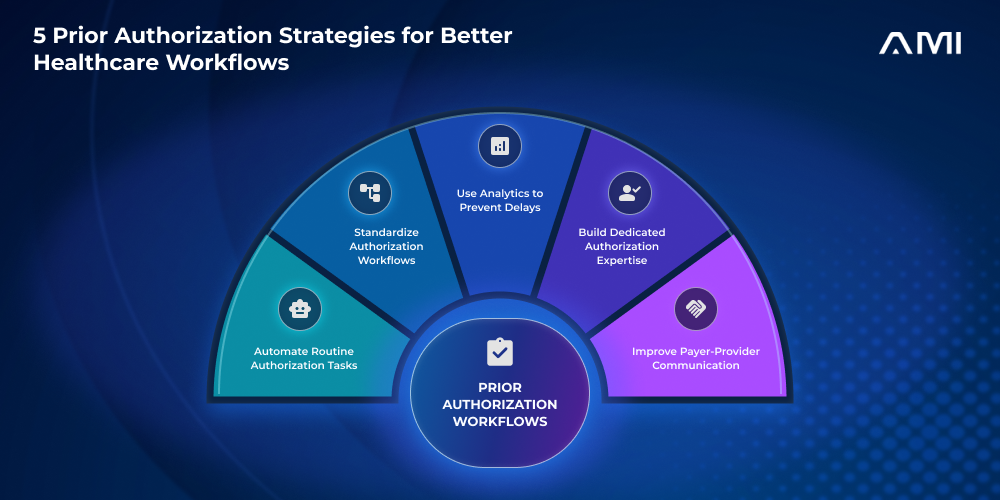
5 Strategies to Improve Prior Authorization Workflows
Improving the prior authorization process requires more than simply adding automation or increasing staff capacity. Healthcare organizations need workflows that reduce unnecessary administrative effort, improve visibility, and create clearer ownership across providers, payers, and operational teams.
The strongest authorization models combine technology, standardized processes, analytics, and specialized expertise to reduce delays while maintaining appropriate review and oversight.
1. Automate Routine Authorization Tasks
Many authorization delays are created before a reviewer even sees the request. Missing documentation, manual data gathering, repeated status checks, and disconnected workflows slow down the entire prior authorization process.
Prior authorization automation can reduce this administrative load by helping teams manage repetitive steps such as intake, documentation review, routing, and follow-up prioritization.
For example, automation can help teams:
- Identify missing information before submission
- Route requests based on payer or service requirements
- Track pending approvals and follow-up dates
However, automation should not remove human oversight. Complex cases, clinical interpretation, payer exceptions, and unusual authorization scenarios still require experienced teams who can evaluate context and make informed decisions.
Operational Principle: The goal of automation is not fewer people reviewing requests. It is fewer people spending time on avoidable administrative work.
2. Standardize Authorization Workflows
One of the biggest problems in prior authorization in healthcare is inconsistency. Each payer may have different submission requirements, documentation expectations, review criteria, and communication channels.
Without a standardized approach, teams often spend time figuring out the process for each request instead of moving requests forward.
A stronger workflow establishes:
- Clear ownership at every stage
- Defined documentation requirements
- Consistent escalation paths
- Visibility into pending and delayed requests
A standardized approach helps teams manage this variation without creating unnecessary rework. This standardization is often strengthened by effective front-end revenue cycle management, where accurate patient data, coverage information, and pre-service workflows create a stronger foundation for authorization success.
3. Use Analytics to Prevent Delays and Denials
Most organizations analyze authorization problems after they happen. A request gets delayed, a denial occurs, or a provider escalates an issue.
A more proactive approach uses authorization data to understand where friction is developing for better denial prevention.
Teams can analyze:
- Which payers create longer turnaround times
- Which services generate repeated documentation requests
- Where authorization queues are aging
- Which denial reasons appear most frequently
This type of visibility allows organizations to improve processes upstream rather than repeatedly solving the same problems at the end of the workflow.
Key Question: Are authorization teams resolving new challenges, or repeatedly fixing the same process failures?
4. Build Dedicated Authorization Expertise
Authorization requires knowledge of payer rules, documentation standards, clinical terminology, and changing healthcare requirements.
For organizations managing high volumes, dedicated authorization specialists can improve consistency across request preparation, documentation review, payer communication, and escalation management.
This is especially valuable when internal teams are balancing multiple revenue cycle responsibilities and cannot dedicate enough attention to complex authorization workflows.
The objective is not simply adding more staff. It is creating specialized ownership for a process where small errors can create significant downstream delays.
5. Improve Payer-Provider Communication
The payer prior authorization process depends on both sides having accurate information and clear expectations.
Providers need visibility into:
- Current request status
- Missing information
- Decision timelines
- Required next actions
Payers need complete clinical documentation and accurate request details to complete reviews efficiently.
Better communication reduces unnecessary follow-ups, prevents avoidable delays, and creates a more predictable experience for everyone involved.
The Role of AI in Prior Authorization Automation
AI is becoming an important part of prior authorization automation because authorization workflows involve large amounts of documentation, rules, and repetitive administrative decisions.
AI-assisted workflows can support:
- Document classification
- Information extraction
- Case summarization
- Missing information identification
- Request prioritization
- Status communication
- Workflow routing
For example, AI can help organize a large authorization request package and highlight missing documentation before submission.
However, successful AI prior authorization requires appropriate governance.
| AI Can Support | Human Teams Should Own |
|---|---|
| Document extraction | Clinical interpretation |
| Workflow routing | Complex exceptions |
| Case summaries | Final review decisions |
| Pattern detection | Escalation decisions |
| Status assistance | Policy interpretation |
The future of authorization is not AI replacing people. It is AI reducing administrative workload so skilled teams can focus on higher-value decisions.

Why does revenue still leak after the claim is submitted?
Because small breakdowns across eligibility, coding, billing, denials, and follow-up can quietly delay cash flow. AM InfoWeb helps healthcare teams strengthen RCM operations with process discipline, trained teams, and AI-assisted execution.
Prior Authorization Best Practices
Strong prior authorization best practices focus on creating workflows that improve accuracy, visibility, and turnaround time. The goal is to reduce avoidable delays while ensuring teams have clear processes for managing requests.
Maintain Clear Documentation Standards
Incomplete information is a major cause of authorization delays. Standardized documentation requirements help teams submit cleaner requests and reduce unnecessary follow-ups.
Key areas include:
- Required clinical documentation
- Submission requirements
- Escalation procedures
Track Authorization Performance
Organizations need visibility into where requests slow down and why. Monitoring authorization performance helps identify workflow gaps and recurring issues.
Important metrics include:
- Turnaround time
- Approval and denial trends
- Pending request volume
- Additional information requests
- Appeal outcomes
Review Payer-Specific Trends
Different payers often have different requirements and review patterns. Tracking payer-specific trends helps organizations improve workflows, strengthen training, and adapt to changing expectations.
When Organizations Need Prior Authorization Services
As authorization volume increases, internal teams may struggle with maintaining speed, accuracy, and visibility.
Organizations may consider prior authorization services when they experience:
- Growing authorization queues
- Delayed approvals
- Staffing limitations
- Increasing documentation requirements
- High follow-up volume
- Limited reporting visibility
- Difficulty maintaining turnaround expectations
External support should not simply transfer workload. It should strengthen execution while allowing healthcare organizations to retain control over policies, clinical decisions, escalation rules, and governance.
Looking to improve authorization turnaround without increasing administrative burden? Explore AM InfoWeb’s Healthcare Payer Support services capabilities for authorization workflows, provider communication, QA, reporting, and operational execution.
How AM InfoWeb Supports Prior Authorization Workflows
AM InfoWeb supports healthcare organizations through a co-managed orchestration model that combines trained healthcare teams, AI-assisted workflows, QA, documentation discipline, reporting, and client governance.
AM InfoWeb helps organizations manage complex authorization workflows while maintaining visibility and control across each stage of the process.
Supported workflows can include:
- Prior authorization intake support
- Documentation review and preparation
- Authorization status tracking
- Provider communication support
- Payer workflow coordination
- Follow-up and escalation management
- QA and operational reporting
Supported by SOC 2 Type II, ISO 27001, and HIPAA-aligned practices, AM InfoWeb helps healthcare organizations strengthen authorization operations while protecting sensitive healthcare information.
The objective is not simply faster processing. It is a more controlled workflow where routine activities move efficiently and complex cases receive appropriate attention.
Need additional authorization support without losing operational oversight? AM InfoWeb’s co-managed healthcare operations combine trained teams, AI-assisted workflows, QA, reporting, and structured escalation management.
Get in TouchFinal Thoughts
The prior authorization process does not need to remain a source of unnecessary administrative burden. By combining standardized workflows, better communication, automation, analytics, and trained expertise, healthcare organizations can create more efficient authorization experiences.
The future of prior authorization is not removing oversight. It is creating smarter workflows where technology and healthcare professionals work together to improve speed, transparency, and patient access.
Frequently Asked Questions
About the Author

Written by
Urza Dey
Urza Dey is a content and copywriter with over five years of experience across marketing, B2B SaaS, HealthTech, EdTech, and related industries. At AMI, they contribute to content strategy, blog development, and marketing communication focused on healthcare operations, business process management, and AI-enabled service delivery.