
How to Prevent Breach of Confidentiality in Healthcare
TL;DR — Confidentiality Depends on Everyday Workflow Discipline
EMR systems help healthcare teams store, retrieve, update, and share patient information electronically.
HIPAA establishes privacy and security expectations for protected health information, including electronic PHI.
Strong EMR and HIPAA compliance combines technology, policy, process, training, monitoring, and human oversight.
Access controls, individual user accounts, audit trails, secure transmission, backups, and activity monitoring support electronic record protection.
HIPAA-compliant EMR software does not automatically make an organization compliant if permissions, workflows, or staff practices are weak.
IT vendors and operational partners may become part of the compliance environment when they access, maintain, or transmit ePHI.
Release of Information workflows depend on accurate patient matching, record-scope review, secure export, delivery documentation, and audit-ready closure.
Understanding how to prevent breach of confidentiality in healthcare starts with recognizing that patient information can be exposed through everyday workflow mistakes, not only major cyberattacks. A wrong fax number, unsecured email, shared login, overheard conversation, unverified caller, or overly broad medical record release can all expose protected healthcare information.
Preventing these incidents requires more than a privacy policy. Healthcare organizations need practical controls across medical records, patient support, billing, claims, payer communication, Release of Information, and vendor-supported operations. The strongest approach combines access discipline, verification, secure communication, authorization review, QA, documentation, and human oversight.
What Is Confidentiality in Healthcare?
What is confidentiality in healthcare? It is the responsibility to protect patient information from unauthorized access, use, discussion, or disclosure.
Confidentiality applies wherever patient information is handled. This includes clinical care, billing, claims processing, patient calls, medical record requests, payer communication, legal requests, administrative work, and third-party operations.
The obligation continues after information has been shared for a legitimate reason. A staff member may be authorized to access a patient record for work, but that does not permit them to discuss it casually, view unrelated information, or disclose it through an unapproved channel.
Confidentiality vs Privacy: What Is the Difference?
The distinction between confidentiality vs privacy is simple but important.
Privacy refers to the patient’s right to control access to personal health information and expect that it will not be exposed unnecessarily. Confidentiality is the duty of healthcare organizations and workforce members to protect that information after it has been entrusted to them.
In practice, privacy establishes the individual’s interest in their information. Confidentiality determines how healthcare teams should access, use, communicate, store, and release it.
Why Is Confidentiality Important in Healthcare?
Why is confidentiality important in healthcare? It protects patient trust, supports honest communication, strengthens care relationships, and reduces the risk of improper disclosure.
Patients need confidence that sensitive information about diagnoses, treatment, insurance, claims, or payment will be handled carefully. Without that confidence, they may hesitate to provide complete information or engage openly with providers and support teams.
Confidentiality also strengthens organizational accountability. It helps healthcare leaders demonstrate that information is being accessed for approved reasons, shared with verified recipients, and handled through controlled workflows.
What Counts as Protected Healthcare Information?
Protected healthcare information, commonly called PHI, includes identifiable health information connected to diagnosis, care, treatment, billing, insurance, claims, payment, or healthcare operations.
PHI can appear in clinical notes, laboratory results, billing documents, claim records, authorization forms, call recordings, portal messages, spreadsheets, emails, or scanned records. It does not have to be a full medical chart.
The risk comes from connecting an identifiable person to healthcare information. That is why confidentiality controls must apply across systems, conversations, documents, and communication channels.
Common Examples of Confidentiality Breaches in Healthcare
A breach of patient confidentiality can happen when records are sent to the wrong recipient, an employee accesses a chart without a work-related reason, or claim details are discussed with an unverified caller.
Other incidents may involve leaving printed records unattended, discussing a patient in a public area, using shared login credentials, releasing records with incomplete authorization, or sending PHI through an unsecured channel.
A simple example of confidentiality in healthcare is a patient calling to request a family member’s test results. Even when the caller sounds familiar or knows personal details, staff should not disclose information until identity and authority have been verified through the approved process.
Best Practices for Maintaining Patient Confidentiality
Protecting patient information requires more than written policies or annual compliance training. Confidentiality must be built into the way healthcare teams access records, verify requesters, communicate with patients, process authorizations, release medical information, and document decisions. Small workflow gaps can create significant exposure, especially when staff are working across phone, email, fax, portals, claims systems, or third-party support channels. The following practices help healthcare organizations reduce avoidable risk while still allowing legitimate care, payment, administrative, and Release of Information workflows to move efficiently.
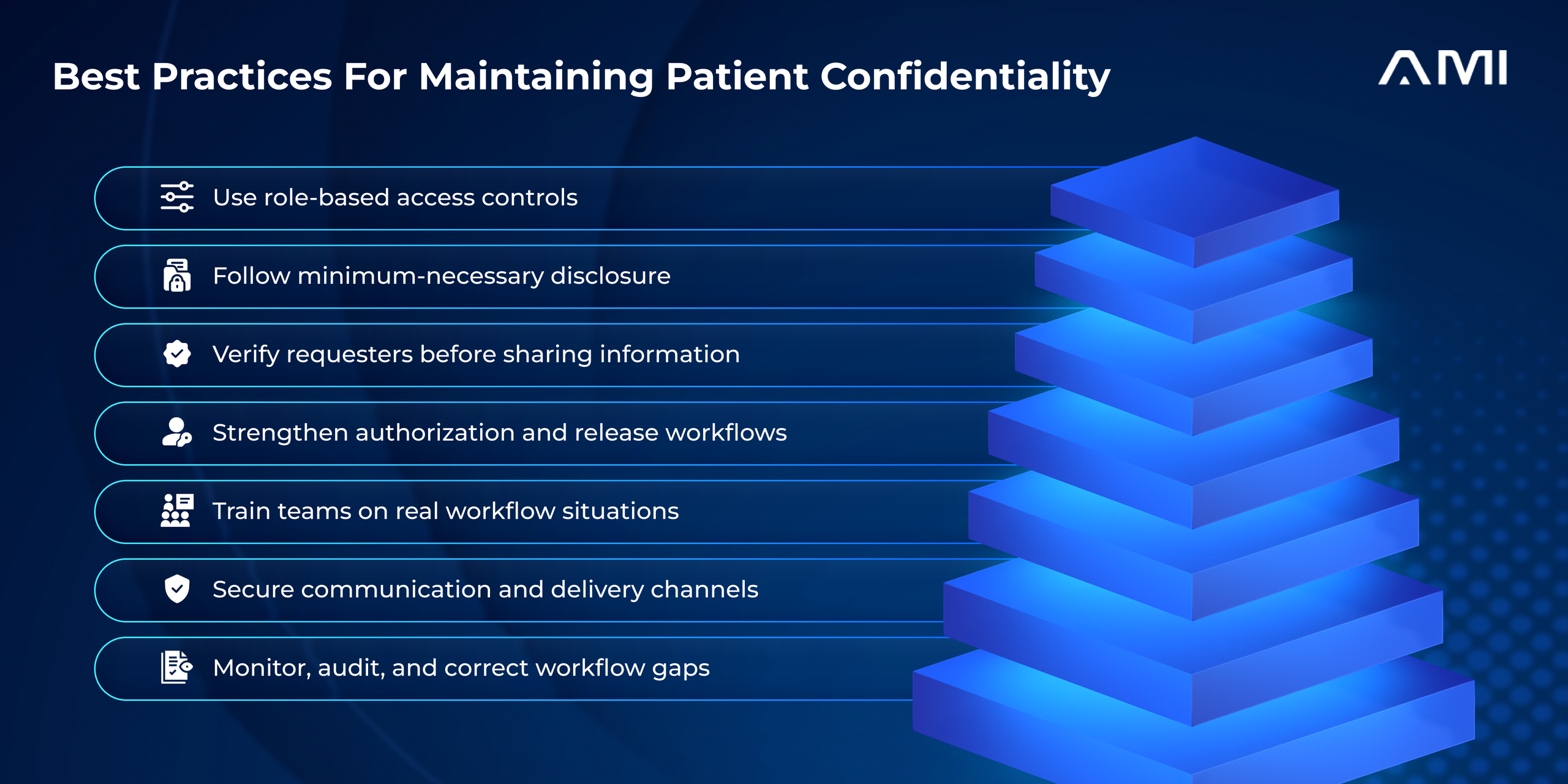
Best practice 1: Use role-based access controls
Staff should access only the information needed for their assigned responsibilities.
A billing employee may need claim and payment details, while a scheduling employee may need appointment and contact information. Neither should automatically have unrestricted access to unrelated clinical records.
Role-based permissions, individual login credentials, regular access reviews, and prompt removal of outdated access reduce unnecessary exposure.
Best practice 2: Follow minimum-necessary disclosure
Healthcare teams should avoid sharing complete records when only a limited portion is needed.
For example, a billing question may require claim details rather than an entire medical history. A payer request may cover a specific date range or service rather than every available record.
Minimum-necessary thinking helps teams align disclosure with the approved task, requester, purpose, and record scope.
Best practice 3: Verify requesters before sharing information
Strong patient confidentiality depends on consistent verification.
Before discussing or releasing information, teams should confirm the patient, requester identity, requester authority, request purpose, authorization status, approved record scope, and secure communication channel.
A practical review should confirm:
- Patient and requester identity
- Requester authority and purpose
- Authorization where required
- Approved record scope
- Minimum necessary where applicable
- Secure delivery method
- Disclosure documentation
- Escalation for unclear requests
Verification should not be skipped because a caller sounds familiar, a requester claims urgency, or the organization name appears legitimate.
Best practice 4: Strengthen authorization and release workflows
Medical record releases can expose PHI when authorization details are missing, expired, vague, or inconsistent.
Teams should confirm who may receive the information, what records are covered, which date range applies, whether the authorization remains valid, and how the records should be delivered.
Incomplete or unclear requests should be paused, documented, and returned for correction rather than processed through guesswork.
Best practice 5: Train teams on real workflow situations
Training should go beyond annual policy acknowledgment.
Staff needs practical examples involving phone calls, email, fax, portal messages, family inquiries, payer requests, legal requests, printed documents, screen visibility, and internal conversations.
Scenario-based training helps employees understand how confidentiality requirements apply when they are under time pressure or dealing with an unusual requester.
Best practice 6: Secure communication and delivery channels
PHI should be communicated only through approved systems and processes.
Secure portals, encrypted electronic delivery, controlled fax workflows, approved mail processes, clean-desk rules, restricted printing, and limits on personal devices can reduce exposure.
The delivery method, recipient, date, and record scope should also be documented so the organization can trace what was shared.

Best practice 7: Monitor, audit, and correct workflow gaps
Maintaining patient confidentiality requires ongoing monitoring.
Healthcare leaders should review access logs, QA findings, wrong-recipient incidents, requester verification failures, incomplete authorization patterns, training gaps, and repeated exceptions.
Risk should be tracked by workflow source, such as phone, email, fax, portal, medical record release, billing, payer request, legal request, internal access, or vendor-supported processing. This helps leaders identify where confidentiality controls are breaking down.
Where AI Can Support Confidentiality Controls
AI-assisted tools can help flag unusual access patterns, missing authorization fields, documentation gaps, duplicate requests, and recurring QA issues.
They may also support trend reporting by showing where confidentiality risks appear most often.
AI should not independently approve PHI disclosure or determine requester authority. Unclear requests, sensitive information, legal scenarios, patient complaints, and exception-based decisions still require trained human review.
How AMI Supports PHI-Aware Healthcare Workflows
AMI supports healthcare organizations with co-managed workflows designed to protect PHI, strengthen requester verification, improve documentation quality, and reduce operational gaps that can create confidentiality risk.
With trained healthcare operations teams, secure processes, Release of Information support, QA checks, and reporting discipline, AMI helps leaders maintain workflow control.
AMI support may include:
- PHI-aware records handling
- Release request intake and authorization review support
- Requester verification and medical record processing
- Secure patient, provider, payer, and legal requester workflows
- QA checks and escalation support
- Audit trail and documentation discipline
- Turnaround time and backlog visibility
- Co-managed operations with client oversight
Need Stronger PHI Controls Across Healthcare Workflows? AMI supports co-managed healthcare operations built around requester verification, authorization review, secure processing, QA, documentation, and workflow visibility.
Get in TouchFinal Thoughts
Preventing confidentiality incidents requires consistent controls across every workflow that touches patient information. For leaders evaluating how to prevent breach of confidentiality in healthcare, the priority should be practical operating discipline: appropriate access, verified requesters, limited disclosure, secure communication, clear documentation, QA, and accountable human oversight.
Frequently Asked Questions
About the Author

Written by
Urza Dey
Urza Dey is a content and copywriter with over five years of experience across marketing, B2B SaaS, HealthTech, EdTech, and related industries. At AMI, they contribute to content strategy, blog development, and marketing communication focused on healthcare operations, business process management, and AI-enabled service delivery.