
AI-Driven Contact Center QA Tools for Healthcare Workflows
TL;DR — AI-Driven QA Tools at a Glance
AI-driven contact center QA tools help healthcare teams review more interactions, identify quality patterns, flag documentation gaps, detect escalation risks, and surface coaching opportunities.
In healthcare, QA must evaluate more than tone or script adherence. It should also assess workflow accuracy, documentation quality, caller next steps, escalation handling, and resolution progress.
Manual QA is still important, but small sample reviews can miss repeat issues across patient, member, and provider support workflows.
AI-assisted QA can help protect documentation quality, escalation accuracy, caller experience, workflow consistency, and coaching quality.
Healthcare leaders should evaluate AI QA tools based on workflow fit, human oversight controls, custom scorecards, escalation rules, reporting dashboards, integration readiness, and privacy-aware processes.
AI should not become the final judge for sensitive healthcare conversations. Complex, urgent, emotional, compliance-related, or exception-based interactions still need trained human review.
AMI helps healthcare organizations improve QA visibility with trained teams, AI-assisted review, Agent Assist, structured documentation, escalation support, trend reporting, and co-managed operational control.
Healthcare contact centers manage complex and sensitive interactions across patient support, member services, provider inquiries, billing questions, benefits, authorizations, scheduling, records, and escalations. In these workflows, quality assurance is not just about checking whether an agent was polite or followed a script. It is about knowing whether the interaction was accurate, documented, routed correctly, and moved toward resolution.
Traditional QA is still important, but many teams can only review a small sample of interactions. That creates visibility gaps across high-volume healthcare contact center operations. Leaders may not see repeated documentation issues, missed escalation signals, frustrated callers, or coaching needs until those issues start creating repeat calls and operational delays.
That is where AI-driven contact center QA tools become useful. The value is not replacing QA reviewers. The value is helping QA teams and operations leaders review more interactions, detect patterns faster, and make smarter human-led decisions.
Why Healthcare Contact Center QA Needs Better Visibility
Quality assurance in healthcare protects more than call quality. It helps protect caller trust, documentation quality, escalation accuracy, workflow consistency, and operational control across healthcare contact center services.
In healthcare, a missed detail can matter. A patient may not know the next step for a bill or appointment. A member may receive an unclear benefits answer. A provider inquiry may be routed without the context needed for follow-up. These small gaps can create repeat calls, delays, frustration, and unnecessary workload.
Manual QA can still catch important issues, but it is often limited by reviewer capacity and sample size. For large healthcare contact centers, leaders need broader visibility into what is happening across patient, member, and provider support workflows.
What AI-Driven Contact Center QA Tools Actually Do
AI-driven contact center QA tools help review interaction data, identify patterns, flag potential quality issues, organize coaching themes, and support reporting. They can work across calls, transcripts, chats, notes, and other interaction records, depending on the workflow and system setup.
In practical terms, these tools can support:
- Interaction review across larger volumes
- Call and transcript analysis
- Documentation quality checks
- Escalation signal detection
- Sentiment and frustration indicators
- QA scorecard support
- Coaching theme identification
- Trend reporting for leaders
The best AI QA tools do not act as the final judge for sensitive healthcare conversations. They help QA teams see more, find patterns faster, and focus human review where it matters most.
Why AI-Driven QA Tools Matter in Healthcare Workflows
Healthcare QA needs a more careful approach than general customer service QA. Conversations often involve privacy expectations, benefits, and billing accuracy, authorization follow-up, provider communication, and escalation of ownership.
That is why contact center quality assurance in healthcare must evaluate more than tone. It should also look at whether approved workflows were followed, whether documentation was complete, whether the caller received a clear next step, and whether unresolved issues were escalated correctly.
For contact center services for healthcare, AI-assisted QA can help leaders see where the operation is creating friction. It can identify repeated questions, poor handoffs, unclear routing, missed notes, and recurring issues that may not show up in small manual samples.
What AI-Driven QA Tools Can Help Protect
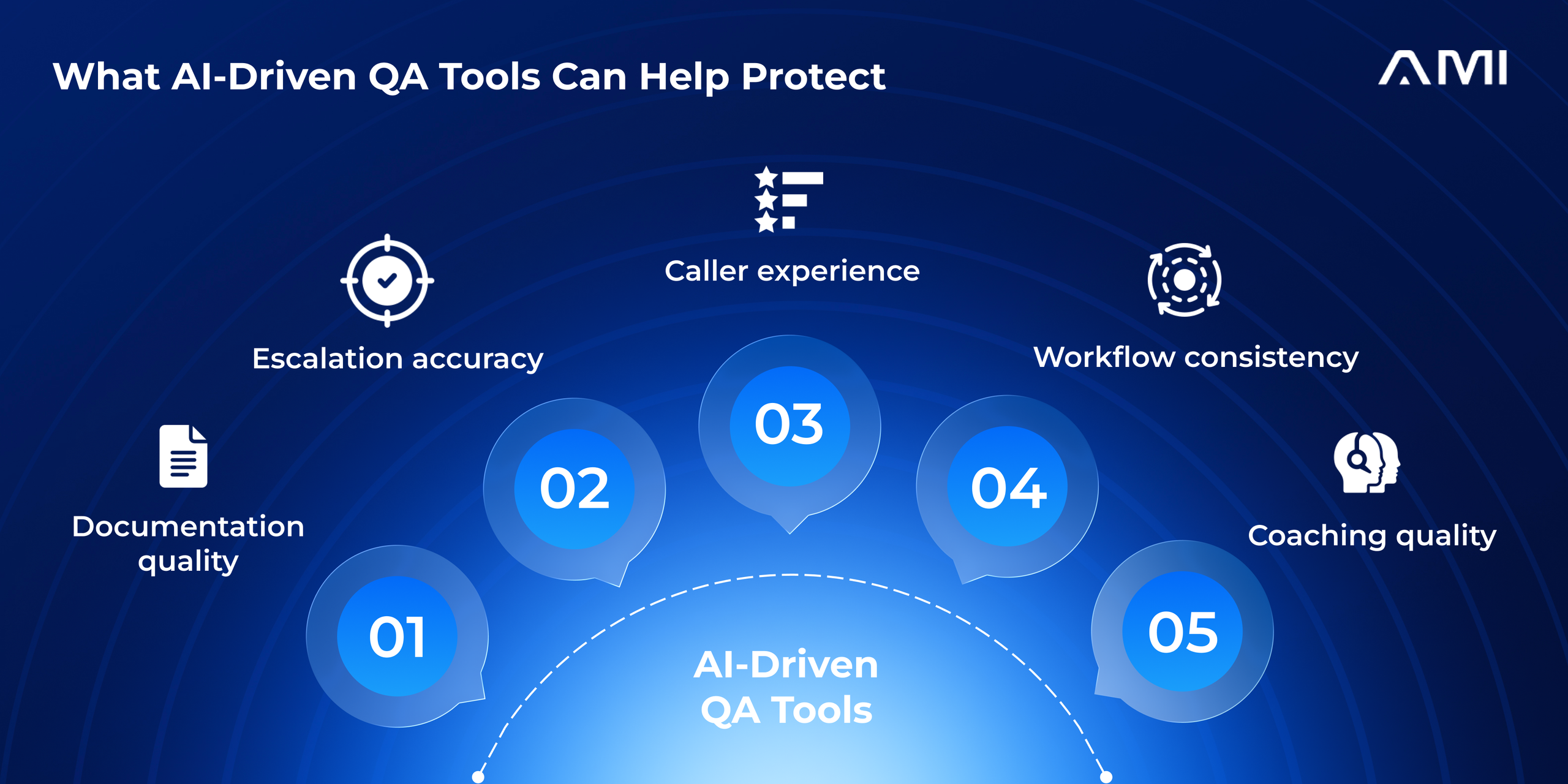
AI-assisted quality assurance can help protect operational consistency across healthcare workflows by improving visibility into what happened during the interaction and what happened after it.
- Documentation quality: AI can help identify missing notes, unclear summaries, inconsistent disposition codes, incomplete intake, and weak follow-up documentation.
- Escalation accuracy: AI can flag interactions where urgency, complexity, sentiment, missing information, or unresolved outcomes may require human review.
- Caller experience: AI can help surface long interactions, repeated issues, unclear next steps, frustration signals, and poor handoff experiences.
- Workflow consistency: AI can help identify whether approved steps were followed across patient, member, and provider support workflows.
- Coaching quality: AI can surface recurring agent support needs, knowledge gaps, process confusion, and training opportunities.
Where AI-Driven QA Fits Into Healthcare Contact Center Operations
AI works best as a behind-the-scenes QA support layer. It helps QA teams review more interactions, organize patterns, and improve coaching visibility without replacing human judgment.
| AI QA support area | How it supports healthcare QA |
|---|---|
| Interaction review | Helps review a larger share of calls, chats, or transcripts so QA teams are not limited to small manual samples. |
| Documentation checks | Flags missing details, unclear next steps, incomplete notes, or inconsistent summaries. |
| Escalation signals | Surfaces conversations that may need review because of urgency, complexity, sentiment, or unresolved outcomes. |
| Coaching themes | Identifies repeated knowledge gaps, script issues, process confusion, or agent support needs. |
| Workflow trends | Helps leaders see repeat-call drivers, routing problems, documentation issues, and process bottlenecks. |
This is where AI-first healthcare contact center operations become valuable. AI supports visibility, while trained teams retain control over judgment, escalation, and sensitive decisions.
What Healthcare Leaders Should Evaluate Before Choosing AI-Driven Contact Center QA Tools
Not every AI tool for QA is built for healthcare workflows. Before selecting a tool, platform, or partner, leaders should evaluate whether the model fits real healthcare contact center operations and not just generic QA use cases.
Key questions to ask:
- Healthcare workflow fit: Can it support patient, member, provider, billing, benefits, authorization, scheduling, and records-related workflows?
- Human oversight controls: Can sensitive, complex, or exception-based cases be routed to trained reviewers?
- Custom QA scorecards: Can scorecards be aligned to different interaction types?
- Escalation rules: Can the tool flag urgency, sentiment, risk, unresolved issues, or missing information?
- Documentation visibility: Can it identify incomplete notes, unclear summaries, and missing next steps?
- Agent coaching support: Can it surface repeated coaching themes across teams and workflows?
- Reporting dashboards: Can leaders see trends, quality gaps, and workflow issues clearly?
- Integration readiness: Can it work with existing processes, SOPs, and handoff requirements?
- Privacy-aware processes: Are data access, review, and governance clearly defined?
- Support for healthcare workflows: Can it support patient, member, and provider interactions without forcing a generic call center model?
The best AI tools for QA are not just feature-heavy. They are workflow-aware, review-friendly, and safe for healthcare environments where human judgment still matters.

Why do healthcare contact centers struggle even after adding more agents?
Because rising volume, fragmented systems, repeat calls, and delayed escalations need more than staffing. AMI combines AI voice, AI non-voice, and trained human agents to improve routing, documentation, QA visibility, and service execution.
What AI-Driven QA Tools Should Not Do in Healthcare
AI should not become the sole judge of sensitive healthcare conversations. It should not make final decisions on compliance-related issues, urgent escalations, patient complaints, benefits disputes, provider escalations, or complex cases without trained human review.
The safest model is clear: AI can support detection, visibility, and pattern recognition. Human QA leaders should review sensitive, complex, or exception-based interactions before final decisions are made. This matters because AI-powered QA tools can create value, but only when boundaries are clear. In healthcare, quality assurance must remain accountable, explainable, and human-led.
How AI-Driven QA Tools Support Agent Assist and Live Team Performance
QA insights should not stay locked inside reports. They should improve live operations.
When AI-assisted QA identifies repeated knowledge gaps, unclear scripts, missed next steps, or escalation confusion, those insights can inform agent assist for healthcare contact centers. Live agents can receive better prompts, clearer knowledge guidance, suggested next steps, and workflow reminders.
This connection between QA and agent assist helps improve consistency across teams. It also supports healthcare contact center best practices by turning quality findings into real operational improvements, not just post-call scoring.
For example, if QA shows that agents often miss follow-up details in authorization calls, agent assist can prompt for the required fields during the interaction. If callers often ask the same benefits question, knowledge guidance can be improved.
Why Human Oversight Still Matters in AI-Assisted QA
AI-driven contact center QA tools should not turn healthcare quality assurance into a black-box scoring process. A stronger model uses AI to expand visibility while trained QA teams review context, validate findings, and make final judgments on sensitive or complex interactions.
AI can flag a frustrated caller. A human reviewer understands the full context. AI can surface an unclear next step. A QA leader decides whether it reflects agent coaching, workflow friction, or a process gap.
This balance is especially important across healthcare call center services, where conversations may involve personal information, financial concerns, care-adjacent questions, provider follow-up, or records requests. AI helps teams see more. Human reviewers decide what it means.
Evaluating AI-driven contact center QA tools for healthcare workflows?AMI helps healthcare organizations improve QA visibility, documentation consistency, escalation accuracy, and coaching with trained teams, AI-assisted review, agent assist, and co-managed operational control.
Get in TouchHow AMI Supports AI-First Healthcare Contact Center Operations
AMI supports healthcare organizations with AI-first Healthcare Contact Center Operations built around service consistency, workflow visibility, and human oversight. The model combines trained healthcare support teams, AI-assisted quality assurance, agent assist, structured documentation, escalation support, and co-managed execution to help improve patient, member, and provider interactions.
AMI’s approach is designed for real healthcare contact center challenges: limited QA coverage, documentation gaps, repeated calls, missed escalation signals, uneven agent performance, and limited visibility into workflow trends. AI supports review, pattern detection, and documentation visibility. Human experts manage sensitive, urgent, unresolved, or exception-based interactions. Leaders retain oversight through reporting, governance, and co-managed operations.
AMI supports:
- Patient, member, and provider inquiry support
- AI-assisted QA and interaction review
- Agent assist for healthcare contact centers
- Documentation quality visibility
- Escalation support with full interaction context
- Trend reporting for coaching and workflow improvement
- Co-managed operations with client oversight
For healthcare teams comparing contact center solutions for healthcare, the goal should not be AI for the sake of AI. The goal should be a safer operating model where quality visibility improves, human judgment stays central, and leaders can continuously improve workflows.
Frequently Asked Questions
About the Author

Written by
Urza Dey
Urza Dey is a content and copywriter with over five years of experience across marketing, B2B SaaS, HealthTech, EdTech, and related industries. At AMI, they contribute to content strategy, blog development, and marketing communication focused on healthcare operations, business process management, and AI-enabled service delivery.