
Healthcare Contact Center Automation: 9 Workflows With Human Oversight
TL;DR — Automation Workflows at a Glance
Healthcare contact center automation should support repeatable operational steps without blocking patients, members, or providers from human help when they need it.
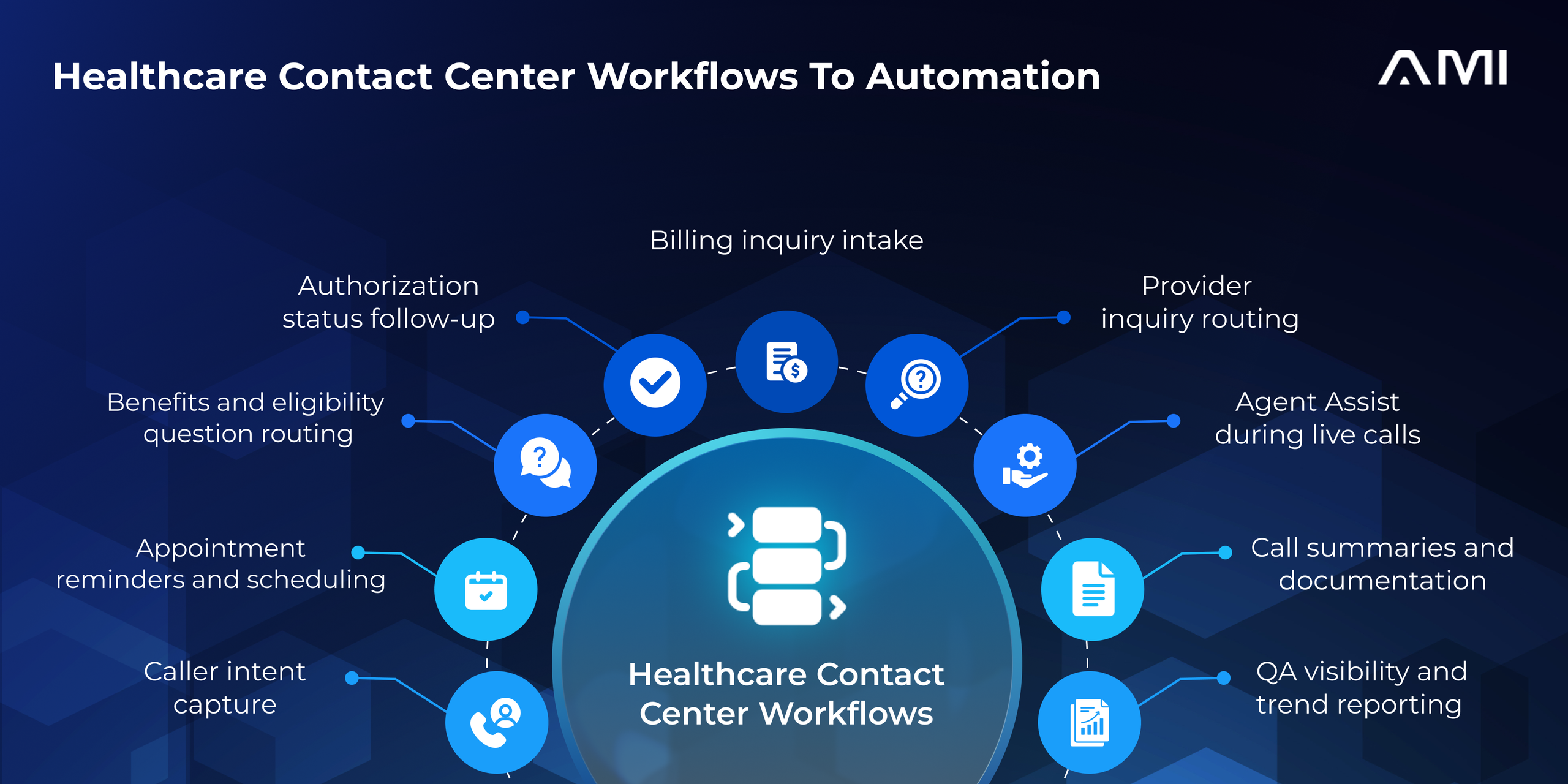
The strongest automation opportunities include caller intent capture, appointment reminders, benefits and eligibility routing, authorization status follow-up, billing inquiry intake, provider inquiry routing, Agent Assist, documentation, and QA visibility.
Automation works best when it improves intake, routing, documentation, escalation, and visibility while keeping sensitive, urgent, emotional, complex, or compliance-heavy interactions human-led.
Agent Assist is one of the safest uses of automation because it supports live agents with approved guidance, knowledge prompts, next steps, and escalation cues while the agent stays in control.
AI-assisted summaries and structured documentation can reduce after-call work, improve handoffs, support QA, and reduce repeat-contact issues.
Healthcare leaders should evaluate automation tools based on workflow fit, escalation readiness, documentation quality, QA visibility, reporting, and operational control.
AMI helps healthcare organizations automate contact center workflows with AI-assisted intake, smart routing, Agent Assist, documentation support, QA visibility, escalation workflows, trained teams, and co-managed oversight.
Healthcare contact centers manage patient, member, and provider interactions that often involve scheduling, billing, benefits, authorizations, medical records, and escalations. These are not simple service conversations. They require accuracy, documentation, empathy, workflow awareness, and clear escalation paths.
That is why healthcare contact center automation needs a careful approach. Automation can reduce friction, improve consistency, and support faster service, but it should not replace trained healthcare support teams or block callers from human help when they need it.
The goal is to automate repeatable operational steps while keeping complex, sensitive, urgent, or exception-based interactions human-led. In AI-first healthcare contact center operations, automation supports intake, routing, documentation, Agent Assist, QA visibility, and escalation while leaders retain operational control.
Why Healthcare Contact Center Automation Needs a Careful Approach
Healthcare is different from general customer service. Healthcare contact centers may handle PHI, billing concerns, benefits questions, provider communication, authorization updates, medical record requests, and emotionally sensitive interactions.
Poorly designed automation can frustrate callers, create wrong routing, miss escalation signals, or make patients and providers feel trapped in a system. Well-designed healthcare contact center automation solutions do the opposite. They support workflow consistency, improve visibility, reduce manual effort, and help trained teams focus on the conversations that need human judgment.
Automation should make contact center healthcare workflows safer and more efficient, not less personal.
9 Healthcare Contact Center Workflows Automation Can Support
These workflows are strong candidates for automation because they are often repeatable, structured, or high-volume. The key is to design every automated step with escalation and human review in mind.
1. Caller intent capture
Caller intent capture helps identify why someone is calling before the interaction reaches a queue or agent. AI can classify whether the caller is asking about an appointment, a bill, a benefits question, an authorization update, a provider request, or a records-related issue.
This helps reduce misrouting and gives agents better context before they begin the conversation.
Human oversight matters when the caller’s need is unclear, sensitive, emotional, or urgent. Automation should support triage, not make final decisions in complex cases.
2. Appointment reminders and scheduling support
Automation can support appointment reminders, confirmations, simple scheduling workflows, and rescheduling prompts. These are often repeatable tasks that do not always require a live agent.
For example, automated reminders can reduce missed appointments, while scheduling prompts can help collect basic preferences before a human team steps in.
Complex scheduling exceptions should remain human-led, especially when the request involves clinical urgency, special instructions, or unclear availability.
3. Benefits and eligibility question routing
Benefits and eligibility questions can quickly become complex. Automation can collect context, identify the type of benefits question, and route the inquiry to the right team.
For simple requests, AI may help guide the caller through approved information or collect missing details. For plan-specific, disputed, or exception-based questions, the case should move to a trained team.
This is where AI-powered contact center solutions can support speed without removing control.
4. Authorization status follow-up
Authorization status calls are a major source of repeat contact in many healthcare environments. Automation can support approved status-based updates, collect missing context, document the interaction, and flag cases that need escalation.
For example, if an authorization is pending, missing documentation, denied, or outside a normal timeframe, the system can help route the case with better context.
Automation should never block human review when the authorization is urgent, unclear, or tied to a sensitive service issue.
5. Billing inquiry intake
Billing calls often involve confusion, frustration, and multiple systems. Automation can gather basic context, identify whether the caller is asking about a balance, statement, payment status, insurance posting, or disputed charge, and prepare the case for a human agent.
This improves intake quality and reduces the time agents spend identifying the issue. Sensitive billing disputes, financial hardship conversations, or unresolved concerns should remain human-led.
6. Provider inquiry routing
Provider inquiries may involve claims status, authorization follow-up, documentation requests, payer communication, or medical record coordination. Automation can classify the provider request, capture key details, reduce misrouting, and route the case with stronger context.
This helps provider support teams work faster and reduces unnecessary transfers. For complex or unresolved provider issues, escalation paths should stay clear and human-owned.

Why do healthcare contact centers struggle even after adding more agents?
Because rising volume, fragmented systems, repeat calls, and delayed escalations need more than staffing. AMI combines AI voice, AI non-voice, and trained human agents to improve routing, documentation, QA visibility, and service execution.
7. Agent Assist during live calls
Agent Assist is one of the safest and most practical uses of contact center automation. It supports live agents with approved guidance, knowledge prompts, suggested next steps, and escalation cues while keeping the agent in control.
This is especially useful when agents must navigate policies, scripts, payer rules, system instructions, or documentation requirements during a live conversation.
Agent Assist helps improve consistency without making automation the decision-maker.
8. Call summaries and documentation
Manual documentation can increase after-call work and create inconsistencies. AI-assisted summaries can help structure notes, capture caller intent, document next steps, and support cleaner handoffs.
Better documentation can also reduce repeat-contact issues caused by missing notes or unclear ownership.
For healthcare teams evaluating contact center automation tools, documentation support should be a major priority because it affects downstream workflows, QA, reporting, and escalation.
9. QA visibility and trend reporting
Automation can also support QA visibility. AI can help review more interactions, identify recurring issues, surface coaching themes, detect documentation gaps, and show leaders where workflows are creating friction.
This does not mean AI should fully judge sensitive healthcare conversations. It means QA teams can use AI to see more patterns and decide where human review is needed.
In automation healthcare workflows, visibility is just as important as speed.
What Should Stay Human-Led in Healthcare Contact Centers
Not every interaction should be automated. Sensitive, urgent, complex, emotional, or compliance-heavy conversations should remain human-led or move quickly to trained teams.
This includes urgent access issues, complex billing disputes, unclear benefits questions, authorization exceptions, privacy-sensitive requests, unresolved cases, complaints, and escalations.
The strongest model for AI and automation in healthcare keeps humans responsible for judgment, empathy, escalation, and final decisions while automation supports the operational layer behind the interaction.
How Automation Supports First-Call Resolution Without Forcing Full Automation
AI agent first-call resolution in healthcare does not mean every call should be handled end-to-end by AI. Better first-call resolution often comes from better intake, smarter routing, real-time agent support, and clearer documentation.
Automation can help capture the right context earlier, route callers more accurately, prompt agents with the right next steps, and document outcomes clearly. This helps more interactions move forward the first time, even when a human agent completes the conversation.
For healthcare leaders, the goal is not full automation. The goal is fewer avoidable transfers, fewer repeat calls, clearer next steps, and stronger ownership.
What Healthcare Leaders Should Consider Before Choosing Automation Tools
Before choosing healthcare contact center automation solutions, leaders should evaluate whether the tool or partner fits real healthcare workflows.
Key questions to ask:
- Does the automation support patient, member, and provider workflows?
- Can sensitive or complex cases route to human teams quickly?
- Does it improve documentation quality?
- Can it support Agent Assist during live conversations?
- Does it improve QA visibility and trend reporting?
- Can leaders review performance, escalation, and workflow outcomes?
- Does the model preserve operational control?
The best contact center automation solutions for healthcare providers should support workflow execution, human oversight, and visibility. They should not create a black-box experience for leaders or callers.
Ready to automate healthcare contact center workflows without losing human oversight? AMI helps healthcare organizations improve intake, routing, documentation, QA visibility, and escalation with AI-assisted workflows, trained teams, and co-managed operational control.
Get Free AssessmentHow AMI Supports AI-First Healthcare Contact Center Operations
AMI supports healthcare organizations with AI-first Healthcare Contact Center Operations designed to improve workflow consistency, service visibility, and human oversight across patient, member, and provider interactions.
The model combines trained healthcare support teams, AI-assisted intake, smart routing, Agent Assist, documentation support, QA visibility, escalation workflows, and co-managed execution so organizations can improve support without losing operational control.
AMI supports:
- Patient, member, and provider inquiry support
- AI-assisted intake and caller intent capture
- Smart routing and escalation with context
- Agent Assist for live support workflows
- AI-assisted documentation and summaries
- QA visibility and interaction trend reporting
- Compliance-aware workflow support
- Co-managed operations with client oversight
For healthcare organizations, automation should not mean losing control. AMI’s approach brings AI voice, AI non-voice, and expert human teams together so repeatable work moves faster while sensitive and complex cases stay human-led.
Frequently Asked Questions
About the Author

Written by
Urza Dey
Urza Dey is a content and copywriter with over five years of experience across marketing, B2B SaaS, HealthTech, EdTech, and related industries. At AMI, they contribute to content strategy, blog development, and marketing communication focused on healthcare operations, business process management, and AI-enabled service delivery.