
Automated Prior Authorization to Reduce Follow-Up Delays
TL;DR — Prior Authorization Automation at a Glance
Automated prior authorization should improve the administrative workflow around prior auth, not automate clinical decisions, approvals, denials, or payer rule overrides.
Prior authorization delays often come from missing information, payer-specific requirements, repeated status checks, unclear ownership, manual follow-ups, and documentation gaps.
Automation can support request intake, missing information capture, payer-specific routing, status checks, follow-up reminders, documentation, escalation, and reporting.
AI can help with structured payer status calls, caller intent identification, required information capture, call summaries, task routing, escalation signals, and trend reporting.
Sensitive, denied, urgent, unclear, clinical, appeal-related, or exception-based prior authorization cases should remain human-led or escalate quickly to trained teams.
Healthcare teams should start safely by automating repetitive follow-up work, defining approved workflows, adding AI-assisted documentation and QA visibility, and expanding only after review.
AMI helps healthcare teams reduce prior authorization delays with AI-assisted payer follow-up support, documentation visibility, task routing, escalation workflows, QA visibility, and trained human oversight.
Prior authorization delays are rarely caused by one issue. They often come from missing information, payer-specific requirements, repeated status checks, manual follow-ups, unclear ownership, and documentation gaps. For healthcare teams, these delays can create more than administrative pressure. They can affect patient access, staff workload, provider communication, and revenue cycle flow.
That is why automated prior authorization should be approached as a workflow improvement strategy, not a promise to automate clinical decisions. The goal is not to let AI approve, deny, or override payer rules. The goal is to reduce the repetitive administrative work that slows teams down.
AI-first healthcare contact center operations can support prior authorization workflows by helping teams capture request details, manage follow-up calls, track statuses, document payer responses, and escalate unresolved cases. When designed with human oversight, automation can help teams move faster without losing control over sensitive or exception-based work.
Why Prior Authorization Creates So Much Administrative Drag
Prior authorization is one of the most follow-up-heavy workflows in healthcare. Every payer may have different requirements, forms, documentation needs, status timelines, and communication channels. Even when a request is submitted correctly, teams may still need to check status, confirm missing information, document updates, and follow up repeatedly.
The process becomes harder when ownership is unclear. A request may sit pending because a payer needs more information, a status update was not documented, or the next step was not assigned to the right team. Staff then spend valuable time chasing updates instead of working on cases that need judgment.
This is where prior authorization process automation can help. By supporting intake, task routing, status checks, documentation, reminders, and reporting, automation can reduce manual friction around the process while keeping sensitive decisions human-led.
What Automated Prior Authorization Should and Should Not Mean
Automated prior authorization should support the administrative steps around prior authorization. That includes intake, missing information capture, payer follow-up, status tracking, reminders, documentation, task routing, escalation, and reporting.
It should not mean AI makes clinical decisions, overrides payer requirements, approves or denies requests, or removes trained staff from complex cases. Prior authorization still involves payer rules, provider judgment, medical necessity documentation, and exception handling.
The safest way to automate prior authorization is to focus on the repetitive work surrounding the decision, not the decision itself. Automation should help teams organize requests, reduce missed follow-ups, document payer communication, and flag cases that need human review.
The Prior Authorization Workflow Areas Automation Can Support
Automation works best when applied to structured, repeatable, trackable steps that follow approved workflows. These are the areas where teams can reduce manual burden without handing control to automation.
1. Request intake and missing information capture
Prior authorization delays often start with incomplete intake. Automation can help collect required patient, provider, payer, service, and documentation details before the request moves forward.
This can reduce rework caused by missing information and help staff understand what is needed from the start. If information is incomplete, the workflow can flag the gap and route the task for follow-up.
2. Payer-specific routing and task assignment
Different payers may have different requirements. Automation can help route requests based on payer, service type, documentation needs, or internal ownership rules.
This makes it easier to assign tasks to the right team and reduce confusion around who owns the next step. It also supports better visibility across pending and delayed requests.
3. Prior authorization status checks
Status checks are one of the most repetitive parts of prior authorization. AI-assisted workflows can support payer follow-up calls, capture updates, and document payer responses for the team.
This is where AI-automated prior authorization calls should be understood carefully. AI can support structured payer status calls and documentation, but it should not make the authorization decision. If the payer response is unclear, delayed, denied, or exception-based, the case should move to trained staff.
4. Follow-up reminders and next-step tracking
Missed follow-ups can create long delays. Automation can help create reminders, task queues, and next-step visibility so teams know which requests need action and when.
This helps reduce manual tracking in spreadsheets or disconnected systems. It also gives leaders better insight into pending work and aging requests.
5. Documentation and call summaries
Documentation quality directly affects prior authorization follow-through. AI-assisted summaries can help document payer calls, status updates, missing information, reference numbers, and next steps more consistently.
This reduces after-call work and helps the next team member understand what happened without starting from scratch. Strong documentation also supports reporting, QA, and escalation review.

Why do healthcare contact centers struggle even after adding more agents?
Because rising volume, fragmented systems, repeat calls, and delayed escalations need more than staffing. AMI combines AI voice, AI non-voice, and trained human agents to improve routing, documentation, QA visibility, and service execution.
6. Escalation for delayed, denied, or exception-based cases
Delayed, denied, urgent, or unclear cases should not sit inside an automated queue without human review. Automation can flag the issue, but trained staff should review and act.
Escalation rules should account for urgency, payer response, missing documentation, denial status, patient access impact, and unresolved follow-ups.
7. Reporting on bottlenecks and payer follow-up patterns
Automation can help leaders see where delays are happening. Reports can show which payers require more follow-up, which request types are delayed, where documentation gaps are common, and where internal workflows need improvement.
This turns prior authorization from a reactive follow-up process into a more visible operating workflow.
How Automation Reduces Follow-Up Workload Without Removing Human Review
The biggest value of healthcare prior authorization automation solutions is not replacing staff. It is reducing the repetitive work that prevents staff from focusing on higher-value cases.
Automation can help reduce repeated payer status calls, improve documentation of payer responses, create better visibility into pending requests, route incomplete cases faster, and escalate urgent or exception-based issues more consistently.
This gives staff more time to focus on cases that actually need judgment, such as denials, appeals, incomplete medical necessity information, payer exceptions, unclear responses, and urgent access concerns.
In this model, automation handles structure. Human teams handle interpretation, escalation, and action.
Where AI Fits in Prior Authorization Calls
AI can support structured call workflows when the task is clear, repeatable, and governed by approved rules. In prior authorization, that often means supporting payer status checks, information collection, call summaries, and routing after payer responses.
AI can help with:
| AI support area | How it supports prior authorization workflows |
|---|---|
| Payer status call support | Helps manage repetitive status follow-ups where the workflow is defined. |
| Caller intent and workflow identification | Identifies whether the interaction is about status, missing information, denial, or escalation. |
| Required information capture | Collects payer response details, reference numbers, missing items, and next steps. |
| Call summary generation | Creates structured summaries for documentation and handoff. |
| Task routing after payer response | Routes the next step to the right team based on payer feedback. |
| Escalation signal detection | Flags delayed, denied, urgent, unclear, or exception-based cases for human review. |
| Trend reporting | Helps leaders identify repeated payer delays, bottlenecks, and follow-up patterns. |
This is where AI prior authorization automation in healthcare should stay focused: supporting the call workflow and operational visibility, not making authorization decisions.
What Should Stay Human-Led in Prior Authorization Workflows
Not every part of prior authorization should be automated. Clinical questions, denied cases, urgent patient access issues, payer exceptions, appeals, incomplete medical necessity information, and ambiguous cases should remain human-led or escalate quickly to trained teams.
Human review is also important when payer responses are unclear or when a case may affect care timing, patient experience, or provider communication.
Automation should help teams identify these cases faster. It should not hide them inside a workflow or treat them as routine.
How Healthcare Teams Can Start Automating Prior Authorization Safely
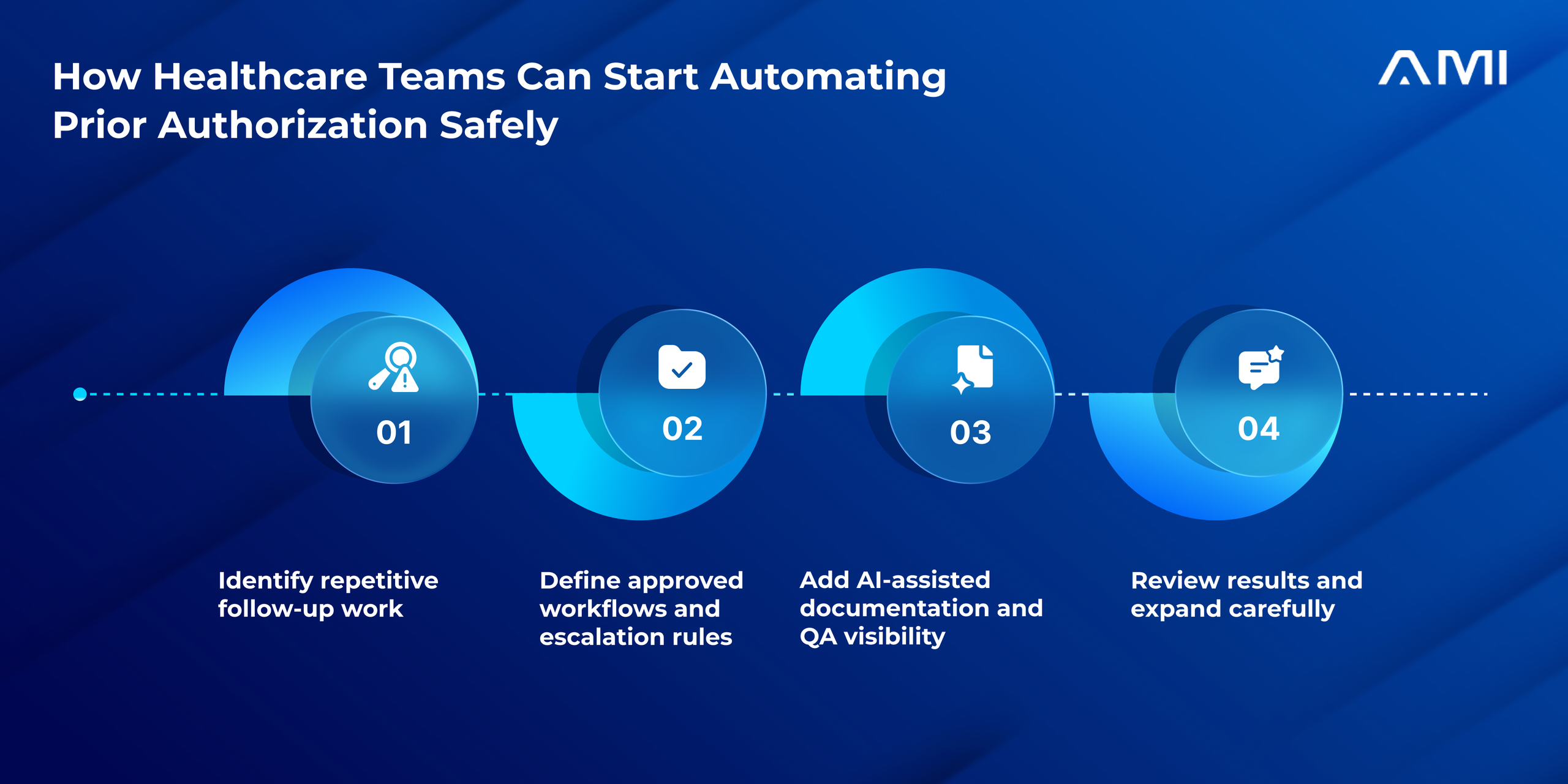
Healthcare teams do not need to automate everything at once. A safer approach is to start with repeatable administrative work and expand only after reviewing quality, escalation, and documentation performance.
Phase 1: Identify repetitive follow-up work
Start with high-volume, low-risk tasks such as status checks, reminders, call documentation, and follow-up tracking. These are often the easiest places to reduce manual workload.
Phase 2: Define approved workflows and escalation rules
Clarify what automation can support, what requires review, and when a case must escalate. This prevents automation from handling work that needs judgment.
Phase 3: Add AI-assisted documentation and QA visibility
Use AI to improve summaries, notes, workflow tracking, and visibility into missed steps, delayed requests, and repeated payer issues.
Phase 4: Review results and expand carefully
Review accuracy, escalation quality, documentation consistency, staff feedback, and payer follow-up outcomes before expanding automation into more workflows.
How AMI Supports AI-First Prior Authorization Workflows
AMI supports healthcare organizations with AI-first Healthcare Contact Center Operations that can help reduce administrative friction in prior authorization workflows. The model combines trained healthcare support teams, AI-assisted intake, payer follow-up support, call summaries, task routing, QA visibility, and escalation workflows so teams can reduce delays and follow-ups without handing sensitive decisions to automation.
AMI supports:
- Prior authorization status follow-up support
- AI-assisted payer call documentation
- Caller intent and workflow identification
- Task routing and escalation with context
- Agent Assist for live support teams
- QA visibility and interaction trend reporting
- Co-managed operations with human oversight
For healthcare teams, the goal is not full automation. The goal is to create a stronger operating layer where repetitive follow-up work moves faster, documentation becomes clearer, delayed cases are easier to spot, and trained teams stay responsible for sensitive decisions.
Looking to reduce prior authorization delays and follow-ups? AMI helps healthcare teams improve payer follow-up support, documentation visibility, task routing, escalation, and QA through AI-first operations with trained human oversight.
Get Your AssessmentFrequently Asked Questions
About the Author

Written by
Urza Dey
Urza Dey is a content and copywriter with over five years of experience across marketing, B2B SaaS, HealthTech, EdTech, and related industries. At AMI, they contribute to content strategy, blog development, and marketing communication focused on healthcare operations, business process management, and AI-enabled service delivery.