


What Is Release of Information in Healthcare? A Complete Guide
TL;DR — Release of Information In a Nutshell
ROI medical records workflows require valid authorization, accurate patient and record matching, secure handling, documented release decisions, and clear operational oversight.
Release of Information delays often begin with incomplete authorizations, unclear requester information, incorrect patient identifiers, missing date ranges, or poorly defined record scope.
PHI records must be prepared and delivered through approved workflows that support access controls, secure transmission, QA review, and traceable documentation.
Different requesters, including patients, providers, payers, attorneys, auditors, and government agencies, may require different verification, authorization, and escalation steps.
Strong ROI workflows intake discipline, authorization review, requester communication, record preparation, QA, turnaround tracking, and backlog visibility.
AI can assist with categorization, indexing, duplicate detection, missing-field identification, and reporting, but human review remains necessary for authorization decisions, exceptions, and sensitive disclosures.
Healthcare organizations receive medical record requests from patients, providers, payers, attorneys, auditors, copy services, and other approved third parties. Understanding what is release of information in healthcare is is important because these requests involve authorization review, identity verification, record matching, secure delivery, documentation, and the careful handling of PHI records.
When this workflow is not managed consistently, organizations can face delayed fulfillment, repeated follow-ups, incomplete documentation, privacy concerns, and limited visibility into request status. Release of Information, commonly called ROI, provides the operational structure needed to review and complete these requests accurately.
What Is Release of Information in Healthcare?
Release of information in healthcare refers to the controlled process of reviewing, approving, documenting, and securely releasing medical records or protected health information to an authorized individual, organization, or approved requester.
ROI is not simply the act of sending documents. The process begins when a request enters the organization and continues through patient identification, requester verification, authorization review, record retrieval, release preparation, delivery, and closure.
Each stage helps ensure that the correct records are released to the correct requester for an approved purpose. It also creates an operational trail showing what was requested, what was reviewed, what was released, and how the request was completed.
What Are PHI Records?
What are PHI records? In practical terms, they are health-related records that identify, or can reasonably identify, a person and relate to diagnosis, care, treatment, billing, claims, insurance, benefits, or payment.
Clinical notes, test results, medical histories, treatment plans, discharge summaries, billing details, claims information, and patient identifiers may all contain protected health information.
Because PHI records contain sensitive patient information, the organization must control how they are accessed, prepared, transmitted, and documented. The risk is not limited to unauthorized disclosure. Errors can also occur when teams select the wrong patient, release the wrong date range, or include information beyond the approved scope.
Why Release of Information Matters in Healthcare
ROI enables patient access, provider communication, care coordination, payer reviews, billing workflows, legal matters, audits, disability reviews, and workers’ compensation processes.
These requests are often time-sensitive. A patient may need records before an appointment with a new provider. A payer may require documentation to review a claim. An attorney may be working within a legal deadline. An internal audit team may need records to validate a process or decision.
An unreliable ROI process can delay these downstream activities. It can also create additional work for staff when requesters call repeatedly for status updates or when incomplete requests move between teams without clear ownership.
A disciplined process helps healthcare organizations balance timely access with accuracy, privacy, and documentation.
Need more control over request intake, authorization review, and medical record turnaround? Explore AMI’s Release of Information Support.
Who Requests Medical Records Through ROI Workflows?
Understanding who can request medical records is important because different requester types may require different documentation and review steps.
Requests may come from patients, authorized family members, healthcare providers, health plans, insurance companies, attorneys, government agencies, auditors, disability reviewers, workers’ compensation teams, copy services, or other approved third parties.
A patient request may not follow the same process as a payer request or legal request. The required authorization, record scope, delivery instructions, and escalation path may differ. ROI teams must recognize these differences and apply the appropriate workflow consistently.
How the Release of Information Process Works
Although the exact workflow varies by organization, requester type, record source, and internal policy, most Release of Information processes follow a structured sequence designed to reduce errors, protect sensitive information, and keep requests moving toward completion. Each stage builds on the one before it, which means a problem early in the process can create delays later. Understanding that sequence helps healthcare leaders see where requests commonly slow down, where additional review may be needed, and why consistent ownership matters across the workflow.
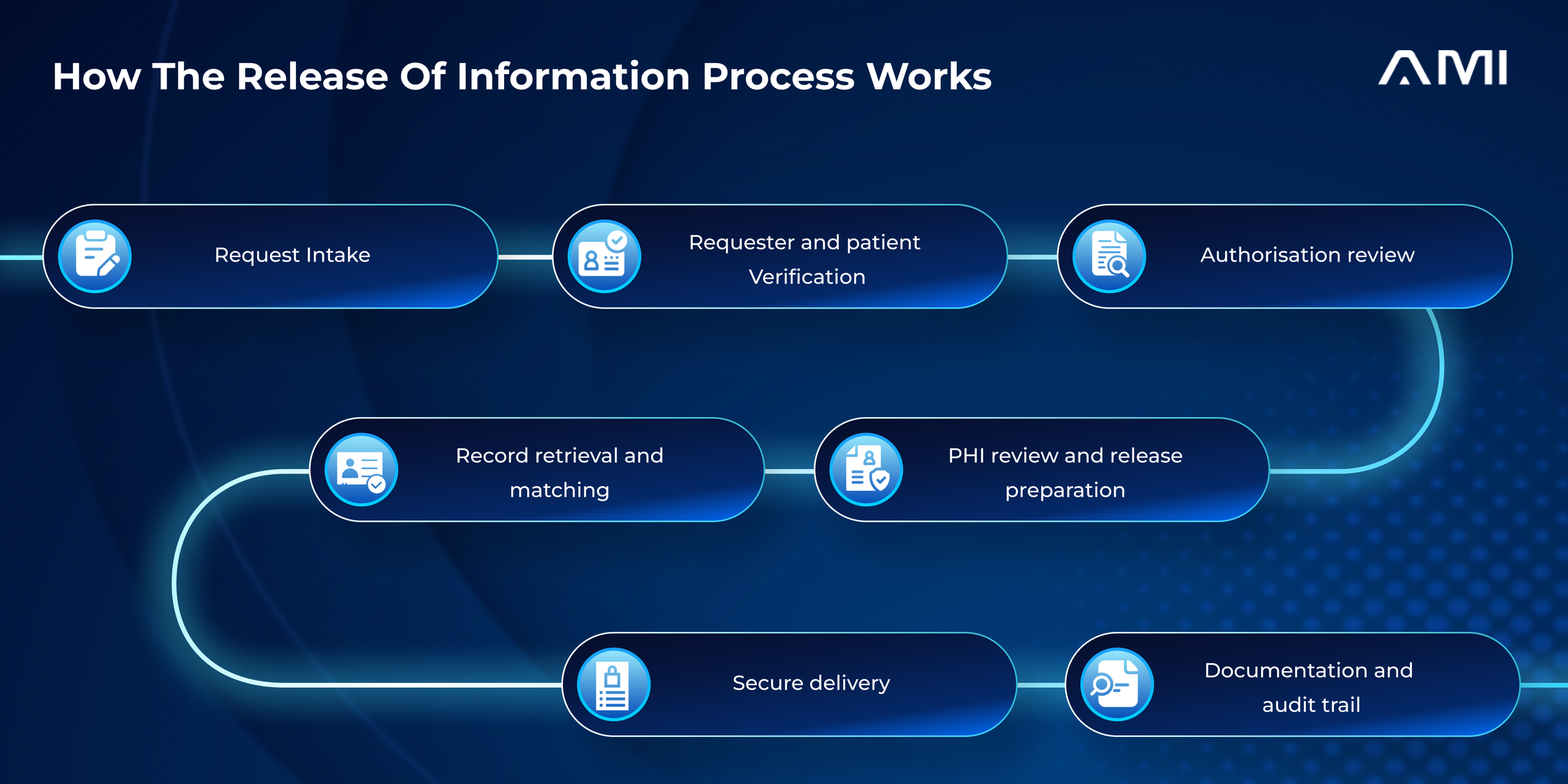
1. Request intake
The process starts when a request enters through an approved channel, such as mail, fax, secure email, a patient portal, a provider channel, a payer workflow, or a legal request queue.
The team captures the requester’s details, patient identifiers, requested records, date range, delivery instructions, and supporting documents. Clear intake matters because missing dates, unclear scope, incorrect patient details, or absent authorization documents usually cause delays later in the workflow.
2. Requester and patient verification
The ROI team must confirm who submitted the request and whether the patient information matches the organization’s records.
This may require comparing the patient’s name, date of birth, medical record number, address, date of service, or other approved identifiers. Weak verification creates the risk of wrong-record selection, duplicate processing, unnecessary follow-ups, or incorrect disclosure.
3. Authorization review
The next step is determining whether the request includes valid authorization or qualifies under another approved basis for disclosure.
The review may include the patient’s name, date of birth, requester information, requested record type, date range, signature, date signed, expiration date or event, and the purpose of the release where required.
The team must identify missing, inconsistent, or unclear information before the request proceeds. When the authorization does not meet the organization’s requirements, the request may need clarification, correction, rejection, or escalation.
4. Record retrieval and matching
After validation, the team locates the appropriate records and confirms that they belong to the correct patient.
This step may involve searching multiple systems, checking dates of service, confirming record types, and matching the retrieved information to the authorized scope. The objective is not simply to find a record. It is to retrieve the correct information for the correct individual and timeframe.
5. PHI review and release preparation
The selected records must then be prepared for release.
The team checks that the file is complete, readable, and limited to the approved scope. It should confirm that the record belongs to the correct patient, covers the correct date range, and contains the requested information.
Sensitive or unusual content may require an additional review or escalation according to organizational procedures.
6. Secure delivery
Records should be transmitted through an approved delivery method, such as a secure portal, encrypted electronic transmission, or controlled mailing process.
The delivery workflow should create a record of what was released, when it was released, where it was sent, and how the request was closed. This supports both security and traceability.
7. Documentation and audit trail
Every completed or rejected request should leave a clear operational trail.
The documentation should show when the request was received, who submitted it, what records were requested, whether authorization was approved, what exceptions occurred, how the records were delivered, and when the case was closed.
A reliable audit trail helps leaders review performance, answer requester questions, investigate errors, and maintain visibility across the entire ROI process.
Common Release of Information Challenges
ROI workflows often become difficult when teams are managing high volumes, inconsistent intake channels, incomplete authorizations, incorrect patient identifiers, missing supporting documents, or unclear request scope.
Requester communication can also consume significant staff time. When status visibility is poor, patients, payers, providers, or legal teams may call repeatedly for updates. This creates more interruptions without necessarily moving the request toward completion.
Healthcare leaders should track incomplete requests, authorization defects, turnaround time, requester follow-ups, rejected requests, escalation reasons, QA findings, aging requests, and backlog volume. These measures reveal whether the main problem is request quality, staffing capacity, workflow design, system fragmentation, or inconsistent review.
Why Release of Information Is More Than Sending Medical Records
Effective release of information involves much more than copying records and sending them to a requester.
The work includes request intake, classification, authorization validation, requester verification, patient matching, PHI-aware handling, record preparation, secure delivery, QA review, requester communication, escalation management, reporting, and audit documentation.
The value of an ROI operation lies in its consistency and accountability. Healthcare organizations need confidence that requests are being handled accurately, securely, and within defined turnaround expectations.
When ROI Workflows Become Difficult to Manage
Healthcare organizations may face growing pressure when request volume or complexity begins to exceed the capacity of existing ROI workflows.
Common signs include delayed fulfillment, repeated requester follow-ups, inconsistent authorization review, missing documentation, limited QA visibility, high legal or payer volumes, and weak reporting.
When these issues emerge, organizations may need to reassess staffing, workflow design, technology, escalation ownership, and process controls. Regardless of how the work is structured, healthcare leaders should retain oversight of policies, exception rules, documentation requirements, escalation decisions, and PHI governance.

What Strong Release of Information Workflows Should Include
A well-managed release of information workflow depends on more than processing requests quickly. Healthcare organizations need clear controls around authorization review, requester verification, PHI handling, record completeness, escalation, and documentation.
Strong ROI workflows typically include:
- HIPAA-aware handling practices
- PHI access and disclosure controls
- Authorization review procedures
- Requester verification steps
- Defined request-processing workflows
- Secure record delivery methods
- QA checks for accuracy and completeness
- Turnaround time monitoring
- Backlog and aging visibility
- Clear escalation pathways
- Audit trail documentation
- Ongoing reporting and oversight
The goal is to maintain visibility across the full request lifecycle. Teams should be able to see where requests stand, identify exceptions, track turnaround performance, review quality findings, and document how issues were resolved.
Facing a growing medical records backlog or repeated follow-ups from requesters? Learn how AMI supports Medical Record Retrieval and related healthcare operations workflows.
Where AI Fits Into Release of Information Workflows
AI-assisted tools can assist with selected parts of the ROI workflow, including request categorization, missing-field identification, document indexing, duplicate request detection, status tracking, QA sampling, and operational reporting.
These capabilities may reduce manual sorting and help teams identify incomplete or aging requests more quickly. AI can also support management visibility by highlighting request patterns, recurring defects, and backlog trends.
However, AI should not independently decide whether sensitive information can be released. Authorization exceptions, legal-sensitive requests, restricted information, unusual requester types, and unclear documentation still require trained human review.
Why Human Oversight Still Matters in ROI Medical Records
Human oversight remains essential because ROI medical records requests are not always complete or straightforward.
Staff may need to interpret unclear authorization language, resolve mismatched patient details, clarify a vague record scope, manage a legal request, or determine whether an exception requires escalation.
Trained teams provide the operational judgment needed to review ambiguity, communicate with requesters, document decisions, and apply organizational policies consistently. Automation may support the process, but human review remains central to authorization, exception handling, and sensitive disclosures.
How AM Infoweb Approaches Release of Information Operations
AMI applies a co-managed approach to ROI operations to release of information workflows, with an emphasis on accuracy, turnaround discipline, PHI handling, quality control, and operational visibility.
In practice, this means supporting healthcare organizations with structured processes for request intake, authorization review, requester communication, QA, escalation, documentation, and reporting. The focus is not only on completing requests, but on maintaining consistency and visibility across the full request lifecycle.
AMI’s approach may include:
- Structured request intake and processing workflows
- Authorization review support
- PHI-aware medical record handling
- Patient, provider, payer, and legal requester coordination
- QA checks for accuracy and completeness
- Turnaround time and backlog monitoring
- Escalation workflows for exceptions
- Audit trail and documentation support
- Co-managed reporting with client oversight
This model allows healthcare organizations to strengthen day-to-day ROI operations while retaining visibility into request status, quality findings, exceptions, and escalation decisions.
Frequently Asked Questions
About the Author

Written by
Urza Dey
Urza Dey is a content and copywriter with over five years of experience across marketing, B2B SaaS, HealthTech, EdTech, and related industries. At AMI, they contribute to content strategy, blog development, and marketing communication focused on healthcare operations, business process management, and AI-enabled service delivery.