

Connecting Record Retrieval With Claims Workflows Without Losing Control
Key Highlights
Evaluate the complete request-to-acceptance workflow, not document delivery alone.
Separate technical connectivity from responsibility for daily execution.
Require demonstrations of partial records, mismatches, rejected deliveries, and reopened requests.
Measure accepted output alongside turnaround, rework, and retained management effort.
Contract for exception ownership, security responsibilities, change control, and exit support.
Expand only after a representative pilot proves the proposed operating model works.
If your retrieval company supports insurers, claims administrators, or claims-related legal matters, an operations partner must do more than obtain documents. It must keep each request connected to the correct matter, maintain reliable status information, resolve exceptions, and deliver records in a form your client can accept.
Otherwise, additional retrieval capacity simply creates a larger reconciliation queue.
The buying decision is therefore not whether a partner can “integrate.” It is whether the proposed operating model preserves your control over requests, information, customer relationships, and delivery standards.
This guide helps you evaluate that model before signing an agreement, expanding an existing engagement, or committing to a pilot.
Define the Handoff You Are Buying
Start your procurement discussion with one question:
At what point does the partner’s responsibility begin, and what evidence proves that responsibility has been completed?
“End-to-end support” is not a usable scope unless both parties define its boundaries.
Your client might originate a request in a claims platform. Your retrieval system may manage provider research and follow-ups. Another environment may receive completed records for review. The partner could operate within one system, several systems, or a controlled handoff between them.
Those arrangements create different access requirements, supervisory responsibilities, and failure points.
Require a scope document identifying:
- Who creates and validates the retrieval order.
- Which identifiers connect the order to the client’s claim or matter.
- Who reviews request documentation before provider outreach.
- Who records provider responses and outstanding requirements.
- Who approves fees, exceptions, and sensitive actions.
- Who checks received records and prepares delivery.
- Who confirms acceptance in the receiving workflow.
Also separate administrative execution from decisions retained by your client. Collecting a missing document is not the same as determining coverage, evaluating liability, or deciding a claim.
A credible partner should explain those boundaries without relying on broad assurances about healthcare experience.
Make Your Existing Platform the Operating Reference
Your company should not have to surrender its established platform simply to obtain additional processing capacity.
However, “we work in your system” needs more detail than a statement in a proposal.
Ask whether the partner will use approved user accounts, structured file exchanges, supported interfaces, or another agreed method. Identify who configures access, maintains field mappings, resolves failed transfers, and approves system changes.
Do not assume that experience with a named platform proves compatibility with your particular configuration.
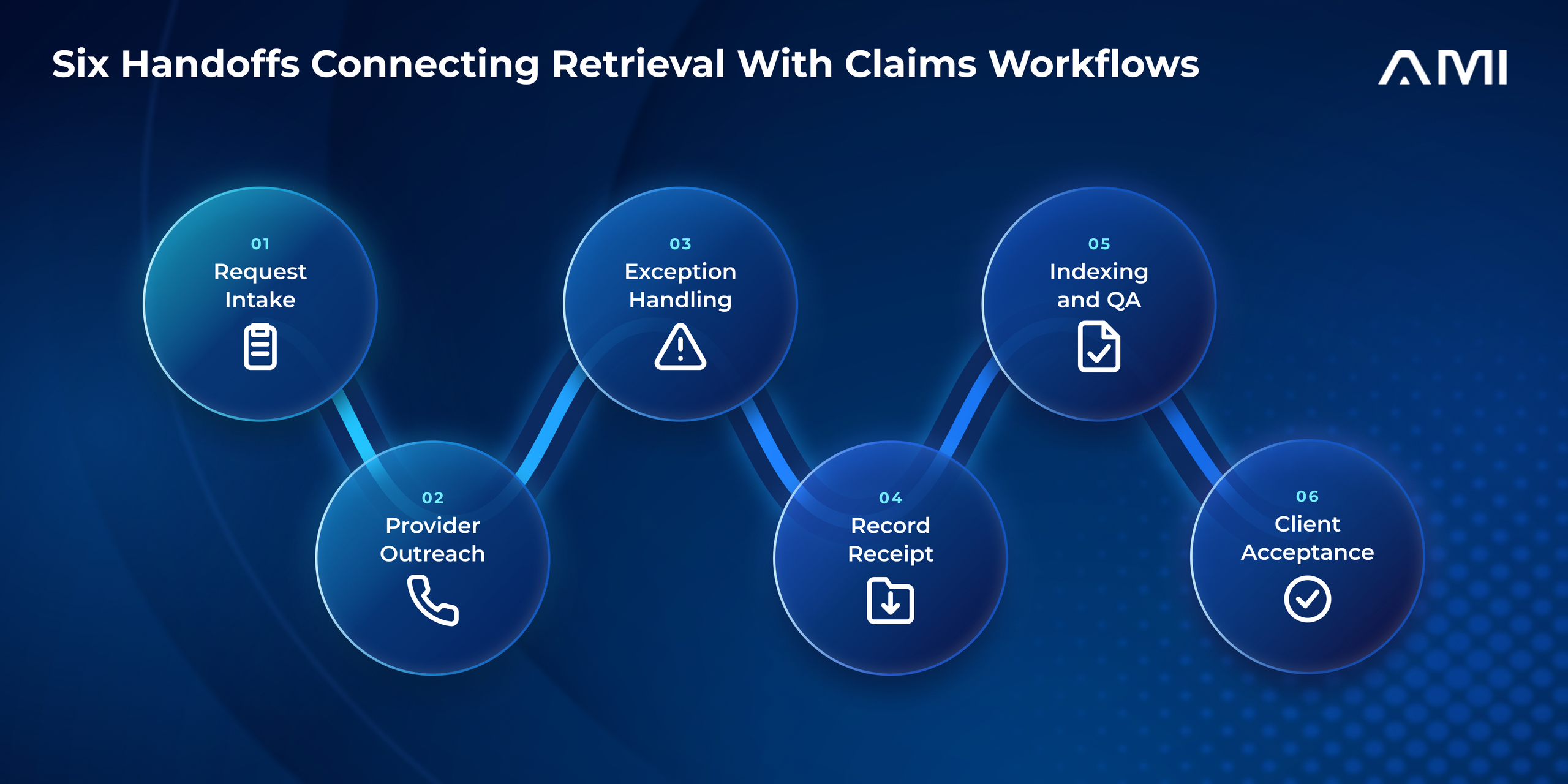
Before selection, require a written mapping of the important handoffs:
| Handoff | What the Partner Must Demonstrate | Acceptance Evidence |
|---|---|---|
| Request intake | Link the incoming order to the correct client, patient, provider, and matter | Validated identifiers and a traceable order |
| Provider outreach | Record requests and responses using your approved workflow | Dated activity, supporting correspondence, and the next action |
| Exception handling | Route incomplete documentation, fee holds, and unresolved responses | Assigned ownership, reason codes, and escalation history |
| Record receipt | Match incoming documents to the correct request | Receipt record and documented discrepancies |
| Indexing and QA | Prepare records against your delivery requirements | Completed checks and identifiable reviewer |
| Client delivery | Transfer the approved production and confirm its receiving status | Delivery evidence, acceptance, or a managed rejection |
The mapping should cover both the document and its associated information. A successfully transferred PDF has limited operational value if the receiving team cannot identify its provider, requested period, outstanding gaps, or review status.
For document-level requirements, establish your medical record indexing standards before agreeing to production targets.
Agree on Status Definitions Before Comparing Turnaround
Status synchronization is often treated as a technical detail. In practice, it determines whether your supervisors and clients can trust the queue.
Ask competing providers to explain the same terms:
- Does “requested” mean prepared, transmitted, or acknowledged?
- Does “received” include partial productions?
- Does “complete” mean all requested records arrived or that the available records passed QA?
- Does “delivered” mean transmitted or accepted by the receiving workflow?
- What happens when a previously closed request reopens?
There is no benefit in synchronizing statuses that mean different things.
Require a shared status dictionary, documented transition rules, and a process for correcting conflicting updates. Each active exception should have an owner, a next action, and an escalation condition.
Then separate provider waiting time from partner-controlled processing time. Otherwise, you cannot distinguish an external delay from records sitting untouched after receipt.
Use the same definitions across your existing operation and the proposed engagement. AM InfoWeb’s guide to medical record retrieval turnaround time provides additional context for separating avoidable workflow delays from broader request aging.
Test Exceptions Instead of Watching a Clean Demonstration
A demonstration built around a complete request and a responsive provider proves very little about daily delivery.
For medical record retrieval services claims workflow integration, ask the partner to demonstrate what happens when work cannot proceed normally.
Use several representative scenarios.
A partial production arrives
The provider sends records for only part of the requested period. Ask how the partner identifies the gap, records partial receipt, continues follow-up, and prevents premature closure.
The original request must remain understandable without forcing your supervisor to reconstruct its history.
The identifiers do not match
Incoming documents contain an unexpected demographic detail or matter identifier. Ask what prevents automatic attachment to the wrong request and who resolves the discrepancy.
A mismatch should create a controlled exception, not an informal message that disappears after a shift change.
Delivery succeeds, but acceptance fails
A file reaches the receiving environment, but the client rejects it because of naming, indexing, completeness, or access problems.
Who owns the rejection? Does the request reopen? Does correction count as new production or rework?
The request changes after outreach
Your client changes the requested period, adds a provider, or withdraws an order. Ask how the change reaches the active queue and how already completed work is accounted for.
Score the demonstration against evidence produced, not presentation quality.
Assign Security Responsibilities to the Actual Workflow
A security review should follow the proposed delivery arrangement rather than stop at a certificate, questionnaire, or compliance statement.
Establish what information the partner accesses, where that access occurs, which tools are used, and whether subcontractors participate.
Request evidence covering:
- Individual accounts and access approval.
- Permissions appropriate to assigned work.
- Restrictions on downloads and local storage.
- Approved transmission and delivery channels.
- Access removal when employees change roles or leave.
- Incident reporting and escalation responsibilities.
- Retention, return, and deletion arrangements.
Your legal and security teams should determine the applicable contractual requirements. HHS guidance explains that business-associate arrangements can include subcontractors handling protected health information on behalf of another business associate. The appropriate structure depends on the parties and functions involved. HHS Business Associate Guidance
Keep AI-supported processing within this review. Permission to perform administrative retrieval work should not be treated as automatic approval to submit records to an additional AI service.
Ask separately about approved use cases, data destinations, retention, verification, and human approval.

Why does record retrieval become difficult to control at scale?
Delays, follow-ups, provider coordination, and documentation gaps can slow down litigation support workflows. AM InfoWeb helps legal and healthcare teams manage record retrieval with structured processes, experienced teams, and clear operational visibility.
Run a Pilot Against Accepted Output
Your pilot should answer a commercial question: Can this partner deliver the agreed work reliably with an acceptable level of retained effort from your team?
Choose requests that represent your expected operating conditions. Include different providers, ordinary documentation problems, partial returns, fee exceptions, and older unresolved requests.
Avoid a pilot consisting entirely of the easiest work.
Before launch, agree on a baseline, sampling approach, review responsibilities, and expansion criteria. Define what constitutes a material error and what happens when the parties disagree about acceptance.
Use a balanced scorecard:
| Measure | What It Helps You Evaluate |
|---|---|
| Intake accuracy | Whether requests enter the workflow correctly |
| Status accuracy | Whether reported progress matches supporting evidence |
| Receipt-to-review time | Whether returned records accumulate before processing |
| First-pass acceptance | Whether output meets the agreed requirements without correction |
| Exception aging | Whether blocked requests have active ownership |
| Rework volume | Whether production counts conceal repeated corrections |
| Retained supervisor effort | Whether your managers must repair the partner’s work |
| Cost per accepted output | Whether the commercial model reflects usable delivery |
Do not combine unlike request types into one average without showing the mix.
A partner processing straightforward single-provider requests should not be compared directly with one handling complex, multi-provider productions unless the evaluation accounts for that difference.
An illustrative acceptance test
Suppose your claims client requires documents linked to a matter identifier, organized by provider, and accompanied by a clear statement of outstanding gaps.
A production arrives with readable records but an unresolved provider mismatch. Counting it as “completed” rewards activity your client cannot confidently use.
Your pilot should test whether the partner catches that mismatch, routes it for resolution, and records the eventual acceptance.
This is an illustrative buying scenario, not a reported client outcome. Its purpose is to make your acceptance criteria observable before larger volumes depend on them.
Compare Total Cost, Not the Cheapest Processing Rate
The cheapest proposal may leave the most work with your internal team.
Request comparable pricing across the same scope, request mix, operating hours, quality requirements, and reporting expectations.
Depending on the engagement, charges may be based on staffing, processing activity, completed requests, or a combination. Understand what each unit includes.
Ask specifically about:
- Setup, training, and knowledge transfer.
- Interface configuration or file-exchange changes.
- Minimum commitments and capacity reservations.
- Partial records and unsuccessful retrieval attempts.
- Reopened requests, corrections, and duplicate work.
- Additional supervision or reporting.
- Transition support when the engagement ends.
Separate provider charges and other pass-through expenses from the partner’s operating fees.
Then include your retained costs: access administration, oversight, acceptance review, exception decisions, and reconciliation.
A useful comparison is:
Total delivery cost ÷ outputs accepted under the agreed definition.
Use this alongside request complexity and service quality. A lower accepted-unit cost is not an improvement if it results from excluding difficult requests or leaving more unresolved work in your queues.
Put Change Control and Exit Support in the Agreement
Workflow integration continues to change after implementation.
Your client may introduce a new status, modify delivery requirements, change a platform field, or tighten access permissions. The agreement should explain how those changes are assessed, approved, tested, and communicated.
Name the owners for operational changes and technical changes. Specify which adjustments are included in the service and which require a revised scope or fee.
Also document your exit arrangements before the relationship becomes operationally essential.
You should be able to recover request histories, outstanding exceptions, status definitions, operating procedures, and agreed reporting records in usable formats.
Confirm how access is removed, what information is returned or deleted, and how active work transfers without duplicate outreach or lost follow-ups.
An operating model that is difficult to inspect or unwind can reduce your control even when its initial performance appears satisfactory.
How AM InfoWeb Supports Claims-Connected Retrieval Operations
AM InfoWeb brings two decades of experience in the U.S. healthcare industry and uses a co-managed model that brings AI agents and skilled human agents together to eliminate process bottlenecks and execute secure healthcare workflows.
Its record retrieval and litigation support services include:
- Facility research and order-entry support.
- Request preparation and provider follow-ups.
- Custodian payment coordination.
- Record organization and client-system documentation.
- Human oversight of exceptions and client-specific processing requirements.
For your evaluation, the engagement should identify which activities AM InfoWeb manages, which approvals your team retains, and how its work connects to your established systems. Any technical interface or AI-supported use case should be assessed against your actual requirements rather than assumed from a general service description.
Relevant delivery experience
AM InfoWeb’s published case study describes embedded retrieval support for a national U.S. litigation-support provider facing workforce disruption and increasing demand. Experienced personnel worked within the client’s workflows, with capacity adjusted as workloads expanded.
The documented experience supports evaluating an embedded delivery model. Your pilot must separately establish the platform fit, status controls, and acceptance requirements of your claims-connected workflow.
Conclusion: Buy a Workflow You Can Verify
The right partner should leave your retrieval company with more usable capacity and clear operational control.
Before committing, require a documented handoff map, shared status definitions, realistic exception demonstrations, security evidence, representative pilot results, and a complete commercial model.
Evaluate medical record retrieval services claims workflow integration by what your receiving client can accept, not by how many requests a partner touches or files it transfers.
If the proposal cannot explain ownership when work fails, the integration is not ready to scale.
Ready to Evaluate Your Retrieval-to-Claims Handoffs? Discuss your current platform, request volumes, exception queues, and delivery requirements with AM InfoWeb to define the scope of a co-managed operating relationship.
Discuss Your Retrieval WorkflowsFrequently Asked Questions
About the Author

Written by
Urza Dey
Urza Dey is a content and copywriter with over five years of experience across marketing, B2B SaaS, HealthTech, EdTech, and related industries. At AMI, they contribute to content strategy, blog development, and marketing communication focused on healthcare operations, business process management, and AI-enabled service delivery.