


Scaling Record Retrieval Services for a National Litigation Provider
Rapid access
Experienced retrieval support
Flexible staffing
Capacity aligned with demand
Continuity
Support through workforce shifts
Consistent throughput
Embedded execution support
A national litigation support provider needed its record retrieval operations to remain dependable while workforce availability shifted and demand continued to grow. Internal teams faced the combined pressure of keeping existing work moving and absorbing larger processing volumes. AM InfoWeb stepped in with experienced retrieval professionals and a flexible support model built around the client's workflows. The engagement helped strengthen operational continuity, staffing capacity, and day-to-day execution.
Client Context
The U.S.-based client delivers nationwide legal services, including court reporting, litigation consulting, and record retrieval. Its teams support complex litigation matters where responsiveness and reliable execution are central to service delivery.
- Client: A national litigation support provider serving the United States.
- Operational focus: Record retrieval services within an established legal-services organization.
- Business need: Maintain continuity while increasing the capacity available to process growing workloads.
For this organization, scaling legal record retrieval meant adding people who could work effectively within existing processes. Extra headcount would only help if the added resources could integrate with internal teams and maintain the expected standard of execution.
Where Operations Were Struggling
During the COVID-19 period, changes in workforce availability put pressure on the Record Retrieval division. Demand remained steady, and subsequent growth increased the workload the team needed to support.
- Workforce disruption made it harder to maintain a dependable level of operational coverage.
- Rising retrieval volumes required capacity that could expand with demand.
- Peak processing periods put additional pressure on internal teams and throughput.
- Larger operations required closer coordination to preserve service consistency.
These pressures were connected. Limited staffing flexibility made volume spikes harder to absorb, while growth increased the need for alignment across teams. The client needed an operating partner that could support both immediate continuity and longer-term capacity.
How AM InfoWeb Stepped In
AM InfoWeb deployed trained record retrieval professionals with litigation support experience. They integrated into the client's workflows and worked alongside its internal teams, providing added execution capacity during a period of disruption.
The partnership centered on embedded support: experienced resources joined the existing operating model, and staffing could increase as the workload expanded. This approach gave the client practical support for current queues while creating a more flexible foundation for growth.
- Experienced resources supported record retrieval tasks within the client's processes.
- Flexible staffing allowed capacity to respond to changing demand.
- Additional support during peak periods helped maintain processing momentum.
- Close coordination with internal teams kept execution aligned as operations expanded.
The Optimized Workflow
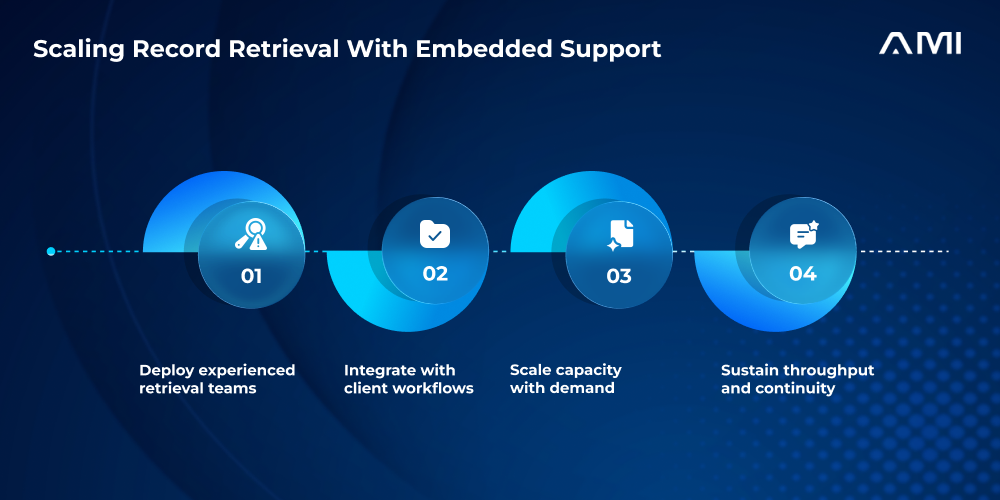
AM InfoWeb's support model connected resource readiness, workflow integration, and demand-based scaling. The following workflow summarizes the documented operating approach.
- Deploy experienced retrieval teams. Bring in professionals familiar with record retrieval and litigation support so added capacity can contribute to the client's ongoing work.
- Integrate with client workflows. Work alongside internal teams and use existing processes to support coordinated task execution.
- Scale capacity with demand. Add trained resources as volumes grow or processing requirements peak.
- Sustain throughput and continuity. Keep teams aligned across changing workloads to support dependable service delivery.
This model made record retrieval support more adaptable. The client could respond to workload changes with experienced capacity while retaining an operating structure connected to its own teams.
What Changed: Before and After
The engagement addressed the client's operating constraints through changes in capacity and coordination.
Before AMI | After AMI |
|---|---|
Staff availability shifted while retrieval work continued. Internal teams faced pressure to maintain operational continuity. | Experienced retrieval professionals added workforce coverage. Their support helped sustain continuity through staffing changes. |
Growing retrieval demand required more flexible staffing. Existing capacity had to absorb larger processing volumes. | Trained resources scaled with workload requirements. Flexible staffing helped the client support growing retrieval demand. |
Volume spikes increased the workload placed on internal teams. Peak demand created pressure to keep requests moving consistently. | Additional retrieval capacity supported peak workloads. This helped maintain processing momentum and consistent throughput. |
Operational expansion increased the need for coordination. Internal teams had to align a growing workload with existing processes. | Embedded retrieval support worked alongside the client’s teams. Integration with existing workflows strengthened day-to-day coordination. |
Results and Business Impact
The client gained a more dependable support structure for its record retrieval function. The reported benefits were operational: continuity during workforce changes, flexible capacity, and consistent throughput as workloads increased.
- Rapid access to experienced support strengthened the resources available for retrieval work.
- Flexible staffing helped the client respond to changing demand and peak volumes.
- Operational continuity supported workflow stability during workforce fluctuations.
- Embedded execution helped sustain coordination and throughput at scale.
- A scalable support structure created a foundation capable of extending into additional service areas.
For a litigation support provider, these improvements mattered because growth could be supported through a more adaptable operating model. The case demonstrates how experienced staffing and team integration can reinforce record retrieval services when capacity is under pressure.
How AM InfoWeb Supports Record Retrieval Operations
AM InfoWeb has two decades of experience in the U.S. healthcare industry and uses a co-managed model that brings AI agents and skilled human agents together to eliminate process bottlenecks and execute secure healthcare workflows.
Its current support capabilities include:
- Record retrieval and litigation support aligned to client processes.
- Experienced operational teams and flexible capacity planning.
- Workflow coordination, documentation support, and operational visibility.
- Human oversight of exceptions and client-specific execution requirements.
In this engagement, the documented improvements centered on experienced staffing, embedded execution, and scalable support.
Explore AM InfoWeb's record retrieval and litigation support services.
Conclusion
The client's challenge was keeping record retrieval dependable while its operating environment changed. AM InfoWeb helped address that challenge by connecting trained resources to existing workflows and scaling support with demand. The result was a stronger foundation for continuity, throughput, and future service growth.