

Medical Record Retrieval Turnaround Time: Reduce Legal Request Delays
TL;DR: medical record retrieval turnaround time
Turnaround begins with a complete, correctly routed request.
Measure active provider time separately from internal queue time.
Escalation rules should depend on age, deadline, and case priority.
Completion requires record-level quality review, not file receipt alone.
Medical record retrieval turnaround time affects discovery planning, chronology work, expert review, demand preparation, and case deadlines. Yet a single average can hide where requests actually wait.
Legal teams need an operating view that separates request preparation, provider routing, authorization issues, follow-up, production, and quality review. That visibility helps teams act before a delayed request becomes a case constraint.
What Is Medical Record Retrieval Turnaround Time?
Medical record retrieval turnaround time is the elapsed time from an accepted request to a complete, usable production. A useful definition states when the clock starts, which pauses are allowed, and what qualifies as complete.
Track calendar days and stage-level working time. The first number supports deadline planning; the second reveals whether delays originate in intake, provider response, payment, delivery, or internal review.
What Determines Retrieval Turnaround for Legal Teams?
Turnaround varies with authorization accuracy, provider identification, record age, archive location, facility workflow, request scope, copy fees, delivery method, and unresolved exceptions. Multi-provider matters add coordination risk because one missing production can hold up the full review.
The legal deadline and the provider response process are not the same clock. Teams should record the governing request type and applicable requirements instead of applying one universal timeline to every matter.
Where Do Avoidable Retrieval Delays Enter the Process?
Avoidable delays often begin before the request reaches a provider. Incorrect facility details, incomplete authority, broad date ranges, and ambiguous record types create rework that compounds during follow-up.
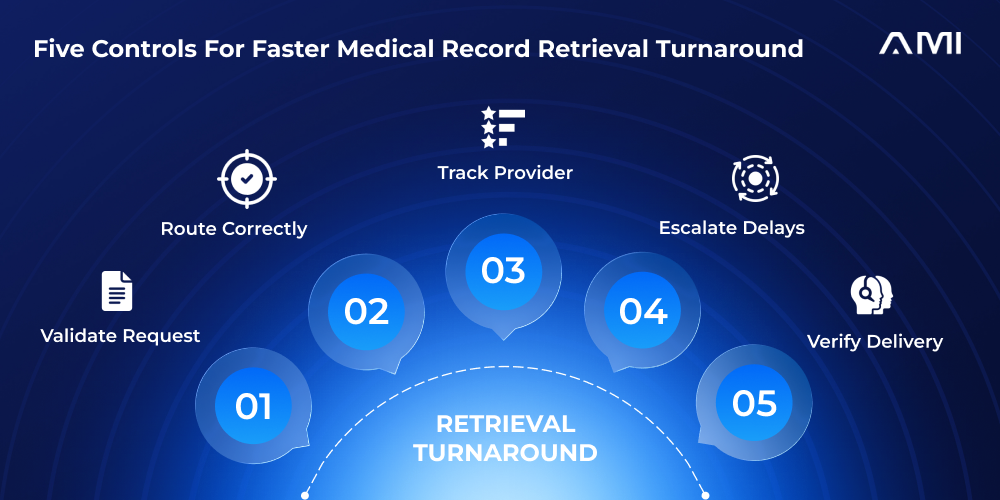
| Retrieval stage | Common delay | Operational control |
|---|---|---|
| Request preparation | Incomplete authorization or scope | Validate authority, dates, and record types |
| Provider routing | Wrong location or custodian | Confirm facility and submission channel |
| Provider response | No acknowledgment or unclear status | Track milestones and scheduled follow-up |
| Exception handling | Fees, rejection, or missing documentation | Use coded reasons and escalation rules |
| Production review | Incomplete or duplicated records | Perform record-level QA before closure |
Primary source: HHS guidance on the HIPAA right of access.
How Should Teams Track Provider Follow-Up?
Use one request record with the provider, submission channel, sent date, acknowledgment, next action, owner, case deadline, and exception reason. Every follow-up should update the same timeline rather than create a separate email trail.
Segment queues by age and state. New requests, acknowledged requests, fee holds, corrected requests, partial productions, and overdue responses require different actions and should not share one generic pending status.
When Should a Retrieval Request Escalate?
Escalation should follow documented triggers such as missing acknowledgment, repeated unanswered follow-ups, approaching litigation deadlines, disputed fees, rejected authority, or an incomplete production. Priority should reflect both age and case impact.
An escalation path needs an owner, next action, evidence, and review date. Escalation without a defined decision or follow-through simply creates another queue.
How Can Legal Teams Evaluate Retrieval Performance?
Review median and percentile turnaround, stage aging, first-pass request acceptance, follow-up touches, exception rates, complete-production rates, and reopened requests. Pair speed with completeness so teams do not close requests prematurely.
For individual access requests, HHS states that covered entities generally must act within 30 calendar days and may use one additional 30-day extension when required conditions are met. Litigation requests can involve different authorities and state rules, so counsel should confirm the requirements for each matter.
Primary source: HHS access timeliness guidance.

Why does record retrieval become difficult to control at scale?
Delays, follow-ups, provider coordination, and documentation gaps can slow down litigation support workflows. AM InfoWeb helps legal and healthcare teams manage record retrieval with structured processes, experienced teams, and clear operational visibility.
What Does Better Retrieval Turnaround Look Like?
Better turnaround means requests move with fewer preventable stops, providers receive accurate information, exceptions become visible early, and completed files are usable on arrival. The goal is not simply more follow-up activity.
A disciplined retrieval operation gives legal teams realistic status, dependable escalation, and a defensible record of each request. That control improves planning even when a provider response cannot be accelerated.
How AM InfoWeb Supports Medical Record Retrieval Turnaround
AM InfoWeb has two decades of experience in the U.S. healthcare industry and uses a co-managed model where AI agents and skilled human agents work together to eliminate process bottlenecks and execute secure healthcare workflows.
AM InfoWeb can support:
- Validated request intake, authorization review, and provider routing
- Structured follow-up schedules with visible request ownership
- Exception queues for fees, rejections, missing records, and corrections
- Production-level quality checks, status reporting, and secure delivery
How Can Legal Teams Reduce Retrieval Delays?
Define the clock, validate requests before submission, track every stage, and escalate according to case impact. When speed and completeness are measured together, legal teams gain a more reliable retrieval process and fewer last-minute surprises.
Need clearer medical record retrieval status? AM InfoWeb can support tracking, follow-up, escalation, and production QA.
Get in TouchFrequently Asked Questions
About the Author

Written by
Urza Dey
Urza Dey is a content and copywriter with over five years of experience across marketing, B2B SaaS, HealthTech, EdTech, and related industries. At AMI, they contribute to content strategy, blog development, and marketing communication focused on healthcare operations, business process management, and AI-enabled service delivery.
Related Posts

Medical Records Subpoena: How Legal Teams Avoid Retrieval Delays
Prevent subpoena delays with precise requests, tracking, privacy controls, and production QA.
Medical Record Indexing: Organize Complex Files for Faster Review
Organize complex medical files through consistent indexing, traceability, and quality controls.