


Medical Record Review Companies: Compare Turnaround, Costs, Quality, Security
TL;DR: Key Highlights
Define review scope and require material statements to link to supporting source records.
Assign accountable human verification and approval for AI-assisted work, with clear uncertainty escalation.
Measure turnaround through accepted, usable delivery, separating retrieval delays from review processing.
Compare service fees plus internal verification, rework, scope changes, storage, and exit costs.
Request workflow-specific security evidence covering access, subprocessors, data use, retention, and incident response.
Test shortlisted providers on equivalent representative records with written acceptance criteria before scaling.
Compare medical record review companies on service scope, reviewer qualifications, source traceability, accepted turnaround, total cost, and documented security controls. Give shortlisted partners the same representative records and written acceptance criteria. Select the company that demonstrates usable, verifiable delivery, not simply the lowest per-page rate or the fastest first draft.
For U.S. law firms and litigation-support organizations, the purchase is really a handoff decision. Can another team organize complex records and return work your people can validate without rebuilding it? A polished chronology is not enough if a treatment date is misattributed, a source link breaks, or an unresolved gap disappears from the summary.
This buyer's guide provides a scope table, weighted scorecard, turnaround framework, cost example, security questions, and pilot checklist. It evaluates operational medical record review services, rather than ranking companies without comparable evidence or treating outsourced summaries as legal opinions.
Define the service before comparing companies
Medical record review companies can use the same service label for very different work. One may organize files and prepare factual chronologies; another may offer clinical analysis through appropriately qualified professionals. Retrieval, indexing, factual summarization, expert opinion, and attorney analysis are separate purchases, even when one supplier coordinates several of them.
Describe the question your team needs answered, the permitted level of interpretation, and the required deliverable. For a personal injury matter, that might be a dated treatment chronology with provider attribution and stable page references. For a litigation-support provider, it could be repeatable document organization and summary production across a portfolio.
An engagement should specify who resolves clinical ambiguity and who makes legal decisions. The ABA's outsourcing guidance emphasizes that lawyers retain responsibility for competent representation and appropriate supervision when using outside support. ABA Formal Opinion 08-451 addresses these responsibilities; applicable jurisdictional rules still govern.
Match each deliverable to its boundaries
| Service | Typical deliverable | Clarify before contracting |
|---|---|---|
| Record retrieval | Source files from identified providers | Provider coverage, request scope, missing files, follow-ups |
| Indexing and hyperlinking | Navigable inventory and page references | Stable identifiers, duplicates, link accuracy |
| Chronology and factual summary | Dated, source-linked account of recorded events | Required fields, attribution, uncertainty flags |
| Clinical interpretation | Qualified professional's scoped analysis | Credentials, specialty, applicable licensure, limitations |
| Expert opinion or testimony | Separately commissioned professional opinion | Qualifications, jurisdiction, engagement requirements |
| Attorney analysis | Case theory and evidentiary or strategic decisions | Retained legal judgment and supervision |
Use evidence to score medical record review companies
A consistent vendor scorecard makes proposals comparable. Set the criteria before demonstrations begin, then ask each medical record review company to provide proof against the same requirements. A confident sales answer is not equivalent to a source-linked sample, documented correction process, or demonstrated export.
The weights below are an illustrative buyer tool, not a validated industry rating. Adjust them to your matters, operating model, and risk tolerance. Score each dimension from zero to five: zero means no usable evidence, three means the agreed requirement is demonstrated, and five means the provider supplies additional relevant evidence. Calculate the weighted contribution as (rating ÷ 5) × weight.
Keep critical requirements outside the averaging exercise. A confidentiality problem, unacceptable data use, or inability to stay within the agreed scope should stop onboarding even if the overall score looks strong. Record the evidence, reviewer, date, and unresolved questions beside each rating.
Send a short, consistent request for proposal. Include the intended users, matter types, approximate page ranges, common file problems, delivery formats, anticipated volumes, and required source references. Ask bidders to identify assumptions and exclusions rather than returning an unqualified yes to every requirement. Medical record review services for attorneys may need different outputs from high-volume processing support for retrieval organizations.
During the demonstration, ask the provider to open a source reference, show how a disputed entry is corrected, and export the result. Then ask a member of your own team to repeat those steps. This checks the ordinary handoff and helps distinguish capabilities demonstrated live from features merely described in a proposal.
Illustrative medical record review vendor scorecard
| Evaluation dimension | Weight | Evidence to request |
|---|---|---|
| Factual accuracy and source traceability | 25% | Cited sample, quality findings, correction log |
| Reviewer qualifications and scope | 20% | Role structure, credentials, supervision, escalation |
| Privacy, security, data governance | 20% | Data-flow map, access controls, subcontractor details |
| Turnaround reliability and capacity | 15% | Defined SLA, queue reports, volume and rush assumptions |
| Pricing clarity | 10% | Scope assumptions, revisions, change and exit charges |
| Usable handoff and reporting | 10% | Export sample, file conventions, status reporting |
Ask for the ordinary handoff, not only the best sample
Request a representative deliverable and its associated inventory, exception list, QA record, and correction history. These reveal how the provider handles imperfect inputs, not just how an ideal document looks.
Test quality against source records, not presentation
The most useful quality question is specific: can your team trace a material statement back to the correct record? Evaluate patient identity, event date, provider, recorded finding, and source reference together. A sentence can sound plausible while combining details from unrelated encounters.
Use five practical tests. Accuracy means the entry reflects the record. Traceability means the reference opens the supporting page. Completeness means the agreed source inventory and required fields reconcile, with gaps disclosed. Neutrality means the reviewer separates recorded facts from assumptions. Usability means your team can search, navigate, and verify the output independently.
Ask medical record review companies what their accuracy percentage actually measures. Does its denominator include blank fields? Are findings checked before or after correction? Are critical identity errors distinguished from formatting issues? Ask for the sampling method and recent examples of defects that changed reviewer training. An unexplained percentage should not drive the shortlist.
Peer-reviewed research · clinical abstraction, not litigation
Why qualifications should include a work-sample test
Zozus and colleagues reported training 69 medical-record abstractors across 30 U.S. clinical sites. Twenty-three percent exceeded the study's acceptance limit on one or both standardized test cases. For legal buyers, the transferable lesson is to test representative work, review discrepancies, and provide feedback. The study does not establish a litigation-vendor accuracy benchmark or prove that credentials alone predict performance.
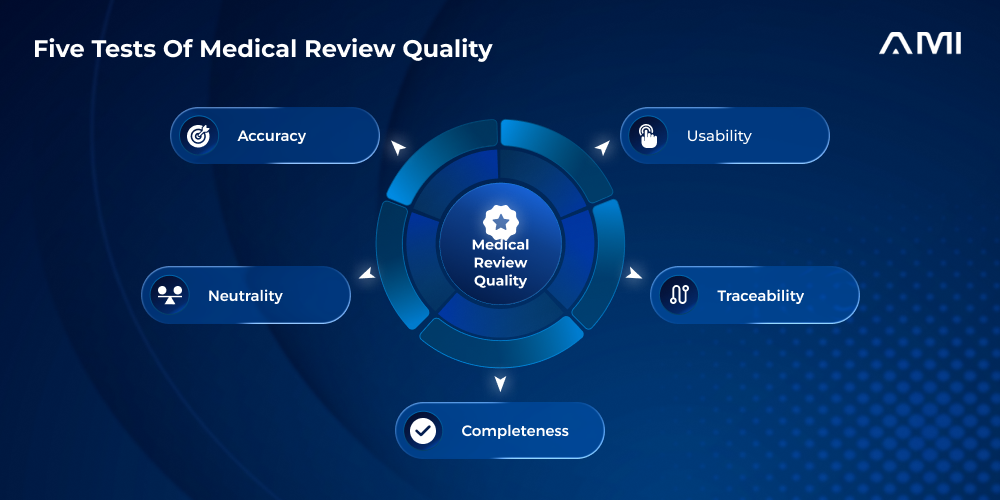
A buyer's quality rubric: the output must be accurate, traceable, complete within scope, neutral, and usable.
Separate AI assistance from accountable human verification
When medical record review companies offer AI-assisted delivery, ask which tasks the system performs and which decisions people verify. Classification, draft summarization, and suggested references are different from determining whether a clinical statement is supported or whether a legal conclusion is appropriate.
NIST identifies confabulation as a generative AI risk, including confidently false content and fabricated citations. That makes fluent wording a poor substitute for evidence. A procurement review should test unsupported statements, ambiguous scans, conflicting dates, and the behavior of the process when no reliable answer exists. NIST's Generative AI Profile is cross-sector guidance, not a certification of a litigation workflow.
Ask who signs off on the deliverable, how uncertain entries reach that person, and what happens when a model or prompt changes. Require an agreed review policy tied to task risk, rather than assuming every AI output is correct or prescribing an identical check for every task. The ABA's Formal Opinion 512 discusses competence, confidentiality, and context-appropriate verification when lawyers use generative AI.
“the lawyer is fully responsible for the work on behalf of the client.”
ABA Standing Committee on Ethics and Professional Responsibility, Formal Opinion 512 (2024), page 4
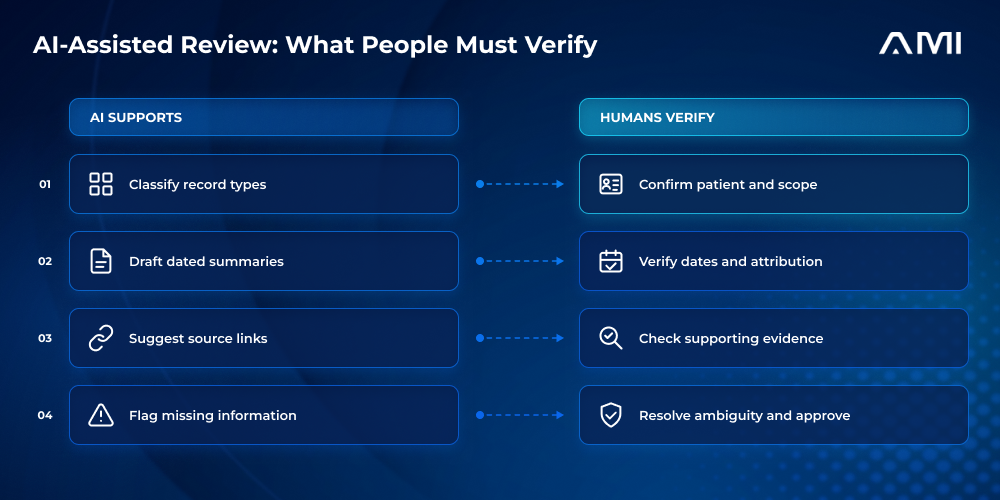
Illustrative task boundaries. Confirm the actual tools, review responsibilities, and escalation rules with each provider.
Define turnaround through accepted, usable delivery
Medical record review turnaround time is only comparable when the clock has a defined start and finish. A promise of five days may start when every file is available, exclude weekends, and end at first delivery. Your team may measure from initial request through an accepted correction. Those are different services.
Track three clocks: time waiting for records or clarification; processing time after the input package is accepted; and time until a corrected, usable deliverable is accepted. Keep provider retrieval delays separate from review processing. Otherwise, a source-record gap can be mistaken for a reviewer productivity issue.
In the service-level agreement, specify business hours, page volumes, scan quality, complexity, rush handling, revision windows, and escalation contacts. State how late-arriving records change scope and whether partially completed packages can be delivered safely. There is no universal deadline in this guide that every medical record review company can meet.
Use the pilot to compare initial delivery and accepted delivery. If one company is faster initially but creates more unresolved questions, the apparent advantage may disappear. Review performance by work type and include delayed matters; averages that omit exceptions hide the cases most likely to disrupt planning.
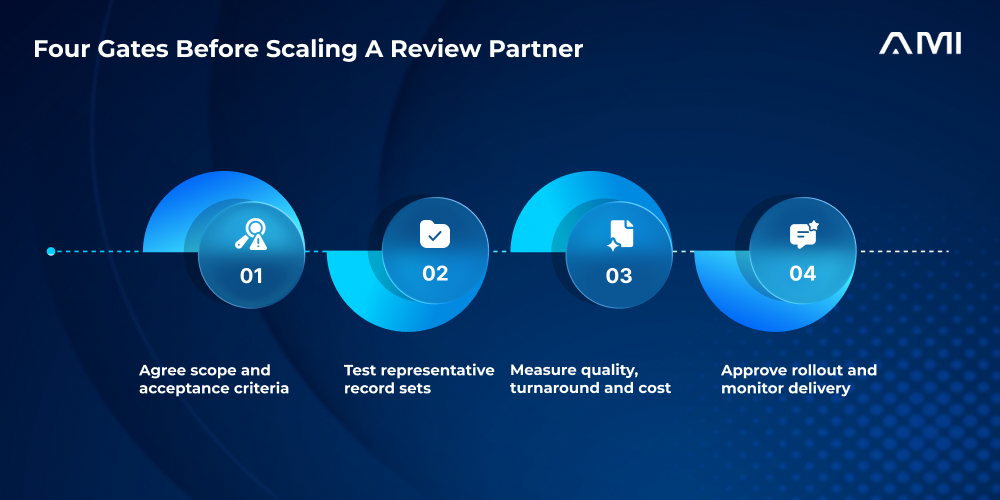
Compare partners through the same four gates before committing a larger volume of work.
Compare total cost after verification and rework
Compare medical record review companies on the cost of an accepted output, not the invoice alone. A low service fee can shift work to paralegals, nurses, or operations managers who must rebuild references, clarify exclusions, and correct the deliverable.
Use this formula: effective review cost = service fee + setup + internal coordination + verification + rework + scope changes + storage and exit costs. Track the internal hours during the pilot. Avoid assuming those hours vanish simply because review has been outsourced.
The example below uses hypothetical prices and an illustrative internal hourly cost. It is not an AM InfoWeb quote, customer result, market average, or ROI promise. Vendor B's quote is $200 higher, but the specified internal work makes its total $100 lower. The three hours released are capacity. Cash savings require avoided spending; productive redeployment creates additional operating value.
For per-page proposals, ask how duplicates, blank pages, attachments, handwritten notes, new records, and amended chronologies are counted. For hourly proposals, ask about minimums and approval limits. For fixed-fee work, require change-control rules. All three models can be reasonable if the scope and residual buyer workload are visible.
Hypothetical comparison for an identical scoped review
| Cost component | Vendor A | Vendor B |
|---|---|---|
| Quoted service fee | $400 | $600 |
| Internal validation and correction | 4 hours × $100 = $400 | 1 hour × $100 = $100 |
| Effective review cost | $800 | $700 |
Request security evidence and map data responsibilities
Before transferring records, identify every organization, tool, and location that can handle the data. Medical record review outsourcing can involve employees, subcontractors, cloud storage, OCR tools, and AI services. A vendor's general security statement does not show which controls apply to your particular workflow.
HIPAA business-associate status depends on the function and relationship involved. Receiving medical records does not automatically make every law firm or vendor a business associate. Determine applicable responsibilities and agreements with counsel using HHS business-associate guidance. Contractual confidentiality and other legal duties also need consideration.
For regulated entities, the HIPAA Security Rule addresses administrative, physical, and technical safeguards for electronic protected health information. Use the HHS Security Rule summary to frame questions about access, audit controls, integrity, authentication, secure transmission, and contingency planning.
Treat a 'HIPAA certified' claim as the beginning of diligence. HHS does not endorse private Security Rule certifications, and a certification does not remove legal obligations. Ask for the assessment scope, date, assessor, findings, and remediation evidence. HHS explains this distinction.
- Who receives access, approves it, reviews logs, and removes access when work ends?
- Which subprocessors and AI tools are permitted, and can records be used for model training?
- What retention, deletion, return, and backup terms apply, including after termination?
- Who reports incidents, within what agreed notification window, and through which contact?
- Can the buyer export source records, summaries, citations, and correction history independently?

Why does record retrieval become difficult to control at scale?
Delays, follow-ups, provider coordination, and documentation gaps can slow down litigation support workflows. AM InfoWeb helps legal and healthcare teams manage record retrieval with structured processes, experienced teams, and clear operational visibility.
Run a representative pilot with written acceptance criteria
A pilot turns a proposal into observable delivery. Give shortlisted medical record review companies equivalent sample inputs, the same output specification, and the same assessment method. Agree the sample size instead of treating a small trial as proof of performance across every future matter.
Include clean digital records, imperfect scans, multiple providers, duplicate pages, missing dates, and ambiguous entries. Choose work that reflects the expected queue, not only the easiest matter. Define an exception route before testing so the provider is rewarded for identifying uncertainty, not guessing through it.
Write down what acceptance means. Useful proposed criteria include reconciliation of the source inventory, traceable material statements, correct identity and attribution, disclosed gaps, workable exports, and delivery within the agreed clock. Set defect-severity definitions, correction deadlines, and numerical thresholds jointly. These are contractual pilot criteria, not universal regulations or industry benchmarks.
The screenshot demonstrates one narrow test with synthetic information: an entry preserves the encounter date, attributes the patient's report, and links to a specific supporting page. It does not infer causation or turn a reported symptom into a diagnosis. A real work sample should also test whether that reference stays usable after export.
Assign acceptance to someone other than the producer of the sample. Log each issue by severity, source, owner, and resolution, then discuss whether it originated in the source record, unclear instructions, or the review process. Those causes require different remedies. A supplier should not silently remove an ambiguous entry to improve its measured defect rate.
- No invented dates, diagnoses, treatment events, findings, or citations.
- No unresolved critical patient-identity or source-attribution errors at acceptance.
- Unreadable text, conflicting records, and missing information remain visibly flagged.
- Corrections have an owner, explanation, source reference, and version history.
- The buyer can open, search, export, and validate the delivered package.
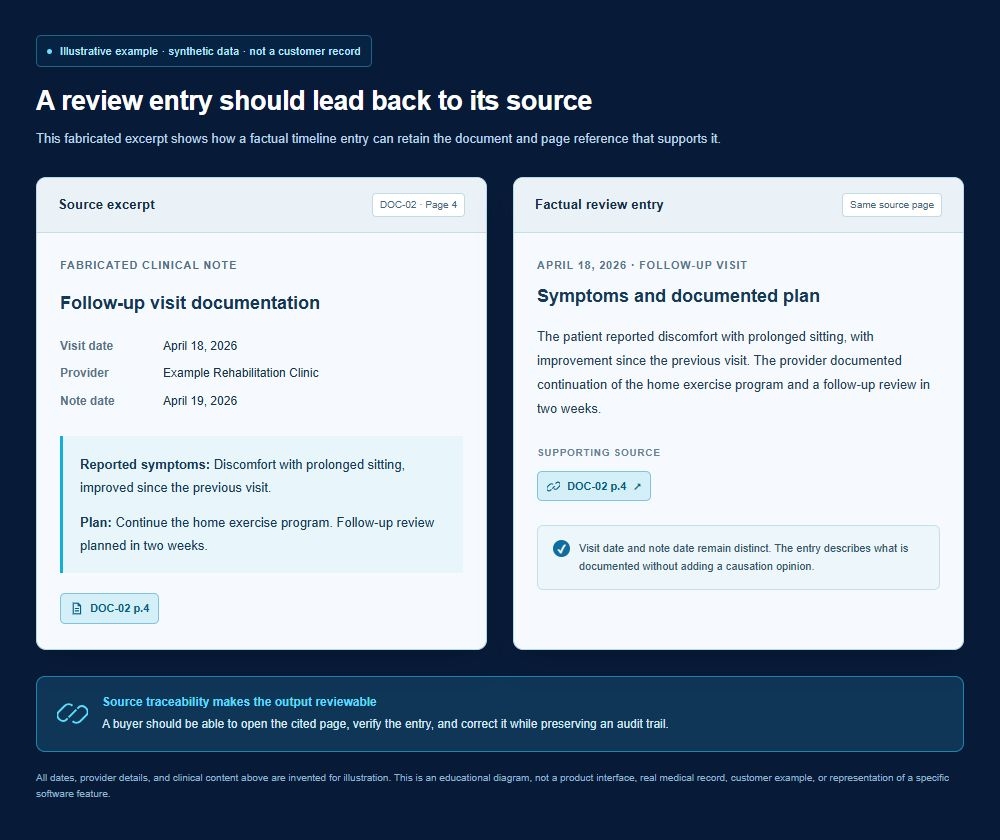
Synthetic working example: verify the date, attribution, and cited page instead of judging a summary by its fluency.
Check capacity and governance before increasing volume
The pilot should finish with a scale decision, not only a satisfaction score. Ask medical record review companies how staffing, training, supervision, and quality sampling change as the queue grows. Capacity is a documented operating plan, not simply a promise to add people.
Agree ownership for intake, exceptions, review, acceptance, and corrections. During transition, retain a baseline sample and compare accepted turnaround, material defect rates, revision volume, and buyer verification hours. If staffing or tools change, decide when requalification is required.
Begin with a controlled queue and increase volume only after reviewing the agreed measures. Confirm backup staffing, an escalation owner, and an exit package before dependencies become difficult to unwind. For legal medical record review, keep clinical questions and legal judgments with the designated qualified professionals. Operational scale should improve throughput without obscuring accountability.
The company-reported example below concerns record retrieval operations, an adjacent workflow. Its value is the operating lesson about flexible trained capacity and continuity; it is not evidence of medical review accuracy or a forecast of your results.
AM InfoWeb case study · company-reported retrieval operations
Maintaining continuity for a national litigation-support provider
AM InfoWeb describes supporting an unnamed U.S. litigation-support provider during pandemic-related workforce disruption and rising demand. The published case discusses trained operational support and flexible capacity. For review buyers, the relevant diligence questions concern onboarding, backup staffing, queue visibility, and continuity. The case does not publish a quantified medical-review accuracy or ROI result, so none is inferred here.
How AM InfoWeb Supports Medical Record Review Operations
AM InfoWeb has two decades of experience in the U.S. healthcare industry and uses a co-managed model that brings AI agents and skilled human agents together to eliminate process bottlenecks and execute secure healthcare workflows. For medical record review operations, the engagement should define approved tasks, human verification, exception ownership, and output requirements.
AM InfoWeb's Record Retrieval & Litigation Support service describes operational support for record-retrieval and release-of-information organizations, including record organization, summaries, hyperlinking, and multi-level quality checks. Buyers can use the scorecard in this guide to discuss the specific workflow and evidence they need.
- Structured intake, request tracking, and provider follow-up coordination.
- Record organization and factual summarization within the agreed scope.
- Source hyperlinking and navigable document handoffs.
- Multi-level quality checks and escalation of exceptions.
- Secure delivery processes and clear operational visibility.
Choose the partner whose work your team can verify
The right choice among medical record review companies is the provider that proves fit against your scope, records, and acceptance criteria. Compare source traceability, qualified oversight, accepted turnaround, total cost, and data controls together. Start with a representative pilot, then scale only when the handoff works.
For a scoped operational discussion, bring sample input types, expected volume, output formats, quality criteria, and deadline assumptions. That creates a practical starting point for evaluating support.
Ready to discuss your record review workflow?
Discuss Review SupportSources and further reading
- ABA Formal Opinion 08-451: Outsourcing Legal and Nonlegal Support Services (2008)
- Zozus et al.: Training to Decrease Medical Record Abstraction Errors (2019)
- ABA Formal Opinion 512: Generative Artificial Intelligence Tools (2024)
- NIST AI 600-1: Generative Artificial Intelligence Profile (2024)
- HHS: Business Associates
- HHS: Summary of the HIPAA Security Rule
- HHS: Security Rule Certification FAQ
- Federal Rules of Evidence (effective December 1, 2024)
- AM InfoWeb: Record Retrieval & Litigation Support capabilities
- AM InfoWeb: Scaling Record Retrieval Operations case study
Frequently Asked Questions
About the Author

Written by
Urza Dey
Urza Dey is a content and copywriter with over five years of experience across marketing, B2B SaaS, HealthTech, EdTech, and related industries. At AMI, they contribute to content strategy, blog development, and marketing communication focused on healthcare operations, business process management, and AI-enabled service delivery.
Related Posts
Medical Record Indexing: Organize Complex Files for Faster Review
Organize complex medical files through consistent indexing, traceability, and quality controls.

Medical Chronology Template: What a Litigation-Ready Timeline Should Include
Build litigation-ready medical chronologies with traceable events, citations, and quality controls.