
Medical Record Retrieval Process Management: Comparing Operational Support Partners
Key Highlights
This guide compares operational support partners for U.S. retrieval companies, not direct retrieval vendors for law firms.
AM InfoWeb, Amalga Group, 1Point1, and eNoah document relevant retrieval-support capabilities.
GeBBS and Firstsource offer adjacent payer-focused capabilities that require separate fit assessment.
Evaluate ownership, accepted output, stage-level turnaround, security, and total operating cost.
A co-managed model should preserve your client relationships, systems, and decision rights.
AI should address specific workflow problems, with approved data use and accountable human oversight.
Winning a large account can expose weaknesses in a medical record retrieval operation faster than it creates additional capacity.
New orders arrive. Provider follow-ups accumulate. Authorization corrections wait for review. Received records sit in an indexing queue. Experienced supervisors spend their day resolving exceptions instead of managing performance.
Adding people may relieve one queue while moving the bottleneck somewhere else.
For COOs, process leaders, and CXOs considering medical record retrieval outsourcing, the more useful question is: Which partner can manage the agreed work reliably without weakening control over clients, information, and service quality?
This comparison is for U.S. medical record retrieval and Release of Information companies evaluating process management partners, co-managed delivery, and optional customized AI. It is not a list of companies that attorneys should hire to obtain records for individual cases.
What Are You Actually Buying?
A direct retrieval vendor accepts an order from a law firm, insurer, or another requesting organization and manages delivery.
An operational support partner works behind the retrieval company. Depending on the agreement, that partner may support intake, facility research, request preparation, provider communication, fee processing, record receipt, indexing, and quality checks.
Your company retains the customer relationship. The partner performs defined work within an agreed operating structure.
Three arrangements deserve different evaluations:
- Capacity support: Additional trained people execute tasks under your management.
- Managed workflow support: The partner owns specified queues, supervision, quality checks, and reporting.
- Co-managed process delivery: Both organizations share operational responsibilities, with explicit decision rights and escalation boundaries.
Neither is automatically superior. Problems arise when a buyer expects managed outcomes but contracts only for staffing, or expects retained control without defining who approves exceptions.
Before comparing medical records outsourcing companies, decide which arrangement your operation needs.
How This Comparison Was Developed
This is an AM InfoWeb-authored buyer guide, not an independent ranking.
Providers were selected using official descriptions of retrieval-related workflows and buyer groups, reviewed on October 12, 2026. Published capabilities establish a starting point for diligence, not proof of a particular contract’s performance.
The providers fall into two groups:
| Provider | Documented positioning | What to establish before selection |
|---|---|---|
| AM InfoWeb | Process support for retrieval and litigation-support companies | Responsibilities retained by your team and scope of customized delivery |
| Amalga Group | Dedicated operational teams for records-retrieval companies | Coverage, supervision, escalation, and platform access |
| 1Point1 | Retrieval back-office support and downstream summarization | Boundaries between retrieval processing, external waiting, and summarization |
| eNoah iSolution | Medical-record and APS retrieval workflows | Fit between insurance-oriented experience and your request types |
| GeBBS Healthcare Solutions | Payer-focused chart acquisition | Whether its delivery model supports an independent retrieval company |
| Firstsource healthcare | Record retrieval within risk-adjustment support | Whether a standalone retrieval-operations engagement is available |
The distinction matters. A provider can have substantial healthcare experience without offering the particular operating relationship your company requires.
Four Retrieval-Workflow Partners to Evaluate
AM InfoWeb: client-aligned process management
AM InfoWeb brings 18 years of experience in U.S. healthcare, supporting multiple medical record retrieval clients under one roof. That experience informs its approach to the provider follow-ups, authorization exceptions, and coordination challenges that can slow your retrieval operations.
Its record retrieval and litigation-support services cover facility research, order entry, request preparation, provider follow-ups, payment coordination, and record organization. Teams work within your proprietary or third-party retrieval systems, keeping your established platform central to delivery.
Through a co-managed model, AM InfoWeb supports agreed operational responsibilities while you retain your customer relationships and decision rights. AM InfoWeb defines queue ownership, quality expectations, approval boundaries, and escalation procedures around your workflows, giving your team clear visibility into how work progresses.
If your operation needs AI-supported processes, AM InfoWeb can design and customize them around specific workflow challenges and approved use cases. The focus remains on practical operational improvements, supported by skilled human oversight and clear accountability.
Case study: scaling retrieval operations for a national provider
A national U.S. litigation-support provider faced workforce disruption while record retrieval demand continued to grow. It needed additional capacity to keep requests moving and maintain dependable delivery.
AM InfoWeb integrated experienced retrieval professionals into the client’s existing workflows, working alongside internal teams and scaling support as volumes increased. The engagement helped maintain operational continuity, strengthen coordination, and support consistent throughput during workload fluctuations. Read the full case study.
If your team faces similar capacity pressures, this example illustrates how an embedded operating relationship can support growth while keeping established workflows central to delivery.
Amalga Group: dedicated nearshore retrieval-company support
Amalga Group explicitly markets to records-retrieval companies. Its published offering spans order entry through production, provider and custodian communication, indexing, quality checks, and communication with the retrieval company’s law-firm or insurer clients.
It describes dedicated nearshore teams working within client portals, formats, and service-level rules, with U.S.-hours coverage.
This makes it a relevant candidate when operational alignment and nearshore coverage are important selection factors.
Ask how management responsibilities are divided between your supervisors and its team leaders. Confirm coverage during peak demand, access controls, training ownership, and the escalation path for unresolved provider issues. Obtain contractual evidence for required security controls rather than relying on website badges.
1Point1: retrieval back-office workflows and downstream AI
1Point1 publishes a medical record retrieval support offering whose FAQ expressly addresses retrieval-company buyers. Its scope includes back-office processing, record organization, chronologies, billing summaries, and quality checks.
Its separate Clariva offering describes AI-assisted record processing followed by medical-professional verification and source-linked summaries. That is evidence of downstream summarization capabilities, not evidence that AI autonomously manages authorizations or provider outreach.
Consider it where retrieval processing and subsequent document preparation both need attention.
Ask whether these services share a delivery team, quality framework, and commercial agreement. Separate the retrieval SLA from the summarization SLA, and establish which outputs require professional review before release.
eNoah iSolution: APS and insurance-oriented retrieval operations
eNoah iSolution documents patient-detail validation, authorization matching, facility verification, fee and payment coordination, follow-up, updates in client applications, and record-quality checks.
Its published testimonials also identify medical-record-company and U.S. APS retrieval-company engagements. APS, or Attending Physician Statement, retrieval is particularly relevant to insurance and underwriting workflows.
Consider eNoah when that operating experience aligns with your request portfolio.
For litigation-heavy work, verify experience with your authorization requirements, document packages, custodian types, and exception procedures. Confirm whether delivery uses your platform or a provider-owned tool, and what data movement that arrangement requires.
Two Adjacent Healthcare Providers Worth Investigating
GeBBS Healthcare Solutions: payer chart acquisition
GeBBS describes payer-focused chart acquisition using customizable, white-labeled resources and an integrated platform. Its published scope includes multiple retrieval methods, provider and field resources, tracking, and operational visibility.
These capabilities may be relevant to complex chart-acquisition requirements. However, the public page does not establish the same independent retrieval-company buyer relationship documented by the specialist peers above.
Ask whether GeBBS supports your business model, volumes, retained client relationships, and preferred systems before treating it as a direct alternative.
Firstsource healthcare: retrieval within risk-adjustment operations
Firstsource includes medical record retrieval in a broader risk-adjustment support offering covering prospective and retrospective activities, coding, submissions, reporting, and audit support.
It is an adjacent option when record acquisition is connected to health-plan operations.
For a retrieval-company engagement, confirm whether the required process can be contracted independently. Do not assume that technology described for coding also applies to retrieval orchestration, or that a payer delivery model automatically fits litigation-support workflows.
What Separates a Suitable Partner From Available Staffing?
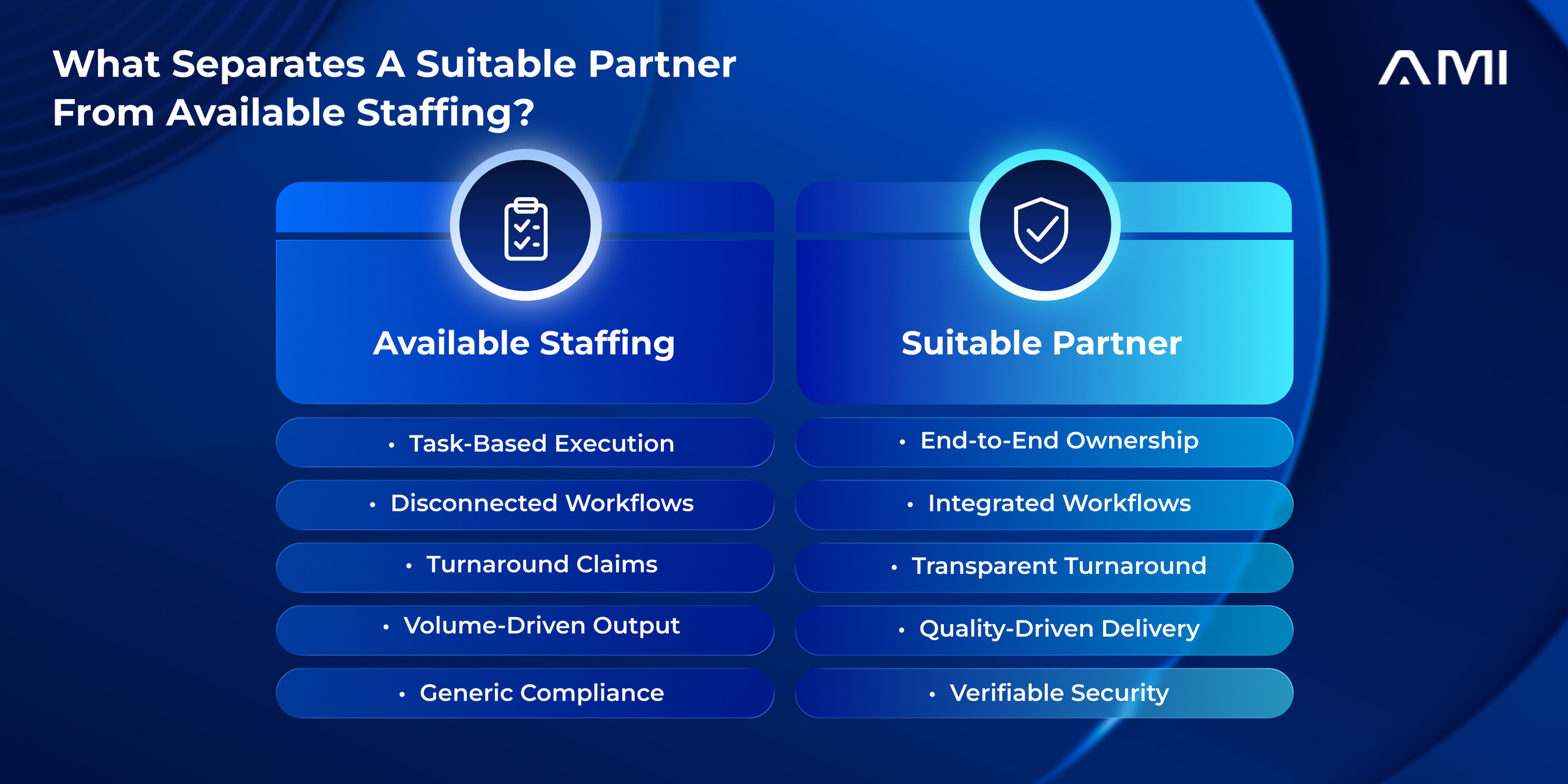
1. Define ownership at every request stage
Start with a real request, not a capabilities presentation.
Walk through its movement from intake to accepted delivery. At each stage, establish who performs the work, who approves exceptions, and what evidence demonstrates completion.
For example, request preparation is not complete merely because a packet was generated. It may require confirmation that patient identifiers, facility details, requested dates, authorization, and delivery instructions match the order.
Similarly, follow-up is not complete because someone made a call. The interaction should produce a documented result and a next action.
Specify ownership for:
- Rejected or incomplete authorizations.
- Provider contact corrections.
- Fee approvals and payment holds.
- Partial records and missing date ranges.
- Unreadable files or patient mismatches.
- Escalations requiring client instructions.
A responsibility matrix is useful only if it handles these exceptions, not just routine tasks.
2. Test compatibility with your operating system
A process partner should not create a second, conflicting version of request status.
If work occurs in another platform, determine how updates return to your system, how quickly they appear, and who resolves synchronization failures. If work occurs directly in your platform, establish individual access, permissions, logging, and approved procedures.
During a demonstration, ask the provider to show:
- An ordinary request moving through the workflow.
- A request rejected by a custodian.
- A partially fulfilled request requiring further action.
- A supervisor reviewing overdue work.
These demonstrations reveal more than a screenshot of a polished dashboard.
Also establish ownership of procedures, provider directories, templates, operational data, and improvements developed during the engagement. Your exit plan should not depend on information that only the partner can access.
3. Compare turnaround claims using identical clocks
Turnaround is often the least comparable number in a vendor presentation.
Does measurement start when the order arrives, when authorization becomes valid, or when the custodian accepts the request? Does it stop at receipt, processing completion, or accepted delivery?
1Point1 provides a useful example: its back-office page displays a 48-hour turnaround claim, while the FAQ specifies 48 hours per processing stage, with overall timing dependent on provider response. It should not be interpreted as a universal 48-hour completed retrieval promise.
Separate three clocks:
- Internal processing time: Work under the delivery team’s control.
- External waiting time: Time awaiting a custodian, payment, or another dependency.
- Total request age: Time from the agreed starting event to accepted completion.
A partner may reduce internal delays without controlling provider response. Reporting should show that distinction while still assigning ownership for follow-up and escalation.
4. Define accepted output before discussing productivity
A processed request is not necessarily a usable request.
Agree on acceptance criteria for patient identity, requested facilities, date ranges, document types, readability, indexing, and recorded exceptions.
Some custodians will return incomplete material. Your acceptance rules should distinguish a documented external limitation from an internal quality failure.
Without this distinction, a provider can improve apparent productivity by closing difficult requests prematurely or transferring correction work to your employees.
The key question is: How much work reaches an agreed acceptance standard without avoidable rework?
5. Request security evidence and map data responsibilities
Security diligence should examine the actual delivery arrangement.
Identify staff access locations, storage locations, subprocessors, download permissions, authentication requirements, incident responsibilities, retention, and deletion procedures. Ask how access changes when staff leave or move between accounts.
Where a HIPAA business-associate relationship applies, determine the relevant contractual responsibilities, including applicable subcontractor arrangements. HHS guidance explains these relationships; their applicability depends on the parties and functions involved.
Have legal and security teams assess the specific workflow. A generic compliance statement is not a substitute for reviewing contractual obligations and supporting evidence.
Where Should AI Fit in a Co-Managed Model?
AI should enter the discussion through a workflow problem, not a requirement to automate everything.
Potential use cases to evaluate include classifying incoming documents, flagging missing information, drafting status notes, prioritizing queues, and preparing source-linked summaries. These are candidates for assessment, not assumptions about any provider’s deployed capabilities.
For each proposed use case, ask:
- What information enters the model?
- Which tools and subprocessors receive it?
- Is training use permitted or prohibited?
- What output requires human verification?
- Which actions remain outside automated authority?
- How are mistakes detected, corrected, and logged?
A co-managed model should identify the accountable human owner, including when an AI-generated recommendation is accepted.
NIST’s voluntary AI Risk Management Framework provides a reference for incorporating trustworthiness into AI design, use, and evaluation. It does not certify a retrieval workflow or replace client-specific controls.
A buyer should be able to adopt process support without being forced into an unsuitable AI deployment. Equally, a useful approved tool should be assessed on measurable results rather than its presence in a sales presentation.
Build a Scorecard Around Accepted Work
The following measures provide a practical starting point. Targets should reflect your baseline, request mix, and contractual responsibilities.
| Measure | Suggested definition | What it helps reveal |
|---|---|---|
| First-pass acceptance | Outputs accepted without avoidable correction ÷ outputs reviewed | Whether quality is improving or shifting downstream |
| Stage aging | Time requests remain in each defined status | Where bottlenecks form |
| Follow-up adherence | Eligible follow-ups completed within the agreed interval | Whether pending work receives consistent attention |
| Reopen rate | Completed requests reopened for preventable processing defects | Whether closure reflects usable delivery |
| Documentation quality | Sampled updates meeting required evidence and next-action standards | Whether status visibility is dependable |
| Accepted output per paid hour | Accepted units ÷ relevant paid delivery hours | Productivity adjusted for quality |
| Escalation aging | Time unresolved exceptions wait for the assigned decision-maker | Whether governance keeps work moving |
Define the unit carefully. A case containing requests to five providers should not be compared with a single-provider request as though both require the same effort.
Review medians and aging distributions, not just averages. Separate routine work from complex exceptions and newly transitioned work from established delivery.
Numbers should support investigation. They should not encourage teams to make the dashboard look better by changing status labels or excluding difficult requests.
Compare Total Operating Cost, Not the Quoted Rate
Medical record retrieval outsourcing can look inexpensive until the buyer includes the work that remains internally.
A useful comparison is:
Cost per accepted unit = delivery fees, retained internal labor, relevant technology costs, transition costs, and correction costs divided by accepted completed units.
Use the same unit and period for every proposal. Keep custodian fees and other pass-through expenses separately identifiable.
Clarify whether pricing is based on:
- Dedicated personnel.
- Paid hours.
- Requests or completed units.
- Pages processed.
- A combination of minimum commitments and variable charges.
Then ask how partial requests, cancellations, reopened work, overtime, and scope changes are charged.
Include your supervisors’ time, training effort, quality review, reporting reconciliation, and exit support. A lower hourly rate may not produce a lower accepted-unit cost if your managers must continually repair the workflow.
Commercial terms are proposal-specific. This comparison does not establish standardized or equivalent prices for the providers listed.

Why does record retrieval become difficult to control at scale?
Delays, follow-ups, provider coordination, and documentation gaps can slow down litigation support workflows. AM InfoWeb helps legal and healthcare teams manage record retrieval with structured processes, experienced teams, and clear operational visibility.
Run a Pilot That Can Expose Operational Weaknesses
A pilot should resemble the work you expect the partner to perform.
Do not select only clean requests with complete authorizations and responsive custodians. Include ordinary exceptions, multiple-provider cases, fee holds, partial returns, and older pending requests where appropriate.
An effective pilot has four components.
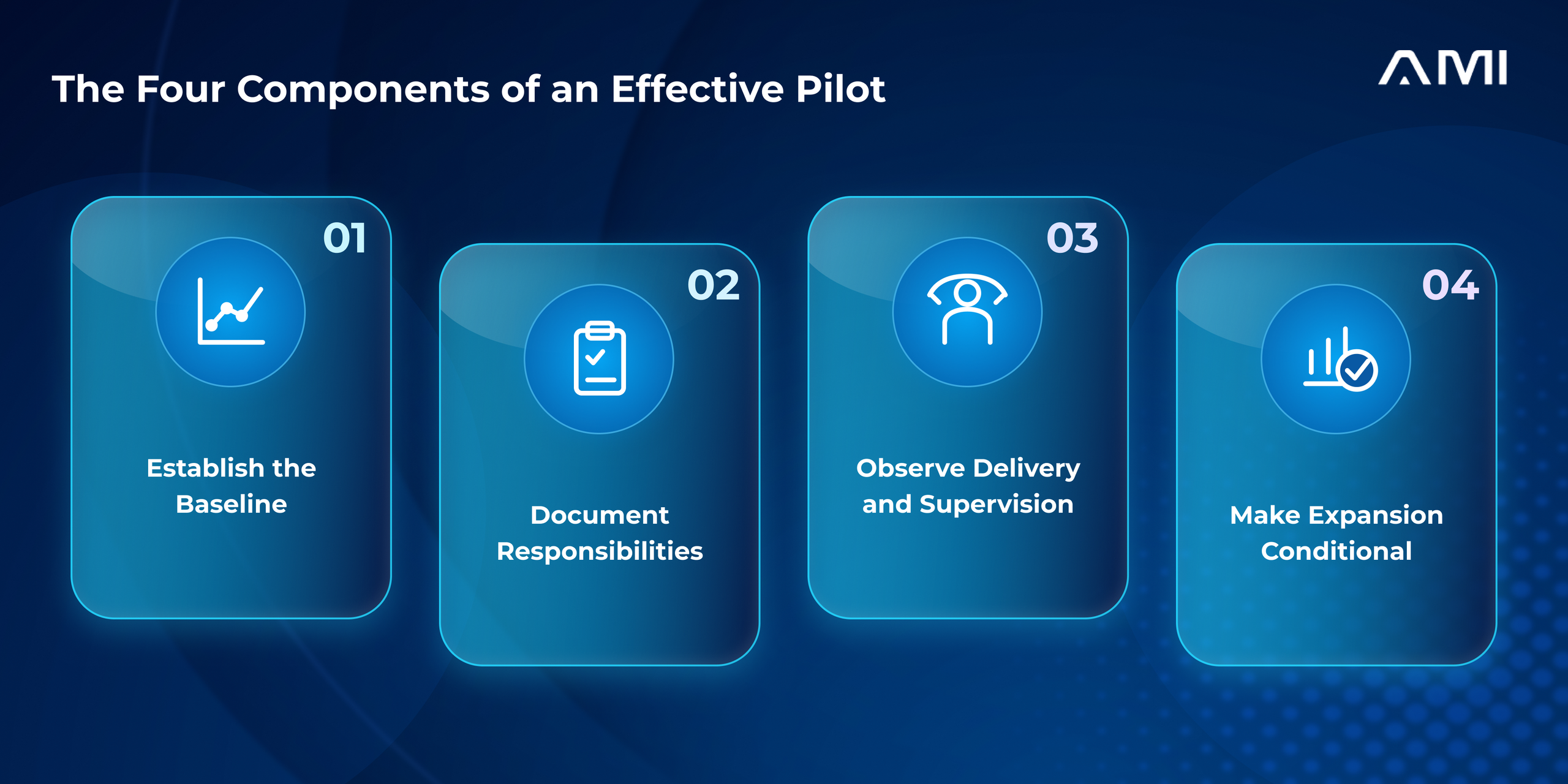
1. Establish the baseline
Record current stage aging, quality, rework, internal management effort, and accepted output. Note differences in request complexity so changes can be interpreted fairly.
2. Document responsibilities
Agree on procedures, access, acceptance rules, escalation authority, and follow-up intervals before live work begins.
Identify which tasks the partner cannot perform without approval. Set boundaries for client communication, spending, sensitive data handling, and any AI use.
3. Observe delivery and supervision
Review request-level evidence, not just weekly totals.
Look for accurate updates, appropriate escalation, consistent handling of exceptions, and supervisors who can explain why queues are aging. Track the assistance your internal team still provides.
4. Make expansion conditional
Define the conditions for increasing volume: stable quality, dependable reporting, manageable retained workload, and demonstrated supervision.
If those conditions are not met, investigate before expanding. More capacity does not repair unclear ownership.
The pilot should also test continuity. Ask how trained backup personnel become available and how work transfers without losing request history.
What an Embedded Operating Relationship Can Look Like
AM InfoWeb’s published case study describes supporting an unnamed national litigation-support provider facing staffing constraints and increased demand. The company reports supplying trained retrieval personnel within the client’s established workflows and supporting capacity expansion and continuity.
This is company-reported evidence, not an independently verified benchmark. The case does not provide sufficient quantified results to predict another buyer’s savings or turnaround improvement. AM InfoWeb’s published case study
The practical lesson is that integration matters alongside staffing. A buyer should investigate how knowledge transfer, procedures, supervision, and operational access worked, not simply how many people were added.
How AM InfoWeb Supports Retrieval Operations
AM InfoWeb brings nearly two decades of experience in U.S. healthcare and uses a co-managed model combining AI agents and skilled human agents to address process bottlenecks and execute secure healthcare workflows. AI-supported processes can be designed and customized for clients that choose them. AM InfoWeb’s operating-model evolution
Its retrieval-support scope includes:
- Facility research and order-entry support.
- Request preparation and provider follow-ups.
- Status documentation within client workflows.
- Payment-related coordination and record organization.
- Training and operational transition support.
The engagement should define the work AM InfoWeb manages and the approvals, relationships, and decisions your organization retains. Record retrieval process support
Conclusion: Choose an Operating Relationship You Can Verify
The best-fit partner is not necessarily the largest company, the lowest-priced proposal, or the provider making the strongest automation claim.
It is the partner whose documented experience matches your request portfolio, whose responsibilities fit your operating model, and whose performance you can verify through accepted output.
Build the shortlist around buyer fit. Compare identical definitions of quality and turnaround. Examine retained cost, security responsibilities, and exception handling. Then use a representative pilot to determine whether the proposed relationship works in your environment.
Ready to evaluate co-managed support for your retrieval operations? Discuss workflow ownership, capacity needs, quality expectations, and governance with AM InfoWeb.
Discuss Your Retrieval OperationsFrequently Asked Questions
About the Author
Written by
Urza Dey
Urza Dey is a content and copywriter with over five years of experience across marketing, B2B SaaS, HealthTech, EdTech, and related industries. At AMI, they contribute to content strategy, blog development, and marketing communication focused on healthcare operations, business process management, and AI-enabled service delivery.