


Outsourcing Metrics: Better Healthcare Scorecards for Quality and Speed
TL;DR: outsourcing performance metrics
Use a balanced scorecard instead of one volume target.
Define every KPI, data source, owner, and review cadence.
Pair speed and productivity with quality and downstream outcomes.
Governance metrics should reveal risk, drift, and corrective action.
Outsourcing performance metrics turn a service agreement into an operating system. They show whether work is accurate, timely, productive, controlled, and economically useful. A single service-level percentage cannot explain all five dimensions.
Healthcare buyers need a scorecard that discourages local optimization. Faster handling is not a gain when rework, repeat contacts, denials, complaints, or compliance exposure rise elsewhere.
Explore how AM InfoWeb supports healthcare operations with a co-managed delivery model.
What Are Outsourcing Performance Metrics?
Outsourcing performance metrics are defined measures used to evaluate the delivery, outcomes, controls, and value of work performed by an external partner. They should connect day-to-day execution to the buyer’s operational and governance priorities.
Each measure needs a formula, source, owner, reporting frequency, target, tolerance, and action when performance moves outside the expected range. Without those definitions, the same number can support different interpretations.
Which Quality Metrics Belong in the Scorecard?
Track first-pass quality, error severity, rework, audit findings, documentation completeness, repeat contact, and downstream corrections. Separate critical errors from minor defects so a high average score does not hide a serious control failure.
Quality samples should represent routine work, exceptions, teams, shifts, and channels. The review method also needs calibration so the buyer and partner interpret standards consistently.
How Should Turnaround and Productivity Be Measured?
Turnaround should follow work from receipt to a completed outcome, with queue aging by stage and priority. Productivity should count usable completed work, not touches, logins, or partially processed items.
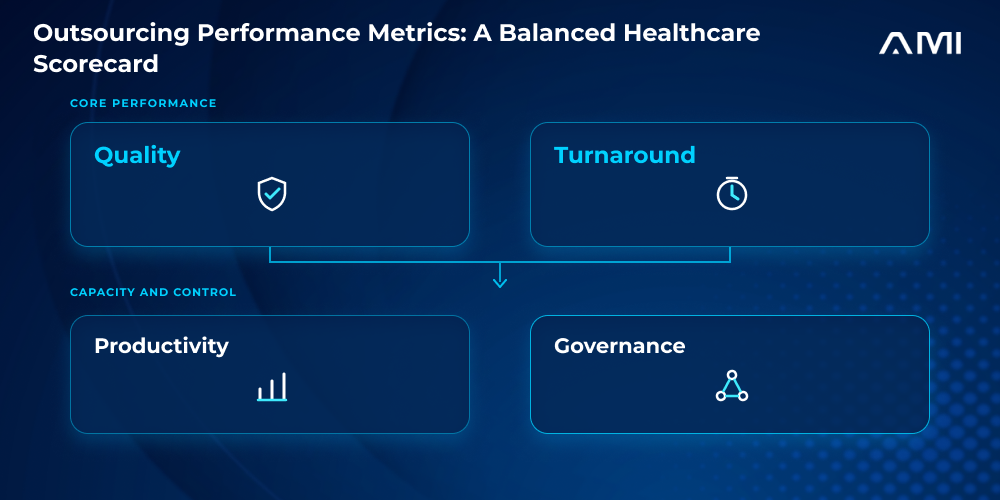
| Scorecard domain | Core measures | Balancing measures |
|---|---|---|
| Quality | First-pass quality, rework, error severity | Downstream corrections and complaints |
| Turnaround | End-to-end completion, queue aging | Abandonment and overdue exceptions |
| Productivity | Completed outcomes per paid hour | Accuracy and repeat work |
| Governance | Risk closure, audit actions, reporting timeliness | Recurring issues and control drift |
Which Economic Measures Show Real Value?
Measure cost per completed outcome, management overhead, overtime, backlog cost, avoided rework, and the capacity returned to internal specialists. A low unit price can still be expensive when the buyer must correct errors or manage frequent escalations.
Compare economics against the baseline and the agreed scope. Volume changes, process redesign, automation, and policy shifts can affect cost independently of vendor performance.
Explore related capabilities across AM InfoWeb's healthcare services.
How Do Governance and Compliance Metrics Fit?
Track access reviews, training completion, audit evidence, incident response, corrective-action aging, recurring root causes, reporting timeliness, and unresolved risks. These measures show whether controls remain effective after implementation.
CMS describes QAPI as a data-driven approach that brings quality assurance and performance improvement together. The principle is useful beyond regulated care settings: governance should use evidence to improve systems, not only grade individual transactions.
Primary source: CMS QAPI definition.
How Should Healthcare Leaders Review the Scorecard?
Use operating reviews for detailed queues, defects, staffing, and corrective actions. Use executive reviews for trends, material risks, economics, capacity, and decisions that require cross-functional ownership.
Avoid changing definitions silently. When scope or demand changes, document the reason, effective date, baseline adjustment, and expected impact. The scorecard should preserve a traceable story of performance.

Why do outsourcing scorecards miss the real operational story?
Volume and speed can look strong while rework, risk, or downstream effort increases. AM InfoWeb helps healthcare teams connect quality, turnaround, productivity, economics, and governance in one operating view.
How AM InfoWeb Supports Outsourcing Performance Management
AM InfoWeb has two decades of experience in the U.S. healthcare industry and uses a co-managed model where AI agents and skilled human agents work together to eliminate process bottlenecks and execute secure healthcare workflows.
AM InfoWeb can support:
- Balanced scorecard design across quality, turnaround, productivity, and governance
- Clear KPI definitions, data sources, targets, and escalation thresholds
- Quality sampling, calibration, root-cause review, and corrective-action tracking
- Operational and executive reporting aligned to healthcare workflow outcomes
Healthcare organizations retain responsibility for their own clinical, legal, privacy, policy, and final operational decisions.
What Makes an Outsourcing Scorecard Useful?
A useful scorecard makes tradeoffs visible and decisions actionable. It measures completed outcomes rather than activity, pairs efficiency with quality, and gives every exception an owner. The result is a shared management tool, not a monthly collection of disconnected numbers.
Need a more balanced outsourcing scorecard? AM InfoWeb can help define measures, reporting, reviews, and corrective actions.
Get in TouchFrequently Asked Questions
About the Author

Written by
Urza Dey
Urza Dey is a content and copywriter with over five years of experience across marketing, B2B SaaS, HealthTech, EdTech, and related industries. At AMI, they contribute to content strategy, blog development, and marketing communication focused on healthcare operations, business process management, and AI-enabled service delivery.
Related Posts

Medical Billing Outsourcing: Control, Cost, and Revenue Performance
Medical billing outsourcing can reduce operational friction without sacrificing control...
Healthcare Contact Center Automation: 9 Workflows With Human Oversight
Automation can reduce friction, improve consistency, and support faster service, but it should not replace trained...