


Medical Record Redaction: Protect PHI During Litigation Document Production
TL;DR: Medical Record Redaction
Medical record redaction removes selected information while preserving authorized evidence.
Counsel defines the legal scope; operational teams apply and document it consistently.
Redaction must cover structured fields, free text, images, metadata, and duplicate versions.
Visual overlays are insufficient unless the underlying content is permanently removed.
Human review remains essential for ambiguous context, privilege, and case-specific exceptions.
Production QA verifies completeness, permanence, legibility, pagination, and release authorization.
Medical record redaction removes or obscures information that should not appear in a particular legal production while preserving the evidence authorized for review. The work can involve protected health information, personal identifiers, unrelated patient information, privileged material, confidential data, and information restricted by a court order or governing rule.
Redaction is not the same as deleting pages or covering text visually. Legal teams need a controlled process that applies the correct scope, makes redactions irreversible, preserves document structure, and creates an audit trail showing what was reviewed.
This guide explains how medical records should be prepared, redacted, validated, and produced without making the remaining evidence difficult to use.
Need reliable support for complex healthcare-record workflows? Explore AM InfoWeb’s healthcare services.
What Is Medical Record Redaction?
Medical record redaction is the controlled removal or masking of selected information from records before disclosure, filing, exchange, or review. The applicable scope depends on the purpose of the production, legal authority, authorization, protective order, jurisdiction, and instructions from counsel.
Redaction may address names, addresses, dates of birth, Social Security numbers, medical record numbers, insurance identifiers, account numbers, contact information, images, signatures, or information about people who are not part of the matter. The required treatment is context-specific.
HHS explains that PHI can appear in structured fields and free text, and that identifiers must be addressed wherever they occur when applying the HIPAA de-identification standard. The agency’s de-identification guidance describes Safe Harbor and Expert Determination. Litigation redaction is not automatically equivalent to HIPAA de-identification, so teams must apply the authority governing the specific production.
When Do Legal Teams Redact Medical Records?
Redaction may be required before records are filed publicly, shared with experts, produced to another party, used in a deposition exhibit, included in a demand package, or transferred to a vendor. The reason may be privacy, privilege, confidentiality, relevance, court rules, or a protective order.
Counsel should define what must be redacted and what must remain visible. Operational teams should not invent legal scope or apply a generic identifier list without case-specific instructions.
Medical record redaction often follows medical record retrieval, organization, deduplication, and production reconciliation. Starting before the source set is stable can create inconsistent versions and missed pages.
What Information May Require Redaction?
| Information Type | Examples | Review Consideration |
|---|---|---|
| Direct identifiers | Names, addresses, telephone numbers, email addresses | Confirm whose identifiers are within scope |
| Record identifiers | Medical record, account, policy, or beneficiary numbers | Search headers, footers, labels, and embedded images |
| Financial identifiers | Payment-card, bank, or Social Security numbers | Apply heightened verification |
| Unrelated patient data | Wrong-chart pages or multi-patient reports | Escalate possible comingled records |
| Privileged content | Attorney communications or protected work product | Route decisions to counsel |
| Sensitive clinical details | Information restricted by authority or order | Follow case-specific written instructions |
This table is operational, not legal advice. The correct redaction scope must come from applicable authority and counsel.
Why Do Medical Record Redactions Fail?
Common failures include:
- Black boxes that can be removed or copied around
- Identifiers remaining in headers, footers, metadata, or images
- Search terms that miss spelling variations and handwritten content
- Over-redaction that removes material clinical context
- Under-redaction caused by unclear instructions
- Inconsistent treatment across duplicate or revised pages
- Redacting one file while producing another version
- Missing quality review after optical character recognition
- No record of reviewer decisions or exceptions
Redaction tools can accelerate detection, but visual verification remains essential. Scans, handwriting, stamps, labels, unusual layouts, and poor image quality can defeat automated recognition.
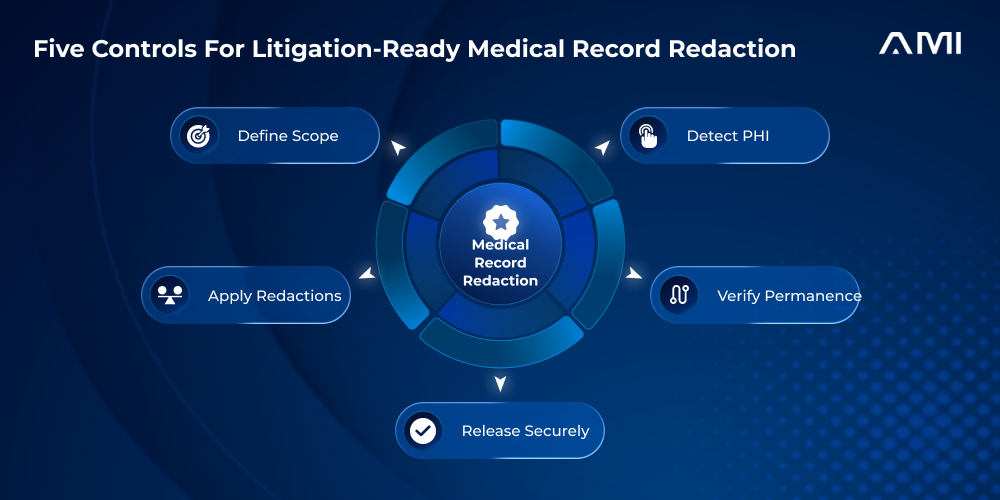
How Should a Medical Redaction Workflow Be Structured?
A controlled workflow should begin with a defined source set and written redaction protocol. Records are inventoried, normalized, reviewed for scope, processed, quality-checked, and exported as a separate production copy.
Teams should preserve the unredacted source with restricted access. Redacted outputs need clear version names, stable page order, and a link to the matter, custodian, provider, date range, and production request.
Exceptions should be routed to counsel or another authorized decision-maker. Operational staff can identify ambiguous content, but they should not decide privilege or legal relevance without authority.
How Can Teams Preserve Evidence Usability After Redaction?
The remaining document should still support efficient legal review. Page numbers, Bates ranges, dates of service, provider names, document types, and clinically relevant content should remain readable when authorized.
Over-redaction can break a chronology, obscure who performed treatment, or make citations impossible to verify. Under-redaction can expose protected or irrelevant information. A defined protocol balances both risks.
Consistent medical record indexing helps reviewers trace redacted pages to providers, dates, document types, and production ranges without exposing restricted content in the index itself.
What Quality Checks Should Follow Medical Record Redaction?
Quality assurance should verify:
- Every page in the approved source set was processed
- Required identifiers are masked wherever they appear
- Redactions are permanent in the delivered file
- Hidden text, annotations, layers, and metadata are addressed
- Authorized content remains readable
- Page order and Bates references remain stable
- Duplicate versions receive consistent treatment
- Exceptions and counsel decisions are documented
- The final production matches the approved file set
High-risk pages can receive a second independent review. Sampling may be appropriate for lower-risk, repeatable content, but the method should reflect the consequence of disclosure.
How Can AI Assist Without Controlling Redaction Decisions?
AI can identify candidate names, numbers, addresses, dates, and other patterns across large record sets. It can prioritize pages, group recurring identifiers, and flag likely inconsistencies.
AI should not independently define legal scope or approve the final production. Skilled reviewers must validate context, images, handwriting, ambiguous terms, and case-specific instructions. Exceptions need human escalation and documented resolution.
The most reliable model combines automation for scale with accountable human review for judgment and quality.
Need structured retrieval, organization, and production support? Explore AM InfoWeb’s Record Retrieval & Litigation Support services.
Which Metrics Improve Redaction Performance?
Useful measures include pages processed, turnaround time, exception rate, second-review defect rate, inconsistent duplicate rate, rework volume, missed-identifier rate, over-redaction findings, and delivery accuracy.
Metrics should be segmented by record source, document type, scan quality, reviewer, and defect category. This distinguishes isolated errors from recurring problems in OCR, protocols, training, or source preparation.
Findings can also improve certified medical record preparation and future retrieval instructions.

Why does record retrieval become difficult to control at scale?
Delays, follow-ups, provider coordination, and documentation gaps can slow down litigation support workflows. AM InfoWeb helps legal and healthcare teams manage record retrieval with structured processes, experienced teams, and clear operational visibility.
How Does AM InfoWeb Support Medical Record Redaction?
AM InfoWeb supports legal and healthcare teams with structured record retrieval and litigation-support workflows.
With two decades of experience in the U.S. healthcare industry, AM InfoWeb uses a co-managed model where AI agents and skilled human agents work together to eliminate process bottlenecks and execute secure healthcare workflows.
AM InfoWeb can support:
- Source-file inventory and production reconciliation
- AI-assisted candidate-identifier detection
- Skilled human redaction review
- Case-specific exception routing
- Page, version, and Bates-range control
- Quality assurance and second-level review
- Secure delivery and operational reporting
Counsel retains responsibility for legal scope and production decisions. AM InfoWeb supports controlled execution, traceability, and quality.
What Should Legal Teams Do Next?
Define the authority, audience, source set, redaction categories, exceptions, output format, and approval process before work begins. Preserve the unredacted source, create a separate controlled production copy, and test that redactions cannot be reversed.
Litigation-ready medical record redaction depends on precise instructions, stable files, skilled review, permanent masking, and documented quality control.
Need defensible medical record redaction at scale? AM InfoWeb combines structured workflows, skilled reviewers, quality controls, and production-level verification to protect sensitive information while preserving usable evidence.
Get in TouchFrequently Asked Questions
About the Author

Written by
Urza Dey
Urza Dey is a content and copywriter with over five years of experience across marketing, B2B SaaS, HealthTech, EdTech, and related industries. At AMI, they contribute to content strategy, blog development, and marketing communication focused on healthcare operations, business process management, and AI-enabled service delivery.