

Medical Record Abstraction: Turning Complex Records Into Usable Evidence
TL;DR: Medical Record Abstraction
Medical record abstraction extracts defined clinical and administrative facts into a consistent format.
Abstraction, chronology, summarization, and indexing serve different but complementary review needs.
A written protocol and data dictionary keep fields, terms, and escalation decisions consistent.
Source citations let attorneys and experts verify every material extracted fact quickly.
AI can accelerate classification and candidate extraction, while skilled reviewers validate context.
Litigation-ready outputs are scoped, traceable, validated, and explicit about uncertainty.
Medical record abstraction converts large, inconsistent healthcare files into structured facts that reviewers can use. It identifies the dates, providers, diagnoses, procedures, medications, test results, and outcomes that matter to a defined legal or operational question while preserving a path back to the source.
Good abstraction is not a generic summary. It follows a written scope, applies consistent terminology, separates documented facts from interpretation, and validates every material entry.
This guide explains the abstraction process, useful output formats, quality controls, and the role of human review in litigation-ready workflows.
Need structured support across healthcare and legal workflows? Explore AM InfoWeb’s healthcare services.
What Is Medical Record Abstraction?
Medical record abstraction is the structured extraction of selected clinical and administrative information from source records. The output may be a data table, event list, chronology input, issue matrix, treatment profile, or damages support file.
The scope determines what is captured. A personal injury matter may focus on injury, symptoms, treatment, functional limitations, and prior similar conditions. A billing dispute may require procedures, codes, charges, payer actions, and clinical support.
How Is Abstraction Different From Summarization?
Abstraction extracts defined fields consistently across documents. Summarization explains the overall record in narrative form. A medical chronology orders events by date. These products can complement one another, but they should not be treated as interchangeable.
| Product | Primary purpose | Typical output |
|---|---|---|
| Abstraction | Capture defined facts | Structured fields or matrix |
| Chronology | Reconstruct sequence | Date-ordered event table |
| Summary | Explain the record | Narrative overview |
| Index | Organize sources | Document map with locations |
The right combination depends on the questions attorneys, nurses, experts, or claims teams must answer.
What Information Should an Abstraction Capture?
A protocol may include:
- Encounter date and provider
- Facility and specialty
- Complaint, diagnosis, and relevant history
- Diagnostic tests and material results
- Procedures, medications, and treatment plan
- Restrictions, disability, and functional status
- Referrals, follow-up, and missed care
- Billing or coding fields when relevant
- Source file, page, and document identifier
- Missing or conflicting information
Capturing every available field creates noise. The abstraction should focus on facts connected to the matter’s review objectives.
What Does the Medical Record Abstraction Process Include?
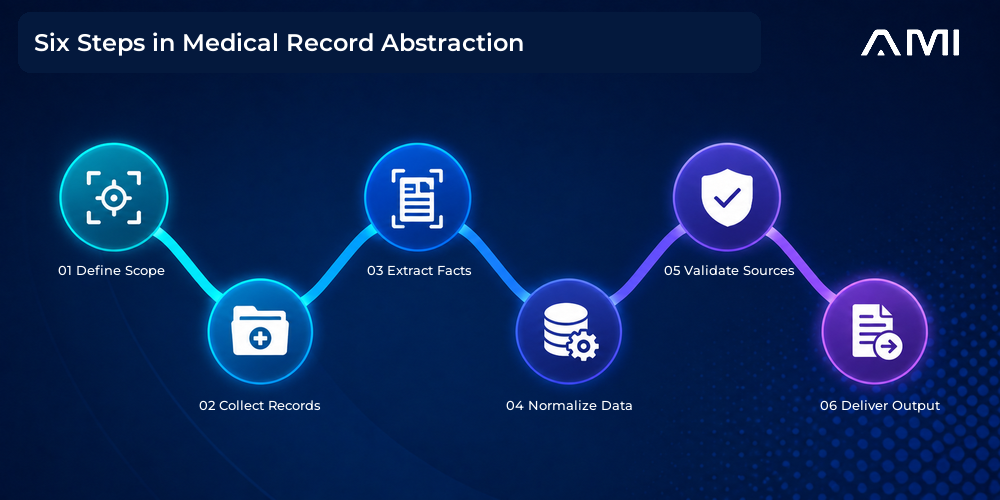
The process starts with a defined question, protocol, data dictionary, and source inventory. Records are collected, deduplicated, indexed, and assigned stable identifiers. Reviewers then extract relevant facts into consistent fields and cite each entry to its source.
Normalization aligns dates, provider names, terminology, and units without rewriting the clinical meaning. Validation checks missing fields, conflicting entries, unsupported conclusions, and citation accuracy. The final output should be usable by its intended reviewer without hiding uncertainty.
Why Is Source Traceability Essential?
An abstract without citations forces attorneys and experts to search the entire chart again. Every material fact should point to a page, file, exhibit, Bates number, or other stable locator.
Traceability also makes corrections easier. When a reviewer challenges an entry, the team can return to the exact source and update the output without relying on memory. Medical record indexing creates the document structure that supports this work.
What Quality Controls Prevent Abstraction Errors?
Quality assurance should test field completeness, source accuracy, chronology consistency, terminology, duplicates, contradictions, and reviewer agreement. High-impact facts may require a second review. Automated extraction can accelerate classification and candidate fact capture, but a skilled reviewer should validate context.
Common errors include copying the wrong date, treating a rule-out diagnosis as confirmed, overlooking negation, confusing patient history with clinician findings, and losing the distinction between ordered and completed care.
Need source-linked abstraction, chronology support, and review QA? Explore AM InfoWeb’s Record Retrieval and Litigation Support.

Why does record retrieval become difficult to control at scale?
Delays, follow-ups, provider coordination, and documentation gaps can slow down litigation support workflows. AM InfoWeb helps legal and healthcare teams manage record retrieval with structured processes, experienced teams, and clear operational visibility.
How Does Abstraction Support Litigation Review?
Structured facts help counsel identify treatment patterns, gaps, prior conditions, causation questions, damages support, and records that require expert attention. A medical chronology template can then arrange source-linked events into a defensible timeline.
Abstraction does not decide medical causation or legal liability. It gives decision-makers a controlled evidence set for analysis.
Which Output Format Should a Team Choose?
Use a table when reviewers need filtering, comparison, or portfolio-level analysis. Use a chronology when sequence matters. Use a narrative when the reader needs synthesis. Complex matters may require all three, connected by consistent source identifiers.
The output should match the workflow. A technically accurate spreadsheet still fails if attorneys cannot quickly find the facts, exceptions, and source pages they need.
How Can Teams Scale Abstraction Without Losing Accuracy?
Create one protocol, train reviewers on representative records, establish escalation rules, and measure agreement before volume increases. Keep versions of the protocol and data dictionary. Track exceptions separately instead of forcing uncertain facts into standard fields.
For portfolio matters, the controls used in mass tort medical record review help maintain claimant-level traceability at scale.
How AM InfoWeb Supports Medical Record Abstraction
AM InfoWeb supports legal and healthcare teams with structured record organization, abstraction, chronology preparation, and quality control.
With two decades of experience in the U.S. healthcare industry, AM InfoWeb uses a co-managed model that brings AI agents and skilled human agents together to eliminate process bottlenecks and execute secure healthcare workflows.
AM InfoWeb can support:
- Record intake, deduplication, and indexing
- Matter-specific abstraction protocols
- Source-linked clinical fact extraction
- Date and terminology normalization
- Chronology and issue-matrix preparation
- Human validation and layered QA
- Exception and contradiction tracking
- Secure delivery and operational reporting
Counsel and qualified experts retain responsibility for legal conclusions, clinical opinions, and case strategy.
What Makes an Abstraction Litigation-Ready?
A litigation-ready abstraction is scoped, consistent, source-linked, validated, and honest about gaps or ambiguity. It reduces review burden without separating facts from the records that support them.
Need clearer evidence from complex medical files? AM InfoWeb combines structured abstraction, source citations, experienced reviewers, quality assurance, and secure delivery.
Get in TouchFrequently Asked Questions
About the Author

Written by
Urza Dey
Urza Dey is a content and copywriter with over five years of experience across marketing, B2B SaaS, HealthTech, EdTech, and related industries. At AMI, they contribute to content strategy, blog development, and marketing communication focused on healthcare operations, business process management, and AI-enabled service delivery.