

Attorney Request for Medical Records Fees: What Lawyers Pay
TL;DR: Attorney Request for Medical Records Fees
Attorney record request fees vary by legal pathway, state rules, format, and provider practices.
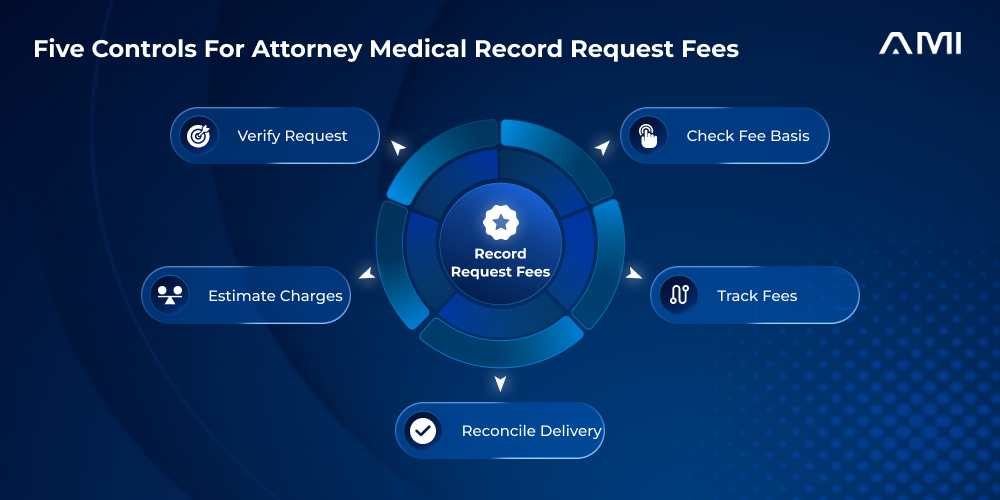
Review scope, authority, fee basis, and estimate before approving a charge.
Track each provider request and invoice to prevent duplicate work and costs.
Reconcile paid fees with complete delivered records and documented exceptions.
Attorney request for medical records fees can become a hidden source of delay when a legal team assumes every provider will apply the same rule. The amount and basis may depend on who initiated the request, the authority used, the format and scope of the production, and applicable law. A good retrieval process does not start by arguing over an invoice. It starts by identifying the request path and documenting what the provider was asked to produce.
For help with high-volume healthcare and legal workflows, explore AM InfoWeb's services.
Why Do Attorney Medical Record Request Fees Vary?
An attorney may forward a patient's access request, send a request under a signed authorization on the firm's own behalf, or obtain records through a litigation process. These are not interchangeable. HHS explains that a 2020 court order limited parts of its earlier third-party directive and fee guidance. Legal teams should verify the current federal rule, the request documents, and any applicable state requirements rather than assume the patient's HIPAA access fee limits automatically govern every attorney-initiated request.
The purpose of this article is operational cost control, not a state-by-state legal fee schedule. The latter changes and requires jurisdiction-specific review. A broader attorney request for medical records guide covers submission and follow-up; this article focuses on what happens when a fee notice arrives.
What Should Lawyers Check Before Approving a Fee?
Match the invoice or quote to the request and the responsive production. An unexplained total is difficult to evaluate. Ask which entity issued the charge, which records and date range it covers, whether the quoted amount is an estimate or final invoice, and whether the fee is tied to copy format, pages, media, delivery, or another permitted basis.
| Review item | Question for the team | Evidence to retain |
|---|---|---|
| Request authority | Was this a patient access direction, attorney authorization, subpoena, or other route? | Signed request, authorization, or legal process. |
| Record scope | Does the charge cover the providers, dates, and record types requested? | Request copy and provider acknowledgment. |
| Fee basis | Which rule or itemized charge supports the amount? | Quote, invoice, and provider explanation. |
| Production status | Has the same material already been delivered or billed? | Receipt log, file inventory, and prior invoices. |
The HIPAA right of access article helps distinguish patient-access fee rules from other disclosure pathways, but it should not be used as a universal pricing answer for litigation requests.
How Can Legal Teams Forecast Record Retrieval Costs?
Build a provider-by-provider request ledger before records arrive. Each entry should record the request pathway, provider, patient and case identifier, record scope, submitted date, fee estimate, invoice date, payment owner, and production status. Keep protected information inside approved systems and make only the minimum necessary cost details visible in shared reports.
For multi-provider matters, flag providers with known retrieval delays or large productions and confirm whether electronic delivery is available. Do not reduce the requested scope solely to avoid fees if doing so would compromise case review. Medical record indexing can make a received production easier to reconcile with the original request.
How Do Teams Prevent Duplicate Fees and Requests?
Duplicate requests arise when a paralegal, vendor, and attorney each follow up without one shared history. Before approving a second charge, compare the new quote with prior invoices and file receipts. Check whether it covers a genuinely new date range, a different provider, or a corrected production. A status of "received" is not enough if the file is incomplete.
This is especially important when a medical records subpoena and an authorized retrieval request run in parallel. The legal team should coordinate authority and production scope with counsel rather than let two workflows produce the same record set without review.
For structured record retrieval and litigation support, see AM InfoWeb's dedicated service page.
Need a clearer view of legal record retrieval charges? AM InfoWeb helps teams track requests, provider fee notices, delivery status, and invoice-to-production exceptions.
Get in TouchWhat Should a Team Do With an Unexpected Charge?
First verify the facts. Confirm that the provider received the intended request, that the invoice references the right patient and scope, and that no previous payment or production was missed. Ask for an itemized explanation when the fee basis is unclear. Preserve the correspondence and deadline impact in the request log.
If the charge appears inconsistent with governing law or the request pathway, escalate to the firm's legal or compliance reviewer. Do not assert a fixed nationwide cap or automatically convert one type of request into another. The HHS fee guidance itself warns that parts of earlier third-party guidance must be read in light of the court order.
How Do You Reconcile Fees With Delivered Records?
Payment completion and record completion are different statuses. Log what arrived, the date range, provider, format, page count when available, and any missing reports or attachments. Match that inventory to the invoice and original request before closing the task. A certified medical records request may also require authentication documents, so the production checklist should capture those deliverables separately.
The result is a more useful cost report: not just dollars spent, but dollars tied to complete, usable, traceable records.
Which Controls Improve Cost Visibility at Scale?
Standard templates, one owner per request, a payment approval threshold, document-level receipts, and exception queues make fee management less reactive. AI agents can categorize notices, match invoice references, and highlight missing production details. Skilled human agents should validate identity, authority, legal questions, and disputed charges before action.

Why does record retrieval become difficult to control at scale?
Delays, follow-ups, provider coordination, and documentation gaps can slow down litigation support workflows. AM InfoWeb helps legal and healthcare teams manage record retrieval with structured processes, experienced teams, and clear operational visibility.
How AM InfoWeb Supports Attorney Record Retrieval Fees
AM InfoWeb has two decades of experience in the U.S. healthcare industry. Its co-managed model brings AI agents and skilled human agents together to eliminate process bottlenecks and execute secure healthcare workflows. For record retrieval cost control, support can include:
- Provider request and fee-notice tracking in shared work queues.
- Human review of request scope, status, and production exceptions.
- Invoice-to-record reconciliation and documented follow-up.
- Operational reporting that makes delays and repeat charges visible.
Conclusion
Attorney medical-record request fees are easier to control when legal teams separate request authority, fee basis, payment, and production completion. The goal is not to assume every invoice is wrong. It is to make each charge explainable and every paid production usable for the case.
Frequently Asked Questions
About the Author

Written by
Urza Dey
Urza Dey is a content and copywriter with over five years of experience across marketing, B2B SaaS, HealthTech, EdTech, and related industries. At AMI, they contribute to content strategy, blog development, and marketing communication focused on healthcare operations, business process management, and AI-enabled service delivery.