

Provider Directory Accuracy: How Payers Improve Network Data Quality
TL;DR: Provider Directory Accuracy
Accurate provider directories help members find in-network care and reduce avoidable support friction.
Provider data changes across locations, networks, specialties, contracting, and panel status.
A shared data model should define sources, formats, owners, validation rules, and publication destinations.
Verification should combine attestations, roster review, outreach, claims signals, and documented conflict resolution.
End-to-end workflows must confirm that approved changes reach every required downstream system.
Accuracy metrics should track listings, fields, verification age, turnaround, complaints, failures, and recurring defects.
Provider directory accuracy shapes whether members can find the right in-network care, whether providers receive appropriate referrals, and whether health plans can demonstrate reliable network information. Incorrect locations, phone numbers, specialties, network status, or acceptance details create friction for everyone using the directory.
The problem is difficult because provider data changes constantly. A clinician may move, leave a practice, change network participation, update a specialty, close a panel, or begin serving a new location. Payers often receive those changes through different channels and formats, then must reconcile them across credentialing, contracting, claims, portals, APIs, and printed directories.
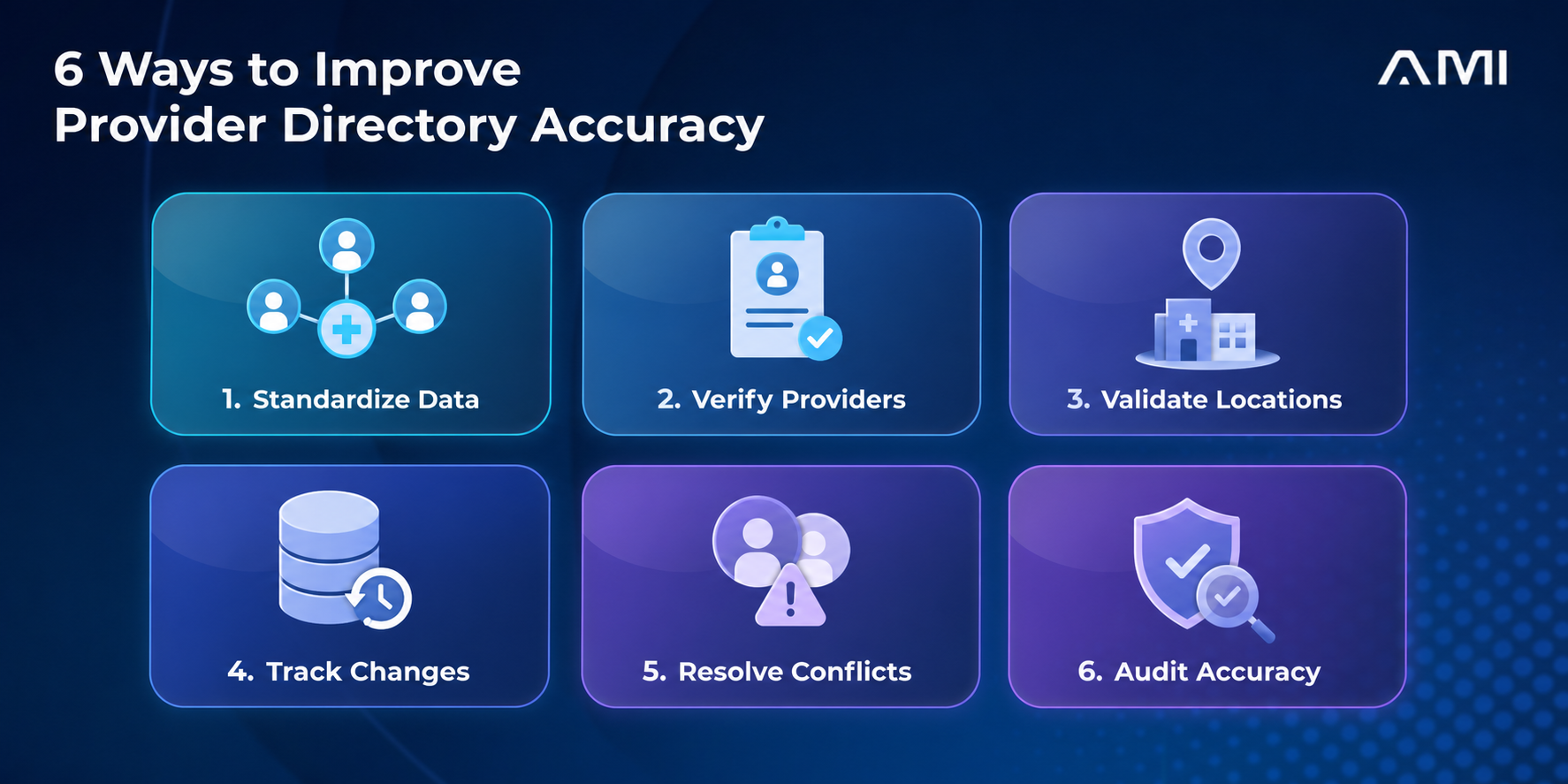
Improving provider directory accuracy therefore requires more than periodic outreach. It requires defined data ownership, standardized records, verification workflows, timely change processing, conflict resolution, and measurable quality controls.
Need stronger operational support across healthcare workflows? Explore AM InfoWeb's healthcare services.
What Is Provider Directory Accuracy?
Provider directory accuracy describes whether published network information correctly represents a provider or facility at the time a member uses it. Core data commonly includes provider name, practice name, address, phone number, specialty, network participation, location affiliation, and whether the provider accepts new patients.
Accuracy is not only a percentage. A record may contain one correct field and several incorrect ones. Payers should define whether they measure field accuracy, listing accuracy, provider accuracy, location accuracy, or successful member access.
CMS states that impacted payers must make specified network information available through a publicly accessible Provider Directory API. Required information includes provider names, addresses, phone numbers, and specialties, with updates made available within applicable timelines.
Why Does Accurate Provider Directory Data Matter?
Members use directories to choose health plans, locate in-network clinicians, schedule care, and estimate financial responsibility. An incorrect listing can cause repeated calls, delayed appointments, abandoned searches, or unexpected out-of-network costs.
Providers experience misdirected referrals, calls to inactive locations, inaccurate specialty representation, and network-status disputes. Contact centers and network teams absorb the resulting complaints and manual research.
Directory data also supports network adequacy, care navigation, claims administration, regulatory reporting, digital tools, and payer-provider communication. The U.S. Government Accountability Office has reported persistent concerns about inaccurate network information and the difficulty of confirming provider availability in its review of Medicare Advantage network oversight.
What Causes Provider Directory Inaccuracies?
Provider data defects usually reflect a fragmented operating model rather than one careless update.
Multiple sources of truth
Credentialing, contracting, claims, call-center, and directory systems may store different versions of the same provider record.
Unstandardized submissions
Providers, groups, delegated entities, and vendors may submit changes through portals, emails, spreadsheets, forms, and roster files with inconsistent fields.
Complex provider-location relationships
One provider may practice at several locations, participate in different networks, or accept new patients only at selected sites.
Delayed change processing
Even when a provider reports a change, unclear ownership, manual queues, or system dependencies may delay publication.
Weak conflict resolution
Claims, credentialing, roster, and outreach data can disagree. Without decision rules and audit trails, teams may overwrite correct information or leave conflicts unresolved.
How Should Payers Govern Provider Directory Data?
Governance begins with a shared data model. Every critical field needs a definition, accepted format, source hierarchy, validation rule, update owner, and publication destination. Provider-level and location-level attributes should remain distinct.
A payer should identify the authoritative source for credentialing status, contract participation, demographic details, specialty, location, and panel status. Source rules may differ by field. The system should preserve when information was received, who changed it, why it changed, and which downstream systems were updated.
Governance also needs cross-functional oversight. Network management, credentialing, contracting, provider operations, compliance, claims, IT, digital, and contact-center teams all use or change provider data. Their workflows should be designed as one lifecycle, not separate databases.
How Can Payers Verify Provider Information Efficiently?
Verification should combine provider attestation, roster validation, targeted outreach, claims signals, returned mail, member complaints, website checks, and other reliable evidence. No single source proves every field.
Risk-based outreach can prioritize providers with high member volume, recent changes, repeated complaints, conflicting records, or historically low response rates. Structured digital forms reduce free-text ambiguity and require complete submissions.
Nonresponses need a defined escalation path. Teams should track attempts, communication channels, due dates, and final disposition. CMS materials for the Qualified Health Plan Directory Pilot describe verification and update expectations, including processes for information that cannot be verified in the QHP Directory Pilot FAQs.
How Should Directory Changes Move Through Payer Systems?
A reliable update workflow starts when the change is received and ends only when every required destination reflects the approved information. Intake should create a traceable work item with the provider, location, affected networks, changed fields, source, and effective date.
Validation should confirm identifiers, required fields, contractual status, credentialing dependencies, and whether the change conflicts with existing data. Approved updates should then move through directory, portal, API, contact-center, claims, and reporting systems according to documented rules.
Teams need reconciliation reports showing records that failed to publish, interfaces that rejected an update, and systems that remain out of sync. For a broader payer workflow perspective, see Healthcare Payer Services That Improve Provider and Member Experience.
Need disciplined provider-data, claims, and support workflows? Explore AM InfoWeb's Healthcare Payer Support services.

Why do payer operations slow down even with more resources?
Because claims, provider inquiries, member support, and policy workflows need more than added capacity. AM InfoWeb helps payers improve accuracy, turnaround time, and operational visibility with co-managed support teams and workflow-focused execution.
Which Metrics Measure Provider Directory Accuracy?
Payers should measure both data quality and operating performance. Useful metrics include:
- Percentage of fully accurate listings
- Field-level accuracy by data element
- Provider and location verification rate
- Average age of verified information
- Change-processing turnaround time
- Unresolved conflict volume
- Update failure rate by downstream system
- Provider response and attestation rate
- Member complaints linked to directory errors
- Reopened or recurring defects
Metrics should be segmented by network, provider type, delegated entity, location, source system, and error category. A high aggregate result may hide serious problems in one region or specialty.
Leaders should also track whether corrected records remain accurate. Repeated errors often indicate a source-system, interface, or governance problem rather than an isolated data-entry mistake. Similar root-cause discipline helps payers improve claims processing accuracy and efficiency.
| Metric | What It Helps Reveal |
|---|---|
| Fully accurate listing rate | Overall directory reliability at the listing level |
| Field-level accuracy | Which provider data elements fail most often |
| Verification age | How recently information was confirmed |
| Change turnaround time | Speed from approved update to publication |
| Downstream update failures | Systems or interfaces that remain out of sync |
| Directory-related complaints | Member access problems linked to inaccurate information |
How Can Automation Improve Directory Accuracy?
Automation can standardize incoming data, validate required fields, compare records, identify duplicates, flag conflicts, route exceptions, and monitor update completion. Matching logic can connect provider and location records across systems even when source formats differ.
Automated signals can identify potential changes from claims activity, returned communications, inactive phone numbers, or provider outreach. However, a signal is not always proof. A provider may bill through one location while remaining available at another.
Human review is essential for ambiguous relationships, network participation, specialty classifications, delegated arrangements, and conflicting evidence. Effective healthcare payer automation combines workflow technology with governed decisions and accountable teams.
How Should Payers Audit Provider Directories?
Audits should test whether published information helps a member reach an available in-network provider. Sampling can target high-volume providers, high-risk specialties, new networks, delegated entities, recent changes, and prior error categories.
Reviewers should validate provider identity, location, phone number, specialty, network status, panel status, and other applicable fields. Audit evidence should record the source, date, method, result, and corrective action.
Root-cause analysis should distinguish provider nonresponse, inaccurate source data, processing delay, system mismatch, interface failure, or publication defect. Correcting the listing is necessary, but fixing the source workflow prevents recurrence.
How Does AM InfoWeb Support Provider Directory Accuracy?
AM InfoWeb supports payer operations with trained teams, structured workflows, quality assurance, escalation controls, and operational reporting.
With two decades of experience in the U.S. healthcare industry, AM InfoWeb uses a co-managed model that brings AI agents and skilled human agents together to eliminate process bottlenecks and execute secure healthcare workflows.
AM InfoWeb can support:
- Provider outreach and attestation follow-up
- Provider roster review
- Demographic and location validation
- Directory change-intake queues
- Data-conflict research and escalation
- Directory update execution
- Exception follow-up and quality checks
- Accuracy and turnaround reporting
Co-managed execution helps payer teams manage high-volume work while retaining governance and decision authority.
The goal is to make provider data more reliable for members, providers, contact centers, claims teams, and regulatory workflows.
What Should Payer Leaders Do Next?
Start by mapping every system and team that creates, receives, changes, or publishes provider information. Define authoritative sources by field and identify where records diverge.
Next, standardize intake, establish verification rules, assign exception ownership, and measure end-to-end update completion. Prioritize defects that affect member access, network status, and frequently used providers.
Provider directory accuracy improves when data governance and operational execution work together. Consistent verification, traceable changes, cross-system reconciliation, and accountable follow-up turn directory maintenance into a controlled payer capability.
Need stronger control over provider directory data? AM InfoWeb combines trained payer-support teams, structured workflows, QA, and operational reporting to help improve verification, update execution, and directory accuracy.
Get in TouchFrequently Asked Questions
About the Author

Written by
Urza Dey
Urza Dey is a content and copywriter with over five years of experience across marketing, B2B SaaS, HealthTech, EdTech, and related industries. At AMI, they contribute to content strategy, blog development, and marketing communication focused on healthcare operations, business process management, and AI-enabled service delivery.