

Healthcare Payer Industry Growth: 2026 Trends and Drivers
TL;DR — What Is Driving Private Payer Industry Growth?
Private health insurance accounted for roughly 31% of U.S. national health expenditures in 2024.
Continued healthcare spending growth is increasing pressure on the private healthcare payer industry to control administrative and medical costs.
Aging populations and higher healthcare utilization are increasing claims, authorization, pharmacy, and member-support activity.
Value-based payment models are making payer-provider data exchange and performance tracking more complex.
Growing enrollment and coverage changes increase work across Enrollment and eligibility, claims, billing, and member records.
AI, automation, interoperability, and digital workflows are changing how payer operations are structured.
Without scalable processes, increased volume can create backlogs, repeat contacts, delayed resolution, and greater operational costs.
The private healthcare payer industry is operating in a healthcare system that continues to grow in both spending and administrative complexity. U.S. healthcare spending reached approximately $5.3 trillion in 2024, with private health insurance accounting for about $1.64 trillion, or 31% of national health expenditures. CMS projects overall national health spending to approach $9 trillion by 2034, while private health insurance spending is expected to continue growing throughout the period.
But market growth tells only part of the story. Private payers are also managing an aging population, rising medical costs, changing coverage patterns, value-based payment models, evolving regulations, digital member expectations, and wider use of AI and automation. These forces are creating more operational activity across claims, provider data, member services, authorization, enrollment and eligibility, and other payer workflows.
What Is the Private Healthcare Payer Industry?
The private healthcare payer industry includes commercial and privately operated organizations that finance, administer, or reimburse healthcare coverage and benefits.
Private payers may include commercial health insurers, managed-care organizations, third-party administrators, employer-sponsored plan administrators, and insurers operating products such as Medicare Advantage plans. Their responsibilities extend well beyond reimbursing healthcare providers.
Private payer operations can include eligibility, benefits administration, provider-network management, claims, prior authorization, appeals, grievances, provider inquiries, member support, enrollment, payment, and reporting.
This is different from government payers, such as traditional Medicare and Medicaid programs administered through public structures. Private insurers may administer certain publicly funded products, but this article focuses specifically on private payer organizations and the operational forces affecting their growth.
Who Are Payers in Healthcare Industry Operations?
The question who are payers in healthcare industry operations often comes up because the term “payer” can describe several types of organizations.
At a basic level, a payer is responsible for financing or administering payment for covered healthcare services. Within the private market, this can include commercial insurers, TPAs, private managed-care organizations, employer-sponsored benefit administrators, and companies operating private health-plan products.
The responsibilities of payers in healthcare also extend across relationships with providers, members, employers, pharmacies, regulators, and healthcare technology platforms.
That network of relationships is one reason the private healthcare payer industry is becoming increasingly operationally complex.
Healthcare Payer Industry Trends 2026 Reshaping Private Payers
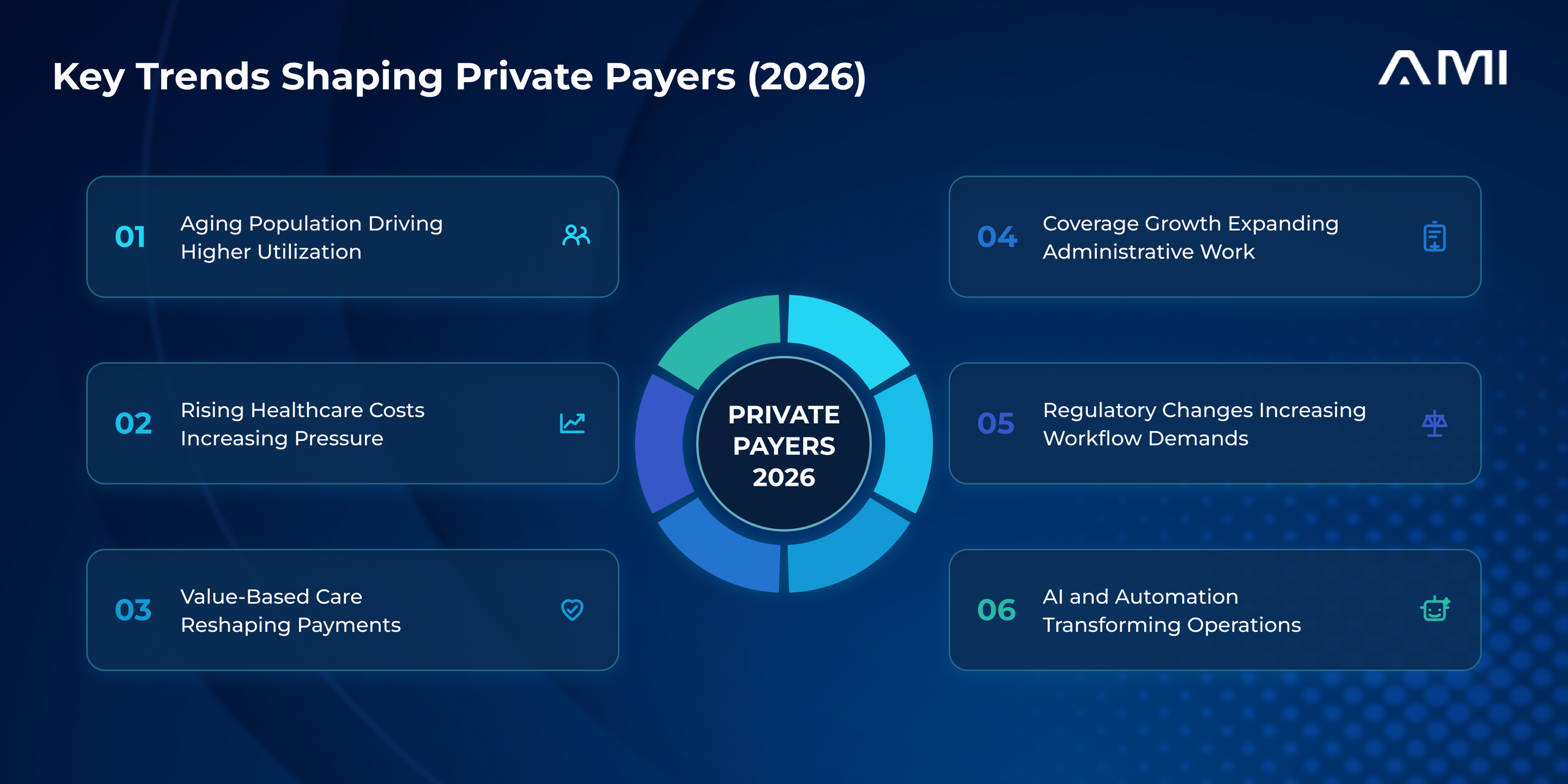
Several forces are shaping the private payer market simultaneously. The most important healthcare payer industry trends in 2026 are not isolated market developments. Each one changes the amount, type, or complexity of work payer organizations must manage.
The table below summarizes the major trends and their operational implications.
| Trend | What Is Changing | Impact on Private Payers |
|---|---|---|
| Aging population | More older adults require healthcare services | Greater claims, pharmacy, authorization, and support activity |
| Rising healthcare costs | Medical spending and premiums continue increasing | More pressure on claims accuracy, utilization, and administrative cost |
| Value-based care | Payment is increasingly tied to quality and outcomes | More complex provider contracts, reporting, and data requirements |
| Coverage changes | Employer and individual plans serve large and changing populations | More enrollment, eligibility, billing, claims, and member-record activity |
| Regulation | Interoperability and prior authorization expectations are increasing | Greater demand for speed, transparency, documentation, and status visibility |
| AI and automation | Technology is moving deeper into payer administration | More opportunity to reduce repetitive work while maintaining human oversight |
An Aging Population Is Increasing Healthcare Demand
The U.S. population continues to age, increasing healthcare utilization and demand for coverage designed around older populations. The U.S. Census Bureau projects that by 2030, all baby boomers will be age 65 or older, making approximately one in five Americans of retirement age.
For the private healthcare payer industry, this demographic shift can increase activity across several workflows:
- Claims and pharmacy benefits
- Prior authorization
- Member inquiries
- Provider-network administration
- Care coordination
- Medicare Advantage operations
Payer Impact: More covered lives do not simply create more premium volume. They also create more claims, inquiries, exceptions, documentation, and follow-up work.
Private Medicare Advantage products also connect commercial insurers directly with the growing senior population. As enrollment and utilization increase, payer operations must be able to manage both higher transaction volume and more complex member needs.
Rising Healthcare Costs Are Increasing Payer Pressure
Healthcare costs continue to rise faster than the broader economy. CMS projects national health expenditures to grow at an average annual rate of approximately 5.4% between 2025 and 2034, with healthcare spending expected to represent more than 20% of U.S. GDP by 2034.
Employer-sponsored health coverage is experiencing similar pressure. Average family premiums have continued to rise, adding greater cost pressure for employers, members, and insurers.
Within the private healthcare payer industry, rising costs affect:
- Benefit and plan design
- Provider reimbursement
- Utilization management
- Pharmacy spending
- Claims administration
- Payment integrity
- Member affordability
Why It Matters: As healthcare becomes more expensive, administrative leakage becomes more expensive too. Rework, avoidable denials, duplicate contacts, incorrect processing, and unresolved exceptions can all increase total operating cost.
This also changes how payers in healthcare approach cost control. Operational efficiency, data accuracy, workflow visibility, and payment integrity become increasingly important alongside benefit and network strategies.
Value-Based Care Is Changing Payer-Provider Relationships
Value-based healthcare continues to shift portions of reimbursement away from pure service volume toward quality, outcomes, and total cost of care.
For private payers, this can add new administrative requirements alongside traditional claims activity.
| Traditional Payer Activity | Additional Value-Based Requirement |
|---|---|
| Process claims | Track quality and cost outcomes |
| Maintain provider contracts | Manage performance-based arrangements |
| Review utilization | Evaluate patterns across populations |
| Exchange claims data | Exchange broader clinical and performance information |
| Issue reimbursement | Reconcile incentives, risk, or shared savings |
This makes the relationship sometimes framed as payers vs providers increasingly interconnected.
Providers generate clinical, coding, and billing information. Payers administer benefits, contracts, payment rules, reimbursement, and performance requirements. Value-based models require more accurate information to move between both sides.
Operational Shift: More sophisticated payment models require stronger provider data, documentation, contract administration, reporting, and workflow visibility.
For the private healthcare payer industry, effective payer-provider coordination therefore becomes an operational requirement rather than simply a relationship-management issue.
Employer and Individual Coverage Remain Major Demand Channels
Employer-sponsored and individual health coverage continue to represent major sources of private insurance demand in the United States.
Millions of Americans receive coverage through employer plans, while Marketplace products continue to create substantial enrollment activity for private insurers.
For the private healthcare payer industry, membership changes affect far more than enrollment totals. They create work across:
- Enrollment and eligibility
- Member records
- Premium and billing administration
- Benefit configuration
- Provider access
- Claims processing
- Member inquiries
An enrollment issue can also move downstream.
An incorrect effective date, coverage status, or plan configuration may later appear as an eligibility problem, claim issue, provider inquiry, or member complaint.
Operational Takeaway: Enrollment accuracy acts as an upstream control. Errors introduced early in the member lifecycle often generate more expensive work later.
Regulation Is Increasing Demands for Speed and Interoperability
Regulation continues to push healthcare payer workflows toward faster turnaround, better information exchange, and greater transparency.
The CMS Interoperability and Prior Authorization Final Rule is one example. Certain operational requirements began taking effect in 2026, with additional API-related requirements generally beginning in 2027 for applicable payer organizations.
Areas affected include:
- Prior authorization turnaround
- Status communication
- Data exchange
- Documentation
- Interoperability
- Workflow tracking
For applicable organizations, CMS has established prior authorization decision timelines that include 72 hours for expedited requests and seven calendar days for standard requests.
What This Means Operationally: Authorization teams need more than processing capacity. They need accurate intake, clear ownership, status visibility, documentation, exception handling, and escalation.
Not every requirement applies identically to every private payer product, but the direction across the us healthcare payer industry is increasingly clear: administrative workflows are expected to become faster, more transparent, and more digitally connected.
AI and Digital Operations Are Changing Payer Workflows
Technology across the private healthcare payer industry is moving beyond basic digitization.
Payer organizations are increasingly evaluating automation, analytics, conversational AI, workflow orchestration, and AI-assisted tools for high-volume administrative work.
Potential applications include:
- Inquiry classification
- Call and case-note summarization
- Document extraction
- Workflow routing
- QA support
- Knowledge retrieval
- Repeat-contact analysis
- Backlogs monitoring
- Operational reporting
Where AI Can Help: High-volume, repetitive activities with defined workflows, large information sets, or frequent handoffs. Where Human Oversight Remains Important: Complex claims, disputed decisions, unusual benefit scenarios, sensitive member situations, clinical determinations, and judgment-intensive exceptions.
For private payers, the objective should not simply be to automate as much work as possible. Technology should reduce repetitive administrative effort while preserving governance, accuracy, security, and escalation control.
What Growth Means for Private Payer Operations
Industry growth can create commercial opportunity, but it also creates more administrative activity.
A private payer can expand membership while simultaneously experiencing operational strain if workflows, staffing, technology, and quality controls do not scale with demand.
The relationship between payer processes also matters. One issue can easily create additional work somewhere else.
For example:
Enrollment error → eligibility mismatch → claim problem → provider inquiry → member contact → escalation
The visible problem may therefore appear far away from the actual root cause.
Seeing higher volume without better visibility across payer workflows? AMI’s co-managed payer operations support claims, enrollment, provider inquiries, member services, QA, and reporting while keeping client oversight in place.
Why Claims Administration Becomes More Important as Payers Scale
Claims sit at the center of many interactions between private payers, healthcare providers, and members.
As healthcare utilization and spending grow, claims administration must handle increasing transaction volume while maintaining accuracy, documentation, and appropriate turnaround.
Claims operations may need to:
- Identify missing or inconsistent information
- Process routine transactions
- Manage exceptions
- Document status and actions
- Support provider inquiries
- Route complex issues
- Manage corrections or additional information
- Track unresolved work
When workflows fall behind demand, backlogs can develop.
That aging work can then generate repeated provider calls, escalations, member questions, and additional administrative expense.
For the private healthcare payer industry, strong claims operations therefore require visibility into more than throughput. Leaders need to understand aging, exception rates, quality, repeat contacts, and unresolved cases.
Why Member Services Depend on Back-Office Accuracy
Members increasingly expect clear information about benefits, eligibility, claims, networks, authorizations, and financial responsibility.
Effective member services therefore depend heavily on the accuracy of upstream payer systems and workflows.
A representative may be able to answer quickly, but speed does not create a good experience if the underlying claim status, enrollment record, provider information, or authorization data is incomplete.
Strong member-support workflows should make it easy to identify:
- What the member is asking about
- What happened previously
- What information is available
- What action has already been taken
- Who owns the next step
- When follow-up should occur
In the private healthcare payer industry, front-office member experience and back-office operational quality are closely connected.
Why Enrollment and Eligibility Accuracy Matters
Enrollment is one of the first operational dependencies in a health-plan relationship.
When member information, coverage dates, plan details, or eligibility status are incorrect, those errors can affect claims, authorizations, provider interactions, billing, and member support.
This makes enrollment and eligibility an important control point for private payer operations.
Strong workflows require accurate data capture, timely updates, exception handling, clear documentation, and visibility into unresolved cases.
As payer organizations grow, maintaining this level of accuracy becomes increasingly difficult without standardized processes and QA.
Why Authorization Requires Better Workflow Visibility
Prior authorization sits at the intersection of benefit rules, provider communication, clinical information, and administrative review.
The process can involve intake, documentation review, status communication, decision-making, escalation, and follow-up.
Strong Authorization workflows should make four questions easy to answer:
- What information has been received?
- What is still missing?
- Who currently owns the request?
- What needs to happen next?
When these answers are unclear, a single authorization can generate multiple provider calls, member concerns, duplicate work, and delayed care coordination.
For the private healthcare payer industry, better workflow visibility is increasingly important as regulatory and member expectations around turnaround and transparency continue to rise.

Why do payer operations slow down even with more resources?
Because claims, provider inquiries, member support, and policy workflows need more than added capacity. AMI helps payers improve accuracy, turnaround time, and operational visibility with co-managed support teams and workflow-focused execution.
Why Operational Backlogs Matter as Private Payers Grow
Growth creates a challenge that is often less visible than membership or revenue: unfinished work.
Backlogs can accumulate across claims, provider data, enrollment, authorization, correspondence, appeals, grievances, or inquiry queues.
The important point is that backlog volume alone does not reveal the cause.
A growing queue may result from:
- Insufficient capacity
- Poor routing
- Repeated data errors
- Incomplete documentation
- Unclear ownership
- Excessive manual steps
- Upstream process failures
- Dependencies on another team or system
Diagnostic Question: Is the team actually short on capacity, or is the workflow creating unnecessary work faster than the team can resolve it?
Private payer leaders need visibility into backlog age, exception type, repeat-contact drivers, quality findings, and root causes.
Simply adding resources without identifying the underlying problem can move the bottleneck rather than eliminate it.
How Data Security Affects Private Payer Growth
Private payer operations depend on large volumes of member, provider, health, financial, and administrative information.
As the healthcare payer industry becomes more digitally connected, secure information handling must remain integrated into everyday operations.
Important controls can include:
- Role-based access
- Secure documentation
- System permissions
- Data-transfer controls
- Auditability
- Third-party governance
- Incident processes
- Workforce security practices
Greater automation also increases the importance of defining where information moves, who can access it, what systems retain it, and how exceptions are handled.
Security and operational efficiency should therefore evolve together rather than being treated as separate initiatives.
Where AI Can Support Private Healthcare Payer Operations
AI can help private payers manage increasing administrative volume when it is applied to clearly defined operational problems.
AI-assisted healthcare payer workflows may support inquiry classification, summarization, information extraction, work routing, QA, knowledge retrieval, pattern detection, and operational reporting.
A simplified model looks like this:
| AI Can Assist With | Human Teams Retain Oversight Of |
|---|---|
| Classifying routine inquiries | Complex disputes |
| Summarizing prior interactions | Sensitive member situations |
| Extracting information | Exceptions requiring judgment |
| Routing work | Clinical review |
| Supporting QA | Coverage interpretation |
| Identifying repeat contacts | Escalations and final decisions |
The strongest operating model is therefore not automation versus people.
It is the orchestration of automation and trained teams so repetitive work can move faster while exceptions remain visible and controlled.
For a practical walkthrough of payer enrollment updates, see our guide on how to change healthcare payer enrollment, including the key steps and operational considerations involved.
How AMI Supports the Healthcare Payer Industry
Growth across the private healthcare payer industry can create pressure when internal teams face persistent queue growth, repeat inquiries, documentation gaps, inconsistent QA, or limited visibility into aging work. Healthcare payer services can help address these pressures by strengthening execution across high-volume administrative workflows.
AMI supports payer organizations, health plans, TPAs, and benefits administrators through co-managed healthcare operations that expand execution capacity while clients retain governance, policies, exception rules, and escalation authority.
AMI support can extend across:
- Healthcare payer operations
- Claims processing and claim-status support
- Provider-data management
- Provider inquiry handling
- Member-support workflows
- Eligibility and benefits support
- Enrollment operations
- Authorization-related administrative support
- Documentation and case-note discipline
- QA and escalation management
- Backlog monitoring
- Operational reporting
- AI-assisted and human-orchestrated execution
The objective is not simply to add staffing against increasing volume. It is to create more controlled operations in which payer leaders can see what is moving, what is aging, where exceptions are occurring, and where intervention is required.
Need stronger control as payer volumes and workflows become more complex? AMI’s co-managed healthcare operations connect trained teams, AI-assisted execution, QA, documentation, and operational visibility across payer workflows.
Get inTouchFinal Thoughts
The private healthcare payer industry is growing within a market shaped by rising costs, demographic change, regulation, value-based care, and rapid technology adoption. As these forces increase operational complexity, private payers need stronger processes across claims, Member services, Enrollment and eligibility, Authorization, QA, and reporting.
Sustainable growth will depend on how effectively payer organizations can scale these workflows without allowing delays, repeat work, and backlogs to grow with them.
Frequently Asked Questions
About the Author

Written by
Urza Dey
Urza Dey is a content and copywriter with over five years of experience across marketing, B2B SaaS, HealthTech, EdTech, and related industries. At AMI, they contribute to content strategy, blog development, and marketing communication focused on healthcare operations, business process management, and AI-enabled service delivery.