

Provider vs Payer: Understanding Their Roles in the Healthcare Revenue Cycle
TL;DR — Providers Deliver Care, Payers Administer Coverage
Providers deliver healthcare, document services, submit claims, and communicate with patients.
Payers administer coverage, review claims, apply benefit and payment rules, and support members.
The relationship between the payer and provider affects eligibility, authorization, claims, denials, payment, and patient responsibility.
Provider-data errors can disrupt directories, network accuracy, claims routing, and member access.
Claims processing is where provider documentation and payer requirements meet.
Patients receive care from providers and may also be members of payer-administered health plans.
AM InfoWeb supports co-managed payer operations across claims, provider data, enrollment, inquiries, documentation, QA, and reporting.
Understanding provider vs payer begins with a simple distinction: a provider delivers healthcare services, while a payer finances or administers payment for covered care. In practice, however, the relationship is much more connected. Eligibility verification, care delivery, clinical documentation, claim submission, payment, denials, appeals, and member support all depend on information moving accurately between both sides.
When the provider submits incomplete information, the payer may be unable to process the claim correctly. When payer data or status communication is unclear, the provider may face delayed payment and additional follow-up. The patient or member often experiences the consequences through coverage confusion, billing questions, or uncertainty about next steps.
Provider vs Payer: What Is the Basic Difference?
The basic difference in provider vs payer is the role each party performs in healthcare delivery and payment.
A provider is the individual or organization delivering care. This may include a physician, hospital, clinic, laboratory, pharmacy, imaging center, therapist, or other clinical organization.
A payer is the organization responsible for paying for or administering payment for covered services. This may include a commercial insurer, Medicare, Medicaid, managed care organization, employer-sponsored health plan, or third-party administrator.
Providers generate the clinical and billing information required to support payment. Payers evaluate that information against eligibility, benefits, contracts, coverage rules, and claims requirements. Both sides depend on accurate data and clear communication for the healthcare revenue cycle to function.
Who Is the Provider in Healthcare?
A provider is a person or organization that delivers healthcare services to a patient.
Providers may include primary care physicians, specialists, hospitals, urgent care centers, diagnostic laboratories, imaging facilities, physical therapists, behavioral health professionals, pharmacies, and other care organizations.
Their operational responsibilities extend beyond treatment. Providers also document the care delivered, assign codes, capture charges, submit claims, respond to payer requests, manage denials, collect patient responsibility, and maintain patient records.
A provider’s reimbursement often depends on whether these activities are completed accurately. Missing documentation, incorrect demographic information, coding problems, or delayed authorization can affect whether a claim is paid, denied, or returned for more information.
Who Is the Payer in Healthcare?
The payer is the organization that finances or administers payment for healthcare services according to a member’s coverage and benefit rules.
A payer may be a commercial insurance company, Medicare, Medicaid, a managed care organization, an employer-sponsored plan, a government program, or a TPA administering benefits on behalf of another organization.
Payers manage enrollment, eligibility, benefits, provider networks, claims, payment, prior authorization, appeals, grievances, and member support. They also maintain provider information and communicate with healthcare organizations about claim status, documentation, reimbursement, and participation.
The payer does not usually deliver clinical care. Its role is to administer coverage and determine how eligible services are processed and paid.
Payer and Provider in Healthcare: How They Work Together
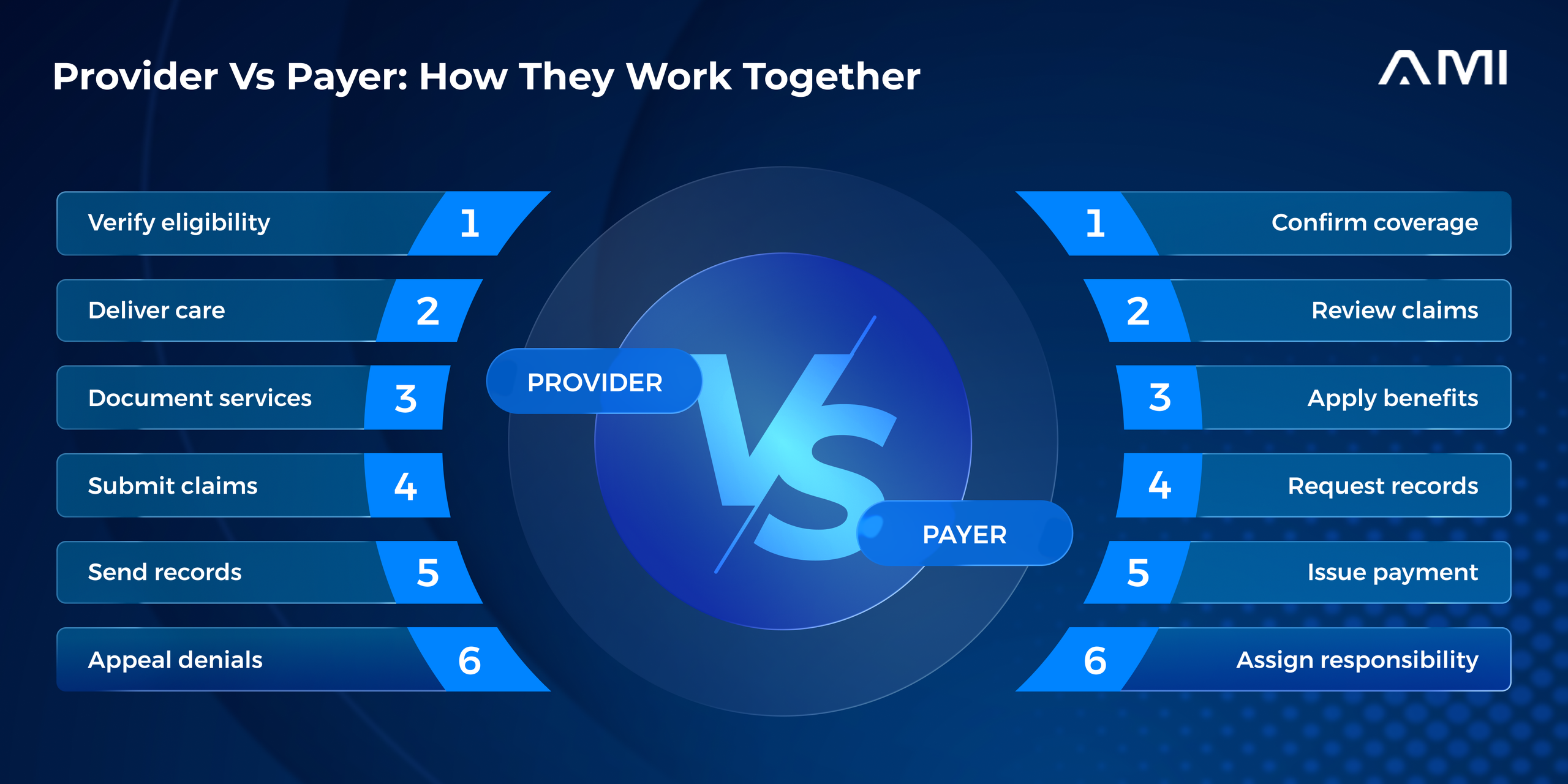
The relationship between the payer and provider in healthcare begins before care is delivered and continues after payment.
The provider may verify eligibility and benefits before an appointment or procedure. During the encounter, the provider documents the service and records the diagnosis, treatment, and medical necessity information required for billing.
After care, the provider submits a claim. The payer reviews the claim against the member’s coverage, provider contract, coding, authorization, documentation, and payment rules. The payer may issue payment, deny the claim, request more information, or assign part of the cost to the patient.
The provider may then follow up, correct the claim, submit additional documentation, appeal a decision, or collect the patient’s responsibility. Reliable coordination helps these steps move without unnecessary delays.
How Provider and Payer Roles Affect the Revenue Cycle
The healthcare revenue cycle connects patient access, care delivery, documentation, billing, payer review, payment, and follow-up. The provider and payer influence different stages, but the stages are interdependent.
A typical revenue cycle includes:
- Eligibility and benefits verification
- Care delivery and clinical documentation
- Coding and charge capture
- Claim submission
- Claims processing and adjudication
- Payment, denial, or additional-information request
- Provider follow-up, correction, or appeal
- Patient or member responsibility
- Reporting and reconciliation
A problem early in the sequence often creates downstream rework. Incorrect eligibility information may lead to billing problems. Missing authorization may cause a denial. Incomplete documentation may delay adjudication. Unclear denial information may lead to repeated provider calls.
Why Payer-Provider Confusion Creates Friction
Operational friction often appears when ownership, data, or next steps are unclear.
A provider may believe an authorization is pending while the payer is waiting for additional documentation. A payer may update a provider record in one system but not another. A claim may be denied, but the reason communicated to the provider may not explain what correction is required.
These gaps create repeat calls, delayed payments, manual rework, escalations, and member frustration. They also make performance harder to measure because the same issue may move between claims, provider relations, member support, and escalation teams.
Clear documentation and shared status visibility reduce this confusion. Every interaction should show what was reviewed, what action was taken, who owns the next step, and when follow-up is expected.
Where Provider Data Connects Payers and Providers
Provider data is one of the most important operational connections between payer and provider workflows.
Payers use provider information for network directories, claims routing, reimbursement, credentialing-related activity, member navigation, and provider communication. The data may include NPI, TIN, specialty, address, phone number, group affiliation, network status, billing information, and practice location.
When this information is outdated or inconsistent, claims may route incorrectly, payments may be delayed, and members may receive inaccurate directory information.
Provider-data quality therefore affects both operational efficiency and experience. Strong maintenance workflows require validation, update tracking, QA, and confirmation that changes are reflected across relevant systems.
Where Claims Processing Connects Payers and Providers
Claims processing is where provider documentation and payer rules meet.
The provider submits information about the service delivered, including patient identifiers, diagnosis codes, procedure codes, dates of service, charges, and supporting documentation. The payer evaluates the claim based on eligibility, benefits, coverage, authorization, contracts, coding requirements, and payment rules.
When the claim is incomplete or inconsistent, the payer may reject it, deny it, request more information, or route it for additional review.
The provider then needs a clear status and reason so the issue can be corrected. Weak communication creates repeated follow-up and unnecessary aging. Strong workflows create a traceable path from submission through adjudication, payment, denial, or appeal.

Why do payer operations slow down even with more resources?
Because claims, provider inquiries, member support, and policy workflows need more than added capacity. AM InfoWeb helps payers improve accuracy, turnaround time, and operational visibility with co-managed support teams and workflow-focused execution.
What Role Do Members and Patients Play?
The words patient and member describe the same person in different contexts.
A patient is receiving care from a provider. A member is enrolled in a health plan or another payer-administered benefit arrangement.
The individual’s experience depends on both organizations. The provider influences access, care quality, documentation, billing communication, and patient collections. The payer influences eligibility, benefits, network access, claim decisions, cost responsibility, and member support.
A claim or enrollment issue may begin as an operational problem but become a patient-facing experience problem. This is why payer-provider coordination matters beyond reimbursement alone.
Healthcare Payer Industry: Why Operations Matter
The healthcare payer industry manages complex administrative workflows that support coverage and payment.
These include enrollment, eligibility, benefits administration, provider data, claims, prior authorization, appeals, grievances, member support, provider inquiries, reporting, and compliance.
The quality of these workflows affects provider satisfaction and member trust. A delayed claim can create provider frustration. An enrollment error can create coverage confusion. Inaccurate provider data can make it harder for a member to find care.
Operational discipline helps payer organizations reduce these issues by improving accuracy, ownership, documentation, and visibility.
What Are Healthcare Payer Services?
Healthcare payer services are operational support functions that help health plans, TPAs, benefits administrators, and payer organizations manage high-volume workflows.
Support may include claims processing, provider data management, member assistance, provider inquiries, enrollment, eligibility, benefits communication, documentation, QA, escalation, and reporting.
These services are most valuable when they strengthen both execution and control. Payer leaders should retain visibility into backlog, aging work, status, quality findings, repeat-contact drivers, and unresolved exceptions.
The goal is not simply to add staffing. It is to create more consistent operations across the workflows affecting providers and members.
Common Payer-Provider Workflow Challenges
Common challenges include outdated provider records, unclear eligibility, authorization delays, incomplete documentation, slow claim-status updates, denials without actionable explanation, repeated provider inquiries, member confusion, and limited reporting.
The visible complaint may not reveal the true cause. A provider may call about a delayed payment, but the root issue may be an enrollment mismatch. A member may question a bill, but the underlying problem may be a claim processed with outdated provider information.
A useful diagnostic approach is to trace one denied claim or repeated inquiry backward through the workflow. This helps determine whether the root cause sits in eligibility, data, documentation, authorization, claim processing, communication, or ownership.
Where AI Can Support Payer-Provider Workflows
AI-assisted operations can help manage high volumes of claims, inquiries, notes, and follow-up work without making automation the final decision-maker.
AI can categorize member and provider inquiries, summarize prior activity, identify missing information, route work to the correct queue, detect repeat-contact drivers, support QA, and surface backlog or escalation trends.
This helps trained teams spend less time sorting routine work and more time handling complex claims, benefit questions, disputes, and exceptions.
Human oversight remains essential for coverage interpretation, contested claims, sensitive member situations, escalations, and decisions requiring operational judgment.
How AM InfoWeb Supports Healthcare Payer Operations
AM InfoWeb supports payer organizations, health plans, and TPAs with co-managed operations designed to improve provider communication, member support, claims follow-up, and workflow visibility.
With trained healthcare teams, secure processes, documentation discipline, QA, escalation support, and reporting, AM InfoWeb helps payer leaders manage high-volume operations while retaining governance and control.
AM InfoWeb support may include:
- Healthcare payer services
- TPA and payer back-office operations
- Provider-data management
- Claims processing and status support
- Provider inquiry handling
- Member-support workflows
- Eligibility and benefits assistance
- Payer-enrollment support
- Case-note and documentation discipline
- QA and escalation workflows
- Backlog and operational reporting
- Co-managed execution with client oversight
Need better coordination across payer and provider workflows? AM InfoWeb’s co-managed payer operations connect claims, provider data, enrollment, member support, QA, and reporting without reducing client oversight.
Get in TouchFinal Thoughts
The difference between provider vs payer is simple, but the relationship between the two shapes the entire healthcare revenue cycle. Accurate eligibility, provider data, documentation, claims, communication, and member support help both sides reduce friction, improve payment workflows, and create a better healthcare experience.
Frequently Asked Questions
About the Author

Written by
Urza Dey
Urza Dey is a content and copywriter with over five years of experience across marketing, B2B SaaS, HealthTech, EdTech, and related industries. At AMI, they contribute to content strategy, blog development, and marketing communication focused on healthcare operations, business process management, and AI-enabled service delivery.