
Claims Adjudication: How Payers Reduce Processing Errors and Delays
TL;DR: Claims Adjudication
Claims adjudication applies eligibility, coding, coverage, benefit, pricing, and payment rules.
A claim can pass front-end transaction edits and still fail coverage or payment review.
Recurring errors often point to source data, configuration, or workflow defects.
Auto-adjudication requires governed rules, reliable inputs, testing, and post-release monitoring.
Manual queues need standardized reasons, priority logic, ownership, and evidence requirements.
Balanced metrics measure speed, accuracy, rework, appeals, and provider inquiry volume.
Claims adjudication determines whether a healthcare claim should be paid, denied, reduced, or routed for additional review. Every decision depends on accurate data, current benefit rules, correct coding, contractual pricing, and a traceable explanation.
Processing problems often appear as isolated claim errors, but recurring defects usually point to upstream configuration, data, or workflow issues. Payers need controls that prevent errors before payment while keeping legitimate claims moving.
This guide explains the adjudication process, common failure points, quality measures, and ways to improve accuracy without creating unnecessary manual work.
Need structured operational support across healthcare workflows? Explore AMI’s healthcare services.
What Is Claims Adjudication in Healthcare?
Claims adjudication is the payer process for validating a submitted claim and applying eligibility, coverage, coding, benefit, pricing, coordination-of-benefits, and payment rules. The output is a payment, denial, adjustment, rejection, or request for more information.
Adjudication differs from front-end acceptance. A claim may pass transaction edits but later fail coverage or payment policy. CMS electronic claims guidance describes format checks followed by coverage and payment-policy review.
What Are the Main Steps in Claims Adjudication?
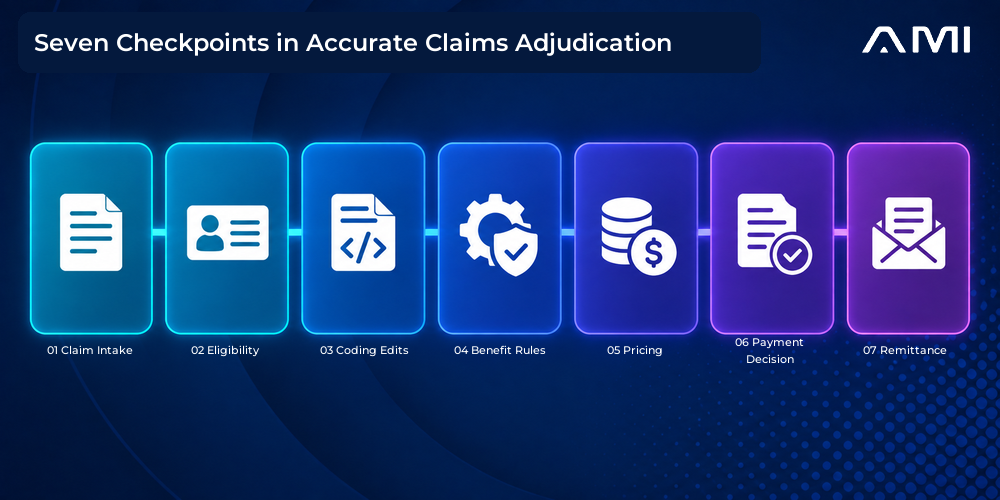
A controlled workflow typically includes:
1. Receive and validate the claim transaction
2. Confirm member eligibility and provider information
3. Apply coding and billing edits
4. Evaluate benefits, coverage, and authorization
5. Apply contract and pricing logic
6. Determine payment, denial, or manual review
7. Generate remittance and explanation information
| Checkpoint | Primary question | Typical exception |
|---|---|---|
| Intake | Is the claim complete and valid? | Missing or invalid field |
| Eligibility | Was coverage active? | Member or date mismatch |
| Coding | Are codes and relationships valid? | Edit conflict |
| Benefits | Is the service covered? | Limit or authorization issue |
| Pricing | Was the contract applied correctly? | Configuration variance |
| Decision | Is the outcome supported? | Manual review required |
| Remittance | Is the explanation accurate? | Incorrect reason code |
Where Do Claims Adjudication Errors Begin?
Errors can originate in provider submissions, member enrollment data, provider directories, authorization systems, code-set updates, contract configuration, or adjudication rules. Repeated manual corrections may hide the source instead of fixing it.
Payers should connect exception categories to root-cause ownership. Guidance on claims processing accuracy and efficiency provides a broader operational view.
How Can Payers Improve Auto-Adjudication Accuracy?
Automation works when rules are current, inputs are reliable, and exceptions are routed predictably. Rule changes should have documented owners, effective dates, test cases, approval, and post-release monitoring.
Straight-through processing should not become the only objective. A high auto-adjudication rate can still produce inaccurate outcomes if configuration defects affect many claims at once.
How Should Manual Exceptions Be Managed?
Manual queues need standardized reason categories, priority logic, required evidence, ownership, and service-level targets. Reviewers should see the claim history, applicable rule, prior actions, and missing information without searching multiple systems.
Escalation should be based on financial impact, member risk, deadline, complexity, and repeated failure patterns. Queue age alone does not show which claims require the fastest attention.
Need stronger claim queues, exception handling, and quality controls? Explore AMI’s Healthcare Payer Support services.

Why do payer operations slow down even with more resources?
Because claims, provider inquiries, member support, and policy workflows need more than added capacity. AMI helps payers improve accuracy, turnaround time, and operational visibility with co-managed support teams and workflow-focused execution.
Which Metrics Reveal Adjudication Performance?
Track first-pass adjudication, auto-adjudication, payment accuracy, denial accuracy, adjustment rate, manual touch rate, queue aging, rework, appeals, and provider inquiries. Segment metrics by product, claim type, provider, rule, and processing platform.
Balanced measures prevent teams from optimizing speed while missing accuracy or explanation quality.
How Do Provider Data and Contract Configuration Affect Claims?
Provider identifiers, network status, specialty, location, contract terms, and effective dates influence payment. Weak provider directory accuracy can therefore create downstream adjudication defects.
Configuration governance should connect contract changes to testing and production validation. Reconciliation reports should identify claims processed under outdated or conflicting terms.
How Can Payers Use Adjudication Insights Upstream?
Recurring edit failures, denials, and adjustments should inform provider education, enrollment correction, rule maintenance, and process redesign. The objective is to eliminate repeat defects, not merely work the same queue faster.
Governed healthcare payer automation can surface patterns and route exceptions while skilled teams resolve context-dependent problems.
How AM Infoweb Supports Claims Adjudication Operations
AM Infoweb supports payer organizations with structured claim operations, exception management, provider coordination, quality assurance, and reporting.
With two decades of experience in the U.S. healthcare industry, AM Infoweb uses a co-managed model that brings AI agents and skilled human agents together to eliminate process bottlenecks and execute secure healthcare workflows.
AMI can support:
- Claim intake and data validation
- Eligibility and provider-data checks
- Exception-queue management
- Documentation and provider follow-up
- Payment and denial quality review
- Adjustment and rework tracking
- Root-cause analysis and reporting
- Secure workflow execution
Payer leaders retain responsibility for benefit design, coverage policy, pricing, adjudication rules, and regulatory compliance.
How Can Payers Strengthen Claims Adjudication?
Accurate claims adjudication requires reliable inputs, governed configuration, balanced automation, clear exception ownership, and feedback into upstream processes. These controls reduce errors and delay without sacrificing explainability or payment integrity.
Need more accurate claims operations? AMI combines trained payer-support teams, structured exception workflows, QA, and reporting to improve processing control.
Get in TouchFrequently Asked Questions
About the Author

Written by
Urza Dey
Urza Dey is a content and copywriter with over five years of experience across marketing, B2B SaaS, HealthTech, EdTech, and related industries. At AMI, they contribute to content strategy, blog development, and marketing communication focused on healthcare operations, business process management, and AI-enabled service delivery.