
AI Patient Scheduling for Better Healthcare Appointment Workflows
TL;DR — AI Patient Scheduling Supports the Team Behind the Appointment
AI patient scheduling helps contact center and front-desk teams manage appointment-related work with better intake, routing, documentation, and escalation.
Scheduling pressure often comes from repeated calls, incomplete appointment requests, provider rules, insurance questions, and unclear next steps.
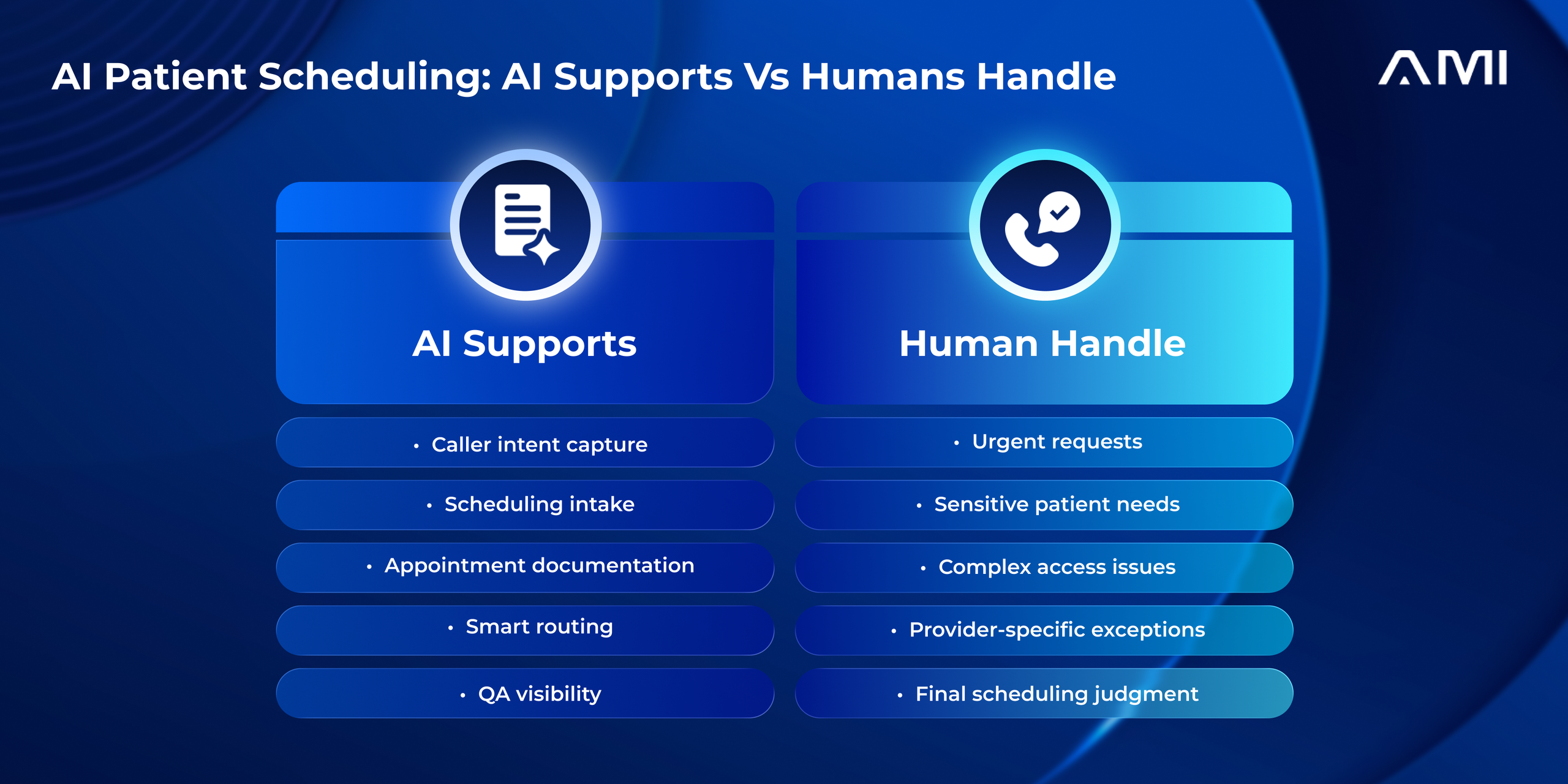
AI can support caller intent capture, scheduling intake prompts, Agent Assist, documentation summaries, routing, QA visibility, and trend reporting.
AI should not replace front-desk teams or fully automate complex scheduling needs.
Urgent, sensitive, unclear, or provider-specific scheduling cases should remain human-led.
Strong scheduling workflows help reduce front-desk interruptions and improve patient access coordination.
AMI supports AI-first scheduling workflows with trained teams, AI-assisted intake, Agent Assist, QA visibility, escalation, and co-managed execution.
Patient scheduling is one of the most repetitive and interruption-heavy workflows for front-desk and healthcare contact center teams. Appointment requests, rescheduling calls, cancellation questions, provider availability issues, insurance-related scheduling concerns, and unclear patient needs can quickly overload staff.
That is why AI patient scheduling should be viewed as an operational support model, not a replacement for front-desk teams. AI can help when it supports the workflow behind the call: capturing intent, collecting context, routing requests, guiding agents, documenting interactions, and escalating complex cases.
The goal is not to fully automate patient access. The goal is to reduce avoidable manual work while keeping trained teams available for patients who need human help, judgment, or reassurance.
Why Patient Scheduling Creates Front-Desk and Contact Center Pressure
Patient scheduling is not just calendar management. It often requires understanding the reason for the visit, provider availability, patient preferences, location rules, insurance-related questions, referral needs, and urgency.
A single call may start as a simple appointment request but quickly become a benefits question, authorization issue, provider-specific exception, or patient access concern. When contact center or front-desk teams do not have enough context, they may need to transfer the call, call the patient back, or route the request manually.
Scheduling also interrupts in-office work. Front-desk teams may be checking in patients, managing paperwork, answering provider questions, and handling walk-ins while also managing rescheduling calls and appointment questions. This is where patient scheduling automation in healthcare workflows can reduce pressure when designed carefully.
What AI Patient Scheduling Should and Should Not Mean
AI patient scheduling should mean AI-assisted support for appointment-related intake, routing, guidance, documentation, reminders, and escalation. It should help teams understand what the patient needs before the request reaches the wrong queue or creates more manual work.
It should not mean every scheduling interaction becomes automated. It should not block patients from reaching human support. It should not decide how to handle urgent, sensitive, unclear, or provider-specific access issues without trained review.
The safest use of AI patient appointment scheduling is to support structured, repeatable parts of the workflow while keeping human teams responsible for complex decisions.
Where Scheduling Calls Create the Most Operational Friction
Scheduling-related workload usually builds up when requests arrive without enough detail, when patients need to change appointments repeatedly, or when scheduling questions connect to other workflows.
Appointment requests arrive without enough context
Teams often need visit reason, patient information, provider preference, insurance details, urgency, location, and availability before they can route or schedule correctly. AI-assisted intake can help collect this context earlier, reducing back-and-forth.
Rescheduling and cancellation calls interrupt front-desk work
Repeated rescheduling and cancellation calls can pull staff away from in-office patient support. AI can help capture the request, confirm details, document the need, and route exceptions to trained staff.
Scheduling questions turn into eligibility or authorization issues
Scheduling often connects to insurance eligibility, benefits, referrals, prior authorization, or required documentation. These requests should not be treated as basic appointment questions. They need routing to the right workflow.
Patients call back because the instructions or next steps are unclear
Unclear appointment instructions, missing preparation details, weak documentation, or incomplete follow-up can create repeated calls. Better summaries and next-step visibility help reduce confusion for patients and staff.
Provider-specific scheduling rules create exceptions
Provider availability, visit type rules, appointment length, specialty requirements, location restrictions, or documentation needs can create complexity. These cases often need trained staff review.
Urgent or sensitive scheduling requests need escalation
Some scheduling requests involve symptoms, emotional distress, access barriers, or unclear patient needs. AI can flag and route these cases, but trained teams should handle them.

Why do healthcare contact centers struggle even after adding more agents?
Because rising volume, fragmented systems, repeat calls, and delayed escalations need more than staffing. AMI combines AI voice, AI non-voice, and trained human agents to improve routing, documentation, QA visibility, and service execution.
How Automation Improves Patient Appointment Scheduling for Support Teams
How automation improves patient appointment scheduling is not only by reducing call volume. It improves the operational steps around scheduling so contact center and front-desk teams can work with better context.
Automation can help collect appointment details earlier, identify the reason for the call, route requests more accurately, document interactions, and support follow-through. This helps teams spend less time asking repeat questions and more time resolving the scheduling need.
For healthcare leaders asking how to schedule patients effectively, the answer is not simply faster booking. It is cleaner intake, better routing, clearer documentation, and stronger escalation when the request is not routine.
How AI-Assisted Contact Centers Support Medical Patient Scheduling
Medical patient scheduling needs workflow support because appointment requests often connect to insurance, provider rules, access needs, or clinical urgency. AI-assisted contact centers can support the team-side scheduling workflow across calls, chats, reminders, notes, and follow-up tasks.
Caller intent capture for appointment-related requests
AI can help identify whether the patient wants a new appointment, rescheduling, cancellation, reminder clarification, provider availability information, insurance-related scheduling help, or escalation.
Scheduling intake prompts for cleaner information capture
AI-assisted prompts can help agents collect required scheduling information more consistently before the request reaches a scheduler, front-desk team, or patient access workflow.
Agent Assist for live scheduling conversations
Agent Assist can guide reps with approved prompts, scheduling rules, reminder steps, provider-specific requirements, and escalation cues while keeping the human agent in control.
AI-assisted summaries for appointment documentation
Summaries can capture request type, appointment context, patient preferences, provider details, unresolved questions, and next steps more consistently.
Routing and escalation for complex scheduling cases
AI can help identify when a scheduling request should move to eligibility, authorization, provider office, patient access, or a trained escalation team.
QA visibility into scheduling workflow gaps
AI-assisted QA and trend reporting can show repeated scheduling issues, unclear documentation, missed escalation triggers, or frequent routing gaps.
What Should Stay Human-Led in AI Patient Scheduling Workflows
Not every scheduling scenario should be handled through automation. Human teams should manage urgent requests, complex medical access issues, confused or distressed patients, payer-related complications, provider-specific exceptions, accessibility needs, and cases where the right next step is unclear.
AI can help surface those cases earlier. It can capture the request, identify signals, and route the interaction with context. But trained teams should decide how to handle sensitive, unclear, or exception-heavy scheduling needs.
This is especially important when automating patient scheduling in healthcare. The goal is safer workflow support, not removing patient access judgment.
How Healthcare Teams Can Start Improving Scheduling Operations Safely
Healthcare teams can improve scheduling operations without moving directly into full automation. A phased approach helps reduce risk and keeps the focus on operational support.
Phase 1: map the most common scheduling call types
Start by identifying new appointment requests, rescheduling calls, cancellations, provider availability questions, reminder clarification, insurance-related scheduling concerns, and follow-up calls.
Phase 2: define what AI can support inside the scheduling workflow
Begin with structured intake, intent capture, routing, reminders, documentation support, and Agent Assist, rather than fully automating complex scheduling decisions.
Phase 3: set escalation triggers for sensitive or complex requests
Define escalation rules for urgent symptoms, unclear visit reasons, patient confusion, insurance complications, provider exceptions, accessibility needs, and unresolved scheduling issues.
Phase 4: add documentation, QA, and reporting visibility
Track whether scheduling interactions are clearly documented, routed correctly, escalated when needed, and connected to the appropriate next step.
How This Differs From Patient Self-Scheduling
AI patient scheduling focuses on how contact center and front-desk teams manage scheduling workflows more efficiently. It supports the operational layer behind appointment-related calls, including intake, routing, documentation, Agent Assist, and escalation.
Patient self-scheduling focuses on patients booking, confirming, canceling, or rescheduling appointments through self-service channels. Both can support access, but they solve different problems. This blog focuses on team-side scheduling operations, not replacing the separate patient self-scheduling workflow.
How AMI Supports AI-First Patient Scheduling Workflows
AMI supports healthcare organizations with AI-first Healthcare Contact Center Operations that help reduce front-desk and contact center pressure across patient scheduling workflows. The model combines trained healthcare support teams, AI-assisted intake, appointment request routing, Agent Assist, documentation summaries, QA visibility, and escalation workflows so teams can improve scheduling operations without making patient access feel impersonal.
AMI supports:
- Patient scheduling inquiry support
- AI-assisted appointment request intake
- Caller intent capture and routing
- Agent Assist for live scheduling conversations
- AI-assisted documentation and summaries
- Routing for eligibility, authorization, or provider-specific issues
- Escalation for urgent or complex requests
- QA visibility into scheduling workflow gaps
- Co-managed operations with client oversight
For healthcare leaders asking how can patient scheduling be improved, the answer is not only more tools. It is a better operating model where AI supports repeatable work, trained teams manage complex needs, and leaders gain visibility into scheduling friction.
Want to improve patient scheduling without adding more front-desk work? AMI helps healthcare teams strengthen appointment intake, routing, Agent Assist, documentation, QA visibility, and escalation with AI-first contact center operations and trained human support.
Improve SchedulingFrequently Asked Questions
About the Author

Written by
Urza Dey
Urza Dey is a content and copywriter with over five years of experience across marketing, B2B SaaS, HealthTech, EdTech, and related industries. At AMI, they contribute to content strategy, blog development, and marketing communication focused on healthcare operations, business process management, and AI-enabled service delivery.