
What Are Healthcare Contact Center Services and AI Benefits
TL;DR — Healthcare Contact Center Services at a Glance
Healthcare contact center services help manage patient, member, and provider interactions across phone, email, chat, and portals.
These services support appointments, billing, benefits, eligibility, authorizations, records requests, provider inquiries, escalations, and after-hours needs.
Traditional healthcare contact centers often struggle with high call volume, long hold times, system switching, inconsistent documentation, limited QA, and delayed escalations.
AI-first contact center operations improve how interactions are routed, documented, monitored, escalated, and resolved.
AI agents and Agent Assist do not replace healthcare support teams. They create a stronger operating layer around human agents.
Modern healthcare leaders should look for partners with healthcare workflow expertise, HIPAA-aware operations, AI-assisted execution, QA visibility, clear escalation protocols, and scalable support.
AMI’s AI-first Co-Managed Orchestrated Operations model brings AI voice, AI non-voice, and expert human agents together to improve speed, consistency, visibility, and service execution.
Healthcare contact center services help organizations manage patient, member, and provider interactions across phone, email, chat, and portals. They support needs like appointments, billing, benefits, eligibility, authorizations, records requests, and provider follow-ups.
As healthcare interactions become more complex, traditional call handling is shifting toward AI-first contact center operations that improve routing, documentation, QA, and service visibility. This shift is also increasing interest in AI-powered contact centers that can support healthcare teams without removing human oversight.
In this blog, we will discuss what are healthcare contact center services, what they include, why they matter, the challenges traditional models face, and how AI-first operations are changing the way healthcare teams manage interactions.
What Healthcare Contact Center Services Include
Contact center services for healthcare cover a wide range of front-office, administrative, and support workflows. The exact scope depends on the organization, but most healthcare contact centers support patient, member, and provider communication across multiple service areas.
Common healthcare contact center services include:
- Patient support: Helps patients with general questions, care navigation, appointment updates, service requests, and status-related inquiries.
- Member and benefits support: Assists members with benefits, eligibility, plan information, ID card requests, coverage questions, and claims-related inquiries.
- Provider inquiry support: Supports providers with authorization status, claims status, documentation requests, payer communication, and follow-up needs.
- Scheduling and access support: Manages new appointments, follow-ups, rescheduling, cancellations, reminders, and access-related coordination.
- Billing and records support: Helps with billing inquiries, payment questions, statements, payment plans, release-of-information intake, and tracking medical record requests.
- Escalation and after-hours support: Routes urgent, sensitive, unresolved, or complex issues to the right team and supports extended coverage beyond standard business hours.
In simple terms, contact center services for healthcare help keep communication moving across the healthcare journey. They reduce confusion, guide people through administrative steps, and help internal teams manage large volumes of service requests.
Why Healthcare Contact Centers Matter
Healthcare contact centers directly shape how patients, members, and providers experience an organization. When answers are delayed, requests are misrouted, or follow-ups are missed, trust breaks quickly.
For large healthcare teams, contact centers are more than call support. They reduce wait times, route issues faster, ease administrative pressure, and create visibility into what is slowing down access, billing, authorizations, records, and provider communication.
Without that visibility, rising call volume may look like a staffing issue when it is often a workflow issue.
Common Challenges in Traditional Healthcare Contact Centers
Traditional healthcare contact centers are under growing pressure as call volumes rise, workflows become more complex, and patients, members, and providers expect faster answers. Many issues are not only call-handling problems. They are process, visibility, documentation, and routing problems that affect the entire support experience.
Common challenges include:
- High call volume: Status updates, billing questions, authorization follow-ups, benefits checks, and records requests can quickly overwhelm support teams.
- Long hold times: Delayed responses create frustration for callers and increase pressure on agents.
- System switching: Agents often move between EHRs, CRMs, payer portals, billing platforms, scheduling tools, and internal trackers during a single interaction.
- Inconsistent documentation: Manual notes and fragmented processes can lead to missing details, repeat calls, and delayed follow-up.
- Limited QA coverage: Many teams can only review a small sample of interactions, which limits visibility into quality and compliance risks.
- Scaling pressure: Peak periods, open enrollment, billing cycles, and seasonal demand can make staffing and service consistency harder to manage.
- Delayed escalations: Complex or sensitive requests may not reach the right team quickly when routing rules and context are unclear.
How Agentic AI Transforms Contact Center Operations in Healthcare
AI-first contact center operations help healthcare teams move beyond basic call handling. The model supports intake, routing, documentation, escalation, QA, and workflow follow-through with greater consistency. This is where agentic AI transforms contact center operations from simple response handling into coordinated service execution.
This does not remove humans from healthcare support. It gives them a stronger operating layer. AI agents can collect information, answer approved questions, guide structured workflows, and route complex cases to the right team. Agent Assist can also support live agents with real-time guidance, suggested next steps, and conversation summaries.
This is where conversational AI in healthcare comes into play. AI can improve how interactions are captured, documented, routed, monitored, and resolved. For healthcare organizations, the value is not only fewer calls. The bigger value is better context, faster escalation, stronger QA, and clearer visibility across patient, member, and provider interactions.
Where AI Fits in Healthcare Contact Center Workflows
AI can support healthcare contact center workflows across multiple service areas. The goal is not to replace every human interaction but to improve speed, consistency, and visibility across high-volume support tasks. In practical terms, AI-powered contact centers help teams manage common workflows with more structure, while keeping human teams available for exceptions and sensitive cases.
| Workflow area | How AI supports the contact center |
|---|---|
| Appointment scheduling | Helps collect patient details, confirm appointment preferences, support rescheduling, send reminders, and route exceptions to staff |
| Benefits questions | Guides callers through common coverage questions using approved knowledge sources and captures missing information for follow-up |
| Authorization follow-up | Checks status, captures required details, summarizes updates, and routes unresolved or denied cases for human review |
| Billing inquiries | Helps answer common payment, balance, statement, and insurance-related billing questions while escalating sensitive issues |
| Provider inquiries | Supports claims status, authorization status, documentation intake, and routing based on provider request type |
| Member support | Assists with eligibility, plan details, ID card requests, claims questions, and escalation where policy review is required |
| Quality and Analytics | Reviews interaction quality, identifies documentation gaps, tracks sentiment, and surfaces recurring service issues |
Appointment scheduling
AI can support scheduling workflows by collecting key details, confirming appointment preferences, sending reminders, and helping reduce routine scheduling pressure on staff. When a request becomes complex, such as a clinical question or urgent care need, the interaction can be escalated.
Benefits questions
Benefits questions often require accuracy and consistency. AI can help guide members, patients, or providers through approved information, capture relevant details, and route complex coverage questions to trained teams.
Authorization follow-up
Authorization workflows generate frequent status calls. AI can support intake, documentation, follow-up tracking, and routing when an authorization is pending, denied, missing documentation, or ready for escalation.
Billing inquiries
Billing questions can create confusion and frustration. AI can help manage common inquiries around balances, statements, payment status, and insurance-related billing questions while escalating sensitive or disputed cases.
Provider inquiries
Provider inquiries often involve claims, authorizations, records, and documentation status. AI can help classify the request, capture provider details, and support faster routing to the appropriate workflow.
Member support
Member support teams handle plan questions, eligibility, claims, ID cards, and service navigation. AI can help improve response consistency and reduce repeated calls for common issues.
Quality and analytics
QA is critical in healthcare contact centers because interactions must be accurate, professional, and properly documented. AI-supported QA can help leaders review more interactions, identify recurring issues, and improve coaching and process visibility.
What Healthcare Leaders Should Look for in a Modern Contact Center Partner
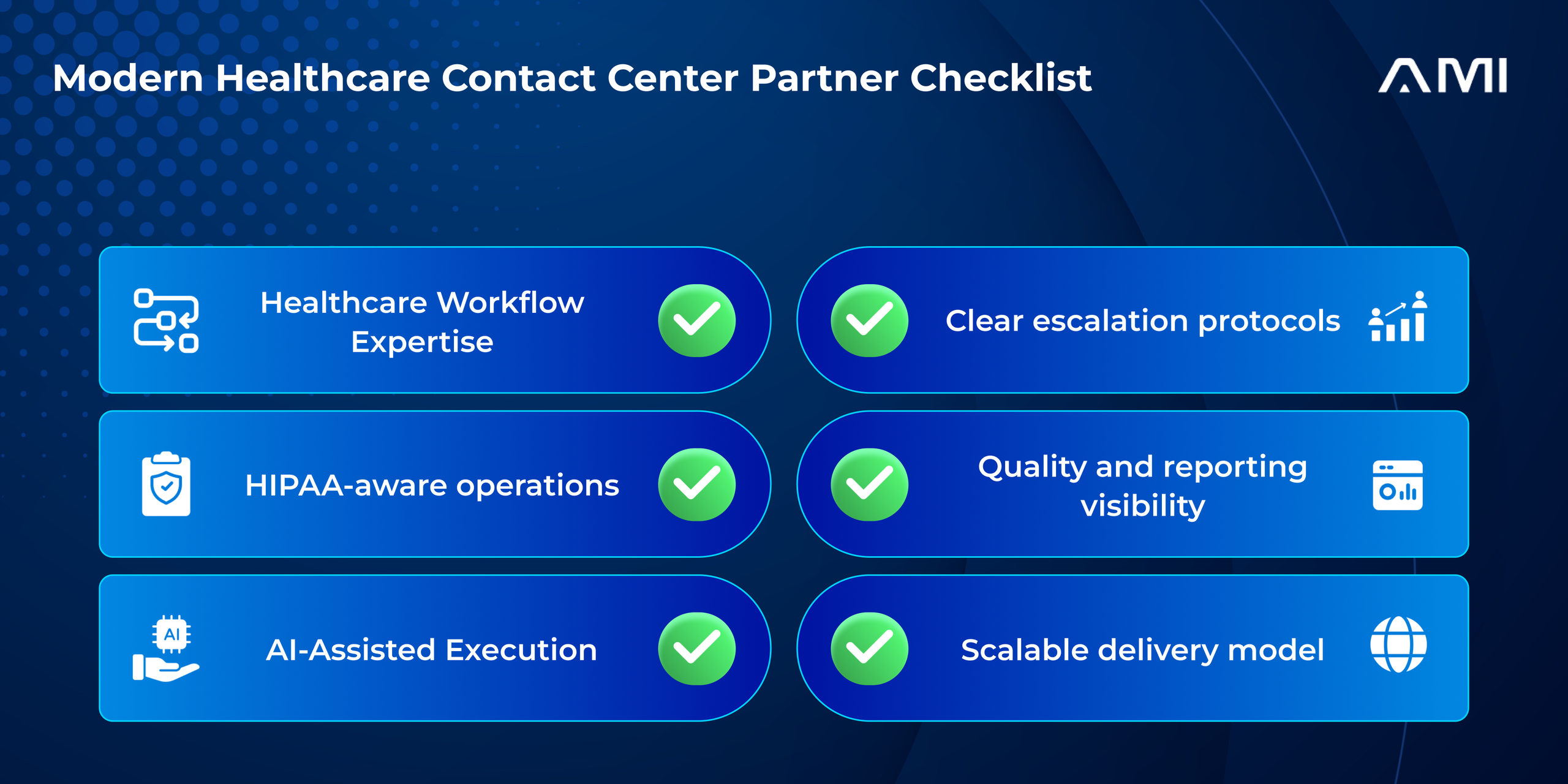
A modern healthcare contact center partner should do more than add staffing capacity. The right partner should understand healthcare workflows, protect sensitive information, support complex escalations, and give leaders clear visibility into service performance.
Key capabilities to look for include:
- Healthcare workflow expertise: Support across patient, member, provider, billing, authorization, and records-related interactions.
- HIPAA-aware operations: Secure processes for handling sensitive healthcare information across channels.
- AI-assisted execution: Support for smarter routing, documentation, QA, summaries, and workflow follow-through.
- Clear escalation protocols: Defined paths for urgent, sensitive, unresolved, or complex requests.
- Quality and reporting visibility: QA processes, dashboards, and insights into volume, trends, escalations, and service performance.
- Scalable delivery model: Ability to support peak periods, expanded coverage, changing demand, and human oversight where needed.
How AMI Supports AI-first Contact Center Operations
AMI brings healthcare contact center operations, AI capability, and human expertise into one coordinated operating model. Instead of treating AI as a replacement for support teams, AMI uses an AI-first Co-Managed Orchestrated Operations model where AI voice, AI non-voice, and trained human agents work together to manage healthcare interactions with more speed, consistency, and visibility.
This model is designed for the real pressures healthcare leaders face every day: high interaction volume, long wait times, after-hours demand, repeated status calls, fragmented documentation, limited QA coverage, and complex escalations. AI supports the structured, high-volume work. Human experts handle sensitive, urgent, unresolved, or exception-based cases. Leaders retain oversight through clear processes, reporting, QA, and operational governance.
AMI’s AI-first healthcare contact center operations support:
- AI voice and non-voice support: Agentic conversational AI agents can support structured patient, member, and provider interactions across voice and digital channels. This is one way agentic AI transforms contact center operations while preserving human oversight for complex cases.
- Expert human escalation teams: Trained healthcare support agents step in for complex, sensitive, urgent, or unresolved interactions that need human judgment.
- HIPAA-aware and SOC 2 Type II certified operations: AMI combines secure processes, compliance-focused workflows, and governed handling of sensitive healthcare information.
- After-hours and high-volume coverage: AI-assisted support helps manage extended service windows, peak call periods, repeated status inquiries, and routine follow-ups.
- Smarter routing and documentation: AI helps capture context, summarize interactions, identify next steps, and route requests to the right workflow or team.
- QA and operational visibility: Built-in quality processes and reporting dashboards help leaders see interaction trends, escalation patterns, service gaps, and performance issues.
- Healthcare workflow alignment: AMI supports appointment, billing, benefits, eligibility, authorization, records, provider inquiry, and member support workflows with process-aware execution.
For healthcare organizations, the goal is not to force AI into every interaction. The goal is to create a stronger operating layer where AI handles what it can, human experts manage what they should, and leaders gain the visibility needed to improve service at scale. This balanced approach is especially important as conversational AI in healthcare becomes part of a contact center strategy.
Frequently Asked Questions
About the Author

Written by
Urza Dey
Urza Dey is a content and copywriter with over five years of experience across marketing, B2B SaaS, HealthTech, EdTech, and related industries. At AMI, they contribute to content strategy, blog development, and marketing communication focused on healthcare operations, business process management, and AI-enabled service delivery.