

Human-in-the-Loop AI Agents: Where Healthcare Teams Retain Final Control
TL;DR: human in the loop AI agents
Human-in-the-loop means meaningful authority, not a ceremonial approval click.
Review thresholds should reflect impact, uncertainty, and reversibility.
Overrides need reasons, source evidence, and a clear owner.
Monitoring should test both AI output and human-review effectiveness.
Human-in-the-loop AI agents can reduce repetitive work, but the phrase only has value when a person can see enough context to make a real decision. In healthcare operations, an agent may prepare a response, classify a request, or suggest a next action. The organization still needs to decide when execution pauses for qualified review.
The goal is not to route every trivial task to a person. It is to keep final control over consequential, uncertain, or restricted actions while letting AI support well-defined preparation.
Explore how AM InfoWeb supports secure healthcare operations with skilled human oversight.
What Are Human-in-the-Loop AI Agents in Healthcare?
They are AI-enabled systems that perform bounded tasks within a workflow and pass selected outputs or proposed actions to an authorized human reviewer. A meaningful loop includes a clear review trigger, enough evidence to evaluate the proposal, the ability to reject or change it, and a record of what happened.
That is different from a generic “human oversight” statement in a vendor brochure. Buyers should ask which actions an agent can complete on its own, which ones pause, and whether staff have the time and tools to review them well.
When Should an AI Agent Pause for Human Review?
Review priority should rise with potential impact, ambiguity, low-confidence inputs, conflicting records, sensitive information, and irreversible actions. A threshold should be defined for the specific workflow, not borrowed from a generic model-confidence score.
| Situation | Why a pause matters | Human action |
|---|---|---|
| Conflicting patient or account details | Wrong-record risk | Verify identity and source |
| Unusual coverage or billing exception | Policy context may be missing | Interpret rule and approve next step |
| Sensitive disclosure or access request | Privacy and authorization risk | Confirm permitted response |
| Low-confidence or incomplete output | Decision basis is unclear | Request more information or reject |
What Makes Human Approval More Than a Rubber Stamp?
A reviewer needs the original input, relevant policy or source material, the agent’s proposed action, uncertainty flags, and a simple override path. If the interface shows only a polished answer, it invites automatic approval rather than independent judgment.
Organizations should define who may approve each class of action, how long a case may wait, how an override is recorded, and what happens if no qualified reviewer is available. A fallback to a safe queue is better than silent auto-approval.
How Should Teams Design Escalation and Override Rules?
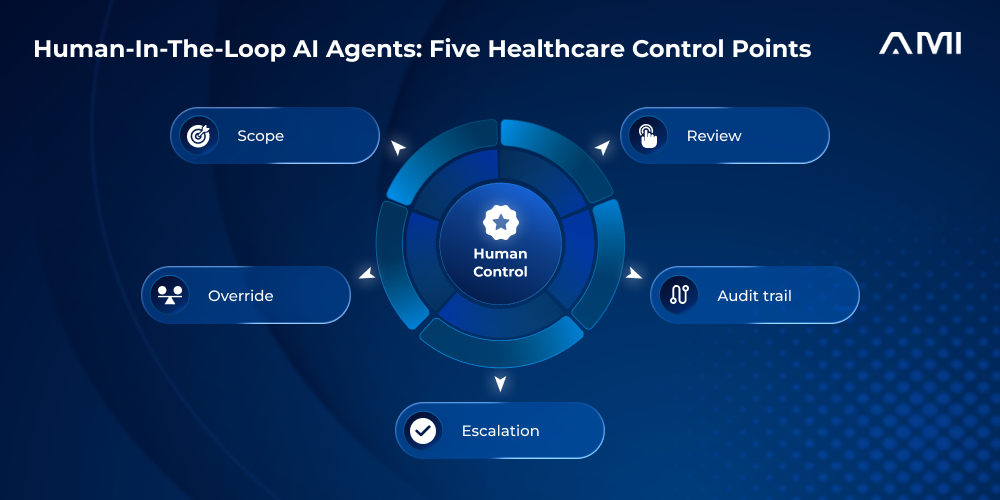
Create escalation tiers based on risk. A missing routine field might return to intake, while a disputed identity, potential privacy issue, or patient-impacting concern should go to a qualified owner. Each tier needs a destination, response expectation, and closure requirement.
An override should preserve the AI proposal, the human change, the reason, and any supporting evidence. Repeated overrides can reveal a bad rule, a drifting model, poor data quality, or a training gap.
See related implementation ideas in AM InfoWeb’s healthcare services.
How Can Organizations Audit Human-in-the-Loop Performance?
Review sampled decisions for reviewer attention, accuracy, timeliness, escalation quality, and whether the documented rationale fits the evidence. Track override rates, repeated exceptions, unresolved queues, and the share of cases where the reviewer had to reconstruct missing context.
NIST’s voluntary AI Risk Management Framework calls for human oversight processes to be defined and documented, and for post-deployment monitoring, appeal, and override mechanisms. Those are useful questions for healthcare teams evaluating AI agent controls.
What Should Healthcare Buyers Ask an AI Agent Vendor?
Ask for a task inventory, prohibited actions, human approval points, audit-log fields, access controls, incident process, monitoring cadence, and evidence of how errors are corrected. If protected health information is involved, review the data flow and business-associate obligations with privacy and legal teams.
A vendor should also explain how the system behaves when a tool fails, the input is incomplete, or the reviewer rejects a recommendation. A safe failure mode is part of the product, not an afterthought.
For a primary reference, see the NIST AI Risk Management Framework.

How AM InfoWeb Supports Human-in-the-Loop AI Workflows
AM InfoWeb has two decades of experience in the U.S. healthcare industry and uses a co-managed model where AI agents and skilled human agents work together to eliminate process bottlenecks and execute secure healthcare workflows.
AM InfoWeb can support:
- Defined review gates for sensitive operational exceptions
- Human validation of AI-prepared context and proposed next steps
- Override documentation, QA sampling, and recurring-error analysis
- Secure access, escalation routing, and operational reporting
Healthcare organizations retain responsibility for their own clinical, legal, privacy, policy, and final operational decisions.
Where Should Human Control Be Placed First?
Begin with the highest-impact actions and the least reliable inputs. Define a bounded AI task, test the review interface with real cases, and measure both staff workload and decision quality. Human-in-the-loop design succeeds when people can understand, change, and account for the action before it affects a patient or workflow.
Need human review that works in practice? AM InfoWeb can help structure AI-assisted workflows with clear approval points, exception routing, and audit-ready documentation.
Get in TouchFrequently Asked Questions
About the Author

Written by
Urza Dey
Urza Dey is a content and copywriter with over five years of experience across marketing, B2B SaaS, HealthTech, EdTech, and related industries. At AMI, they contribute to content strategy, blog development, and marketing communication focused on healthcare operations, business process management, and AI-enabled service delivery.
Related Posts
AI in Healthcare Compliance: Balancing Automation, Oversight, and Accountability
Govern healthcare AI through controlled data, oversight, evidence, and monitoring.
Healthcare Compliance Management: Build Evidence Across Every Operational Handoff
Connect compliance ownership, evidence, monitoring, escalation, and corrective action.