

AI Agent Monitoring: Control Deployed Automation Across Healthcare Operations
TL;DR: AI agent monitoring
Monitoring begins with an approved scope and expected behavior.
Action logs should connect inputs, outputs, tools, reviews, and outcomes.
Thresholds must route uncertain or sensitive work to qualified people.
Incidents, overrides, and drift should trigger documented corrective action.
AI agent monitoring is the operating discipline used to observe deployed agents, detect unexpected behavior, review exceptions, and document corrective action. In healthcare workflows, monitoring must cover more than uptime and response speed.
Teams need evidence about what an agent attempted, which information it used, what tools it called, whether a person intervened, and what happened downstream. Monitoring turns those signals into accountable decisions.
What Is AI Agent Monitoring?
AI agent monitoring combines technical telemetry, workflow evidence, quality review, user feedback, and governance decisions for deployed agents. It tests whether actual behavior remains within approved use, access, and performance boundaries.
Unlike a static pre-launch test, monitoring continues as data, prompts, tools, policies, integrations, and user behavior change. The plan should state who reviews each signal and what action follows.
Why Does Monitoring Continue After Deployment?
Performance can change when inputs shift, integrations fail, policies change, or users find new ways to interact with an agent. Healthcare workflows also contain rare exceptions that may not appear during testing.
NIST describes AI risk management across the lifecycle and its playbook calls for post-deployment monitoring that includes user input, appeal and override, incident response, recovery, and change management.
Primary source: NIST AI Risk Management Framework.
Which Controls Belong in an AI Monitoring Program?
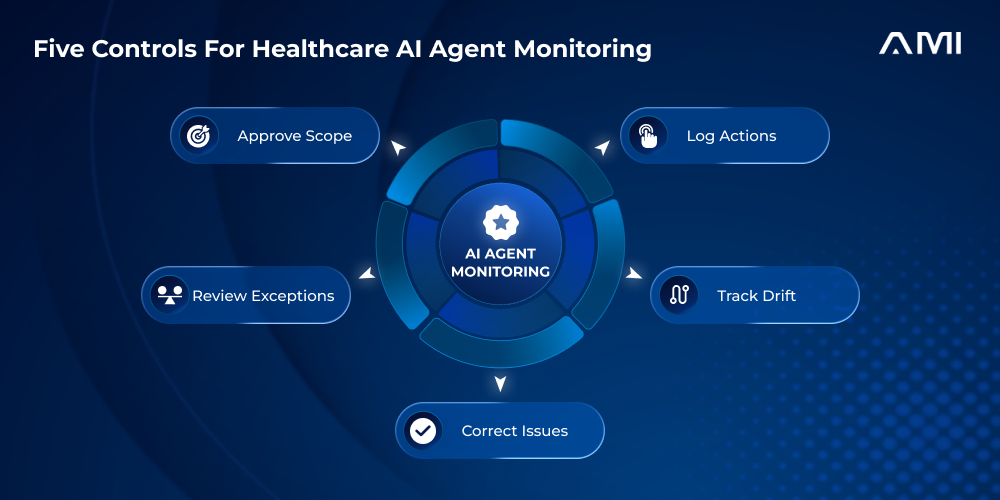
A practical program connects five controls: approved scope, action logs, exception review, drift tracking, and corrective action. Each control should produce evidence that can support an operating or governance decision.
| Control | Evidence | Response |
|---|---|---|
| Approved scope | Allowed tasks, data, tools, users | Block or route out-of-scope work |
| Action logs | Inputs, outputs, tool calls, timestamps | Reconstruct decisions and investigate failures |
| Exception review | Low confidence, overrides, complaints | Assign qualified human review |
| Drift tracking | Quality, error, and outcome trends | Re-test thresholds and workflow behavior |
| Corrective action | Issue owner, fix, validation, closure | Prevent recurrence and document change |
What Should AI Agent Logs Capture?
Capture the agent version, approved use case, requester context, relevant inputs, retrieved sources, tool calls, outputs, confidence or rule results, human interventions, final action, and outcome when available. Apply minimum-necessary and retention requirements to monitoring data.
Logs should support reconstruction without becoming an uncontrolled copy of sensitive content. Security, privacy, legal, and operational teams should define access, retention, masking, and investigation procedures.
How Should Teams Review Exceptions and Drift?
Use risk-based sampling plus triggered review. Triggers may include out-of-scope requests, low confidence, unusual tool use, repeated corrections, changed error patterns, user complaints, access anomalies, or downstream reversals.
Drift is not limited to model accuracy. Workflow drift can appear when staff bypass controls, new integrations change context, queues create delayed oversight, or an agent continues using outdated policy content.
Where Does Human Oversight Fit?
Human oversight needs defined authority, relevant context, sufficient expertise, and time to intervene. A reviewer should be able to pause execution, override a recommendation, escalate risk, and document why the decision changed.
NIST recommends monitoring plans that include appeal, override, incident response, recovery, and change management. Those mechanisms help connect observed failures to accountable remediation rather than passive reporting.
Primary source: NIST AI RMF Playbook Manage function.

How can healthcare teams keep AI actions accountable?
AI can prepare and route work, but deployed agents need clear scope, evidence, exception review, and human authority. AM InfoWeb combines controlled workflows, skilled human oversight, QA, and operational visibility to strengthen accountable AI operations.
How Should AI Monitoring Results Drive Remediation?
Classify issues by severity, affected workflow, data exposure, recurrence, and downstream impact. Assign an owner, containment action, root-cause review, correction, validation test, and closure evidence.
Governance reviews should distinguish isolated errors from systemic behavior. Repeated overrides, rising complaints, or changing outcomes may require threshold changes, new human review, tool restrictions, rollback, or decommissioning.
How AM InfoWeb Supports AI Agent Monitoring
AM InfoWeb has two decades of experience in the U.S. healthcare industry and uses a co-managed model where AI agents and skilled human agents work together to eliminate process bottlenecks and execute secure healthcare workflows.
AM InfoWeb can support:
- Approved workflow boundaries, escalation rules, and human decision points
- Action-level evidence for quality review, exception handling, and audit support
- Skilled human agents who review sensitive, ambiguous, and high-impact cases
- Governance reporting for overrides, drift, incidents, corrective actions, and outcomes
What Makes AI Agent Monitoring Effective?
Effective monitoring connects signals to ownership and action. Healthcare teams should know what each agent may do, preserve evidence of actual behavior, route exceptions to qualified people, and verify that remediation changes future outcomes.
Need stronger oversight for deployed AI agents? AM InfoWeb can support monitoring, review, escalation, and governance.
Get in TouchFrequently Asked Questions
About the Author

Written by
Urza Dey
Urza Dey is a content and copywriter with over five years of experience across marketing, B2B SaaS, HealthTech, EdTech, and related industries. At AMI, they contribute to content strategy, blog development, and marketing communication focused on healthcare operations, business process management, and AI-enabled service delivery.
Related Posts
Human-in-the-Loop AI Agents: Where Healthcare Teams Retain Final Control
Keep human approval, overrides, and audit trails in sensitive workflows.
Payer Compliance Solutions: From Policy to Operational Evidence
A payer compliance program may look complete on paper while still breaking down during daily execution. Policies may...