


Credit Balance in Medical Billing: Resolve Overpayments Without Delays
TL;DR: Credit Balance in Medical Billing
A credit balance signals that payments and adjustments exceed the remaining account responsibility.
Teams must determine whether money belongs to a patient, payer, another account, or a timing difference.
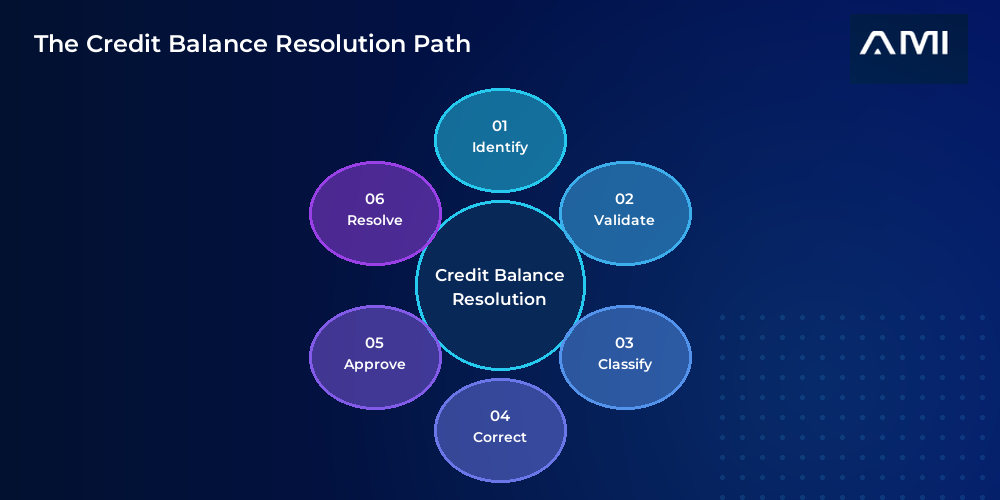
The resolution process identifies, validates, classifies, corrects, approves, and documents each disposition.
Medicare-participating providers should follow current CMS-838 and contractor requirements.
Metrics should segment credits by ownership, age, value, source, and root cause.
Root-cause analysis connects resolved balances to posting, estimation, eligibility, and coordination defects.
A credit balance in medical billing appears when payments or adjustments exceed the amount due on an account. The balance may reflect a legitimate payer or patient refund, but it can also result from duplicate payments, incorrect posting, coordination-of-benefits changes, reversed services, or unresolved system activity.
Credit balances deserve prompt investigation because they affect financial reporting, patient trust, payer relationships, and compliance. Moving them to a holding account does not answer who owns the money or what action is required.
This guide explains the credit balance process in medical billing, how to classify balances correctly, and which controls help healthcare organizations resolve overpayments without creating new errors.
Need stronger support across complex healthcare workflows? Explore AMI’s healthcare services.
What Is a Credit Balance in Medical Billing?
A credit balance is a negative account balance indicating that recorded payments and adjustments are greater than the remaining charges or responsibility. It may be owed to Medicare, another payer, the patient, a guarantor, or another account.
The balance itself is a signal, not a final conclusion. Teams must reconstruct the account history, validate charges and adjustments, review payer sequencing, and determine whether the credit is real, temporary, duplicated, or caused by an error.
CMS defines a Medicare credit balance as an improper or excess payment resulting from patient-billing or claims-processing errors. The official CMS-838 instructions describe reporting and repayment responsibilities for participating providers.
What Causes Credit Balances in Healthcare Accounts?
Common causes include:
- Duplicate payer or patient payments
- Incorrect contractual adjustments or write-offs
- Primary and secondary payers paying more than expected
- Patient prepayments exceeding final responsibility
- Reversed, reduced, or canceled services
- Payments posted to the wrong account or service line
- Retroactive eligibility or coordination-of-benefits changes
- Payer takebacks that have not posted correctly
- Credit transfers or refunds applied without complete documentation
The same source can create different obligations. A duplicate patient payment requires a different review and refund path from a Medicare overpayment or a payer recoupment.
How Does the Credit Balance Process Work?
A controlled credit balance process follows six stages:
1. Identify negative balances through scheduled reports and transaction alerts.
2. Validate the account, charges, payments, adjustments, payer order, and prior activity.
3. Classify ownership and root cause.
4. Correct posting errors before calculating the refundable amount.
5. Obtain required approval and issue the refund, transfer, adjustment, or report.
6. Record evidence, close the account, and feed the cause into prevention work.
Each balance needs an owner, aging status, supporting documents, and a clear disposition. Work queues should separate patient, commercial payer, Medicare, Medicaid, and unresolved balances because rules and deadlines can differ.
How Should Teams Investigate a Patient Credit Balance?
Patient credit balance review should confirm that all payer adjudication is complete and the patient’s final responsibility is correct. Staff should examine payments, statements, estimates, refunds, charge corrections, and related family or guarantor accounts.
Before issuing a refund, verify the recipient, address or payment method, amount, approval, and whether another open balance can legally and appropriately affect the disposition. Organizations should apply their policies and applicable law rather than assuming every credit follows the same path.
Clear communication matters. A patient should be able to understand why the credit occurred, what amount is being returned, and when to expect it. Preventing incorrect balances also supports better patient collection workflows.
How Are Medicare Credit Balances Reported?
Medicare-participating providers should follow current CMS instructions and their Medicare Administrative Contractor’s requirements. CMS uses Form CMS-838 to monitor the identification and recovery of Medicare credit balances. The instructions state that the report is submitted within 30 days after the close of each calendar quarter and includes Medicare credit balances shown in accounting records at quarter end.
Operational teams need a reporting calendar, documented account review, leadership certification workflow, and evidence that identified balances were handled correctly. Compliance or legal teams should confirm how current federal and state requirements apply to the organization.
This article provides operational guidance, not legal advice.
Which Controls Prevent Credit Balance Backlogs?
Backlogs grow when negative balances are discovered only through periodic cleanup. Organizations should monitor them continuously, age them by category, and route them according to ownership and deadline.
Preventive controls include duplicate-payment detection, payment-posting reconciliation, approval for manual adjustments, secondary-payer sequencing checks, refund status tracking, and audit trails for transfers and reversals. The underlying payment posting process should identify exceptions before they become aged credits.
Access should be separated where practical. The same person should not independently identify, approve, and issue a material refund without oversight.
Which Credit Balance Metrics Should Leaders Monitor?
| Metric | What It Reveals |
|---|---|
| Total credit balance value | Overall financial exposure requiring disposition |
| Balance count and aging | Volume and delay by category |
| New credits created | Whether upstream defects continue |
| Average resolution time | Workflow efficiency from identification to closure |
| Root-cause distribution | Processes creating repeated balances |
| Refund accuracy | Whether refunds require correction or reissue |
| Unresolved ownership | Credits still lacking a defensible classification |
Segment results by payer, facility, patient or payer ownership, dollar value, age, and root cause. Total dollars alone can hide high-volume patient issues or a small number of high-risk payer balances.
How Can Root-Cause Analysis Reduce Future Credits?
Resolving an account returns money or corrects the ledger. Root-cause analysis changes the process that produced the credit. Teams should classify causes consistently and connect them to accountable upstream owners.
Repeated duplicate payments may indicate payer-file or posting controls. Patient prepayment credits may reveal weak estimation or final-responsibility workflows. Coordination-of-benefits credits may point to registration or eligibility defects. Incorrect adjustments may require configuration changes or targeted training.
Leaders should compare credit-balance patterns with revenue leakage controls. Both overpayments and missed revenue indicate that account transactions do not reflect the underlying care and reimbursement correctly.
Need disciplined overpayment, refund, and reconciliation workflows? Explore AMI’s Revenue Cycle Management services.
How Should Technology Support Credit Balance Resolution?
Technology can identify negative balances, detect duplicates, group accounts by likely owner, enforce approval steps, and track refunds. It can also prioritize high-value or time-sensitive items and retain supporting evidence.
Rules should not automatically decide ownership when payer sequencing, contractual interpretation, or account history is ambiguous. Experienced reviewers need access to remittances, deposits, claim activity, correspondence, and prior adjustments. Human validation protects against refunding the wrong party or amount.
Dashboards should show aging, work completed, pending approvals, unresolved exceptions, and root causes. A credit should not disappear from reporting merely because it moved to another account or holding ledger.

How Does AM Infoweb Support Credit Balance Operations?
AM Infoweb supports healthcare organizations with controlled revenue cycle workflows, experienced teams, quality assurance, and transparent reporting.
With two decades of experience in the U.S. healthcare industry, AM Infoweb uses a co-managed model where AI agents and skilled human agents work together to eliminate process bottlenecks and execute secure healthcare workflows.
AMI can support:
- Credit balance identification and work-queue management
- Account research and ownership classification
- Payment and adjustment validation
- Refund documentation and approval support
- Aging, exception, and root-cause reporting
- Quality assurance and audit-ready evidence
- Upstream feedback for recurring defects
The goal is timely, accurate disposition supported by evidence, not simply reducing a dashboard total.
What Should Healthcare Leaders Do Next?
Begin with a complete inventory of negative balances across patient accounting and holding accounts. Segment them by owner, age, value, source, and risk. Confirm that policies define review evidence, approvals, reporting, refunds, and escalation.
Then connect resolution findings to prevention. A sustainable credit balance process combines reliable payment posting, clear ownership, timely investigation, controlled refunds, and root-cause correction.
Need stronger control over healthcare credit balances? AMI combines trained RCM teams, AI-assisted prioritization, QA, and operational reporting to improve research, resolution, and prevention.
Get in TouchFrequently Asked Questions
About the Author

Written by
Urza Dey
Urza Dey is a content and copywriter with over five years of experience across marketing, B2B SaaS, HealthTech, EdTech, and related industries. At AMI, they contribute to content strategy, blog development, and marketing communication focused on healthcare operations, business process management, and AI-enabled service delivery.