
Traditional vs Modern Contact Centers in Healthcare (2026)
TL;DR — Comparison at a Glance
Traditional healthcare contact centers usually focus on answering calls, managing queues, and tracking activity. Modern contact centers focus on moving patient, member, and provider requests toward resolution.
Traditional models often rely on menus, transfers, manual notes, and limited QA samples. Modern models use intent-aware routing, structured documentation, broader QA visibility, and context-led escalation.
A modern contact center does not mean AI-only. It combines trained healthcare teams, AI-assisted workflows, Agent Assist, QA visibility, reporting, and human oversight.
AI can support caller intent capture, smart routing, call summaries, documentation, QA review, escalation signals, and workflow trend reporting.
Sensitive, urgent, emotional, complex, or exception-based healthcare interactions should remain human-led or be escalated quickly to trained teams.
Healthcare leaders should compare models based on routing accuracy, documentation quality, QA coverage, escalation handling, reporting visibility, healthcare workflow knowledge, and operational control.
AMI helps healthcare organizations modernize contact center operations with trained teams, AI-assisted execution, Agent Assist, QA visibility, escalation support, and co-managed oversight.
Healthcare contact centers have moved far beyond answering calls and managing queues. Today, healthcare contact centers support patient, member, and provider interactions tied to scheduling, billing, benefits, authorizations, records, escalations, and follow-ups. These workflows require accuracy, documentation, empathy, visibility, and clear ownership.
A modern contact center in healthcare should help teams manage these workflows with more consistency and control. It should not simply add more agents or more tools. It should improve how interactions are captured, routed, documented, monitored, escalated, and resolved.
AI-first healthcare contact center operations can support this shift. AI can help with intake, smart routing, Agent Assist, call summaries, documentation, QA visibility, escalation signals, and reporting. But in healthcare, modern does not mean AI-only. Complex, sensitive, urgent, or exception-based interactions still need trained human teams.
What Is a Modern Contact Center in Healthcare?
A modern contact center is a healthcare support model that combines trained teams, workflow design, digital tools, AI-assisted execution, QA visibility, escalation management, and reporting. It is built to support the full interaction journey, not just answer the call.
In healthcare, that means supporting patient questions, member support, provider inquiries, billing concerns, benefits questions, authorization follow-ups, scheduling requests, and records-related workflows.
A modern model may include AI-powered contact center solutions, but technology alone does not make a contact center modern. The real difference is whether the operation helps leaders improve resolution, documentation, visibility, escalation, and service consistency.
Why Traditional Healthcare Contact Centers Are Under Pressure
Traditional contact centers still have value. Many were built to handle call queues, answer common questions, and provide coverage. But healthcare volume and workflow complexity have changed.
Many traditional models now struggle with rising call volume, long wait times, repeat status calls, fragmented systems, inconsistent documentation, limited QA coverage, staffing constraints, and poor visibility into recurring issues.
These challenges make it harder for leaders to understand why patients, members, and providers are calling, where delays are happening, and which workflows are creating repeat contact. That is why many organizations are rethinking healthcare contact center operations and comparing traditional models with more workflow-aware alternatives.
Traditional vs Modern Contact Centers: The Core Difference
Traditional contact centers often focus on call handling, staffing coverage, queue performance, and average handle time. These metrics still matter, but they do not show whether the interaction actually moved the request forward.
Modern healthcare contact centers focus on workflow resolution. They look at whether the caller’s intent was captured, the request was routed correctly, the interaction was documented properly, the next step was clear, and exceptions were escalated with context.
In short, traditional models often measure activity. A modern contact center should measure progress.
What Healthcare Leaders Should Compare Before Modernizing Contact Center Operations
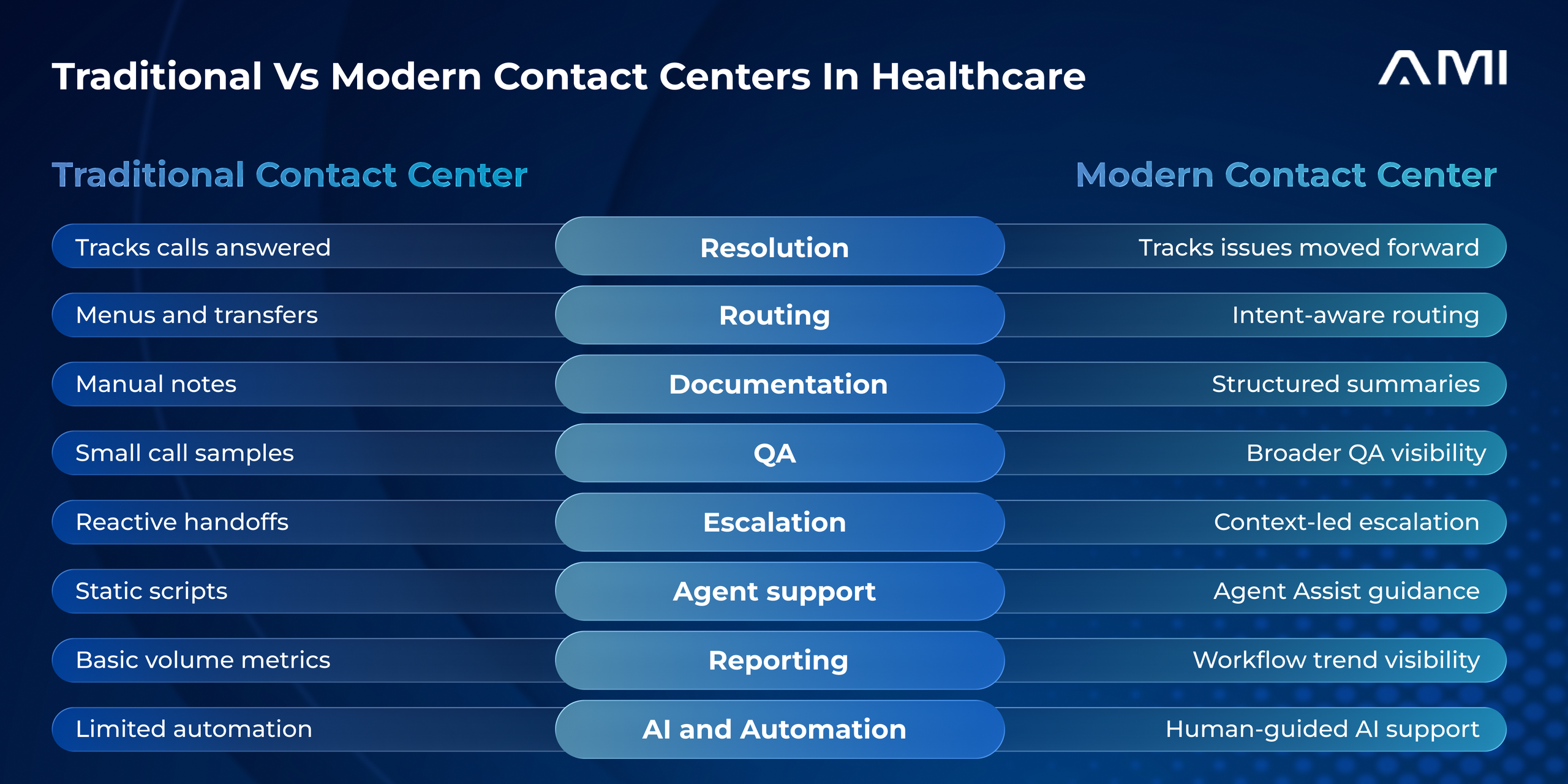
Healthcare leaders should compare traditional and modern models across operational capabilities, not only cost or call coverage. The right model should improve the experience for patients, members, providers, agents, and leadership teams.
1. Call handling vs workflow resolution
Traditional models often measure calls answered, handle time, and queue performance. Modern contact centers should also measure whether the interaction moved the patient, member, or provider request forward.
For example, did the caller receive a clear next step? Was the case documented? Was the workflow completed or routed correctly? These questions matter more than call volume alone.
2. Basic routing vs intent-aware routing
Traditional routing may depend on menus, queues, or manual transfers. This can create frustration when callers reach the wrong team.
Modern contact centers should use caller intent, workflow type, risk, urgency, and complexity to route interactions more accurately. This is especially important across contact center services for healthcare, where a billing question, provider authorization request, and urgent access issue should not follow the same path.
3. Manual notes vs structured documentation
Traditional models may rely on inconsistent agent notes. That can create weak handoffs, repeat calls, and delays.
Modern models should support structured documentation, disposition codes, next steps, summaries, and handoff context. Strong documentation is one of the most important parts of healthcare contact center best practices because it protects workflow continuity.
4. Limited QA samples vs broader QA visibility
Traditional QA often reviews only a small sample of calls. That gives leaders limited insight into documentation gaps, escalation issues, coaching needs, and caller experience.
Modern models can use AI-driven contact center QA tools to review more interactions and surface patterns. AI-assisted QA should support visibility, not replace human judgment. Sensitive healthcare conversations still need trained review.
5. Reactive escalation vs escalation with context
Traditional escalation can create repeated explanations and poor handoffs. The caller may have to explain the issue again, and the next team may not have enough context to act.
Modern contact centers should preserve caller intent, reason for escalation, missing information, urgency, and next steps. This makes escalation safer, faster, and easier to review.
6. Static scripts vs Agent Assist guidance
Traditional agents may rely on static scripts or manual knowledge searches. That can slow down calls and create inconsistent answers.
Agent Assist for healthcare contact centers can support live teams with approved guidance, workflow prompts, suggested next steps, and escalation cues. The agent stays in control, while AI supports consistency.
7. Basic reporting vs workflow visibility
Traditional reporting may focus on call volume, wait time, and average handle time. These numbers are useful, but incomplete.
Modern reporting should show inquiry trends, repeat-call drivers, escalation patterns, QA findings, documentation quality, and workflow bottlenecks. This helps leaders understand what is causing pressure across healthcare contact center services.
8. Generic support vs healthcare-specific workflow knowledge
Traditional outsourced support may be too generic for healthcare workflows. A modern model should understand patient, member, provider, billing, benefits, authorization, and records-related interactions.
This matters when comparing contact center solutions for healthcare, because workflow knowledge affects accuracy, routing, documentation, and escalation quality.
9. Automation-first vs human-guided AI support
Modern does not mean full automation. A safer model uses AI-assisted contact center operations to support repeatable operational tasks while keeping sensitive, urgent, complex, or compliance-heavy cases human-led.
This is where AI and automation in healthcare must be handled carefully. AI can improve consistency and visibility, but human teams should still own judgment-based interactions.
Where AI Fits in a Modern Healthcare Contact Center
AI works best as an operations support layer inside a modern contact center. It can support:
| AI support area | How it helps healthcare contact center teams |
|---|---|
| Caller intent capture | Identifies why the caller is reaching out before routing. |
| Smart routing | Routes interactions by caller type, urgency, complexity, and workflow. |
| Agent Assist | Gives live agents approved prompts, guidance, and next steps. |
| Call summaries | Creates clearer notes and reduces after-call documentation work. |
| QA review coverage | Helps review more interactions and identify patterns. |
| Escalation signals | Flags urgent, unresolved, or complex cases for review. |
| Trend reporting | Shows repeat-call drivers, bottlenecks, and workflow gaps. |
This is not about replacing teams. It is about using contact center automation to reduce friction across intake, routing, documentation, QA, and reporting.
What Should Still Stay Human-Led
Even in modern healthcare contact centers, some interactions should remain human-led. These include sensitive conversations, urgent cases, emotional interactions, complex billing disputes, unclear benefits issues, authorization exceptions, PHI-sensitive concerns, unresolved escalations, and complaints.
Call center automation should not block access to human help. It should identify when human support is needed faster and give trained teams better context.
The strongest AI-first healthcare contact center operations use automation for structure and visibility while keeping people responsible for empathy, judgment, and exception handling.
How AMI Supports AI-First Healthcare Contact Center Operations
AMI supports healthcare organizations with AI-first Healthcare Contact Center Operations designed to improve workflow consistency, service visibility, and human oversight across patient, member, and provider interactions.
The model combines trained healthcare support teams, AI-assisted intake, smart routing, Agent Assist, structured documentation, QA visibility, escalation workflows, and co-managed execution so organizations can modernize healthcare contact center operations without losing control.
AMI supports:
- Patient, member, and provider inquiry support
- AI-assisted intake and caller intent capture
- Smart routing and escalation with context
- Agent Assist for live support workflows
- AI-assisted documentation and summaries
- QA visibility and interaction trend reporting
- Compliance-aware workflow support
- Co-managed operations with client oversight
For healthcare leaders comparing healthcare contact center outsourcing, automation, or modernization options, the goal should not be technology for its own sake. The goal should be a safer, more visible operating model where trained teams, AI support, QA, and reporting work together.
Ready to move from traditional call handling to a modern contact center model? AMI helps healthcare organizations modernize support with trained teams, AI-assisted workflows, Agent Assist, QA visibility, escalation support, reporting, and co-managed operational control.
Get In TouchFrequently Asked Questions
About the Author

Written by
Urza Dey
Urza Dey is a content and copywriter with over five years of experience across marketing, B2B SaaS, HealthTech, EdTech, and related industries. At AMI, they contribute to content strategy, blog development, and marketing communication focused on healthcare operations, business process management, and AI-enabled service delivery.