
Healthcare Contact Center Best Practices for AI-First Operations
TL;DR — Healthcare Contact Center Best Practices at a Glance
Healthcare contact center best practices now need to focus on resolution, not just call handling.
Strong workflows help teams manage patient, member, and provider inquiries with clearer next steps and ownership.
Standardized intake and documentation reduce repeat calls, missed handoffs, and delayed follow-ups.
Intelligent routing and clear escalation rules help sensitive, urgent, or complex cases reach the right team faster.
Agent Assist and AI-assisted workflows can support live teams with guidance, summaries, routing, QA, and visibility.
Healthcare contact center quality assurance should cover more interactions, not just small manual samples.
AI-first healthcare contact center operations work best when trained human teams remain responsible for complex, sensitive, and exception-based interactions.
Healthcare contact centers manage interactions that are often tied to scheduling, billing, benefits, authorizations, records, provider communication, and escalation workflows. These are not simple call-handling environments. They sit at the center of patient access, member experience, provider support, and administrative performance.
As inquiry volume grows, many healthcare contact centers are facing the same pressures: long wait times, staffing strain, fragmented systems, inconsistent documentation, and limited quality visibility. Traditional service models can still support basic call coverage, but they often fall short when healthcare teams need speed, context, compliance awareness, and clear workflow ownership.
This is why healthcare contact center best practices need to evolve. The goal is no longer only to answer calls faster. Modern teams need better intake, smarter routing, stronger documentation, clearer escalations, broader QA, and better visibility into what is driving repeat contact.
AI can help, but only when used carefully. AI-first healthcare contact center operations should not remove people from healthcare support. A stronger model uses AI to support intake, routing, documentation, QA, and reporting while trained teams manage complex, sensitive, and exception-based interactions.
Why healthcare contact center best practices need to evolve
Traditional call center practices were built around volume, speed, and queue management. Modern healthcare contact center operations need more than that. A single interaction may involve a patient record, a payer portal, a scheduling system, a billing platform, an authorization workflow, or an internal escalation path.
When these workflows are not connected, agents spend more time searching for information, callers repeat the same details, and follow-ups become harder to track. Documentation gaps can create downstream delays, while limited QA coverage makes it difficult for leaders to understand where quality, compliance, or process issues are emerging.
For large healthcare organizations, the best practices now need to focus on resolution, not just response time. Teams must improve how requests are captured, routed, completed, measured, and escalated.
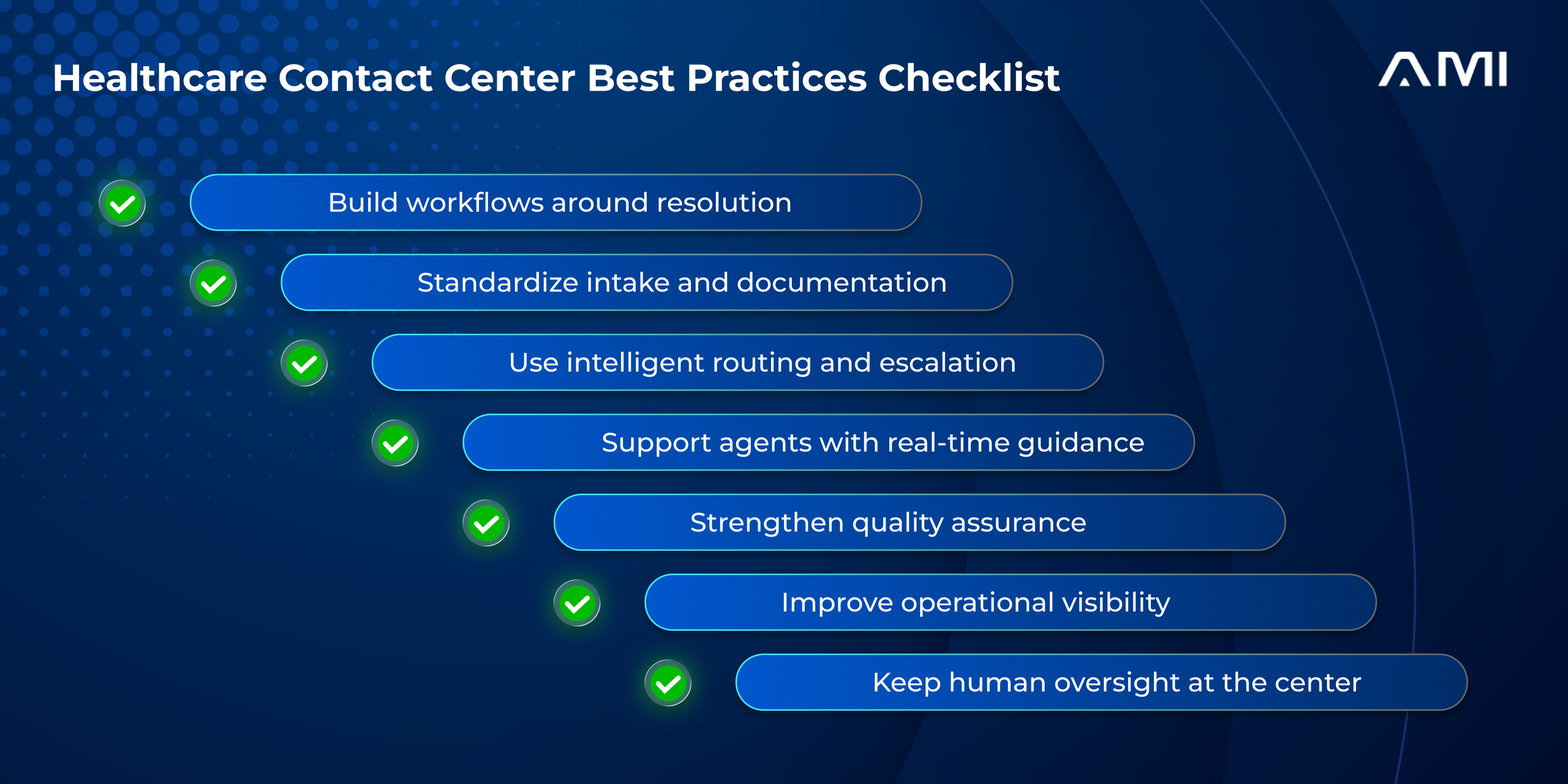
Best practice 1: Build workflows around resolution, not call handling
A strong contact center not only measures how many calls were answered, but also measures whether each interaction moved the request forward. That means every inquiry should be connected to a workflow, outcome, or next step.
For example, an authorization status call should not end with a vague update. The agent should know whether documentation is missing, whether the request is pending, whether follow-up is needed, or whether the case requires escalation. The same applies to billing questions, appointment requests, member inquiries, and provider follow-ups.
Better resolution starts with:
- Clear inquiry classification
- Workflow mapping by request type
- Defined next steps
- Ownership for unresolved cases
- Outcome tracking
AI can support this by capturing caller intent, classifying inquiry types, and routing the interaction to the right workflow faster. When designed well, AI-assisted contact center operations improve speed without removing escalation rules or human review.
Best practice 2: Standardize intake and documentation
Inconsistent intake is one of the biggest reasons healthcare contact centers experience repeat calls, missed handoffs, and delayed follow-up. When agents capture information differently, downstream teams may not have the context they need to complete the request.
Standardized documentation should include required fields, call notes, disposition codes, caller intent, next steps, and escalation details. This gives teams a shared record of what happened and what needs to happen next.
For contact center services for healthcare, documentation is more than an internal process. It protects continuity. A billing team, authorization team, records team, or provider support team should be able to understand the interaction without starting over.
AI can help by generating structured summaries, prompting agents for missing information, and supporting consistent note formats. This reduces manual work while improving the quality of handoffs.
Best practice 3: Use intelligent routing with clear escalation rules
Not every healthcare inquiry should follow the same path. Some requests are simple and structured. Others are urgent, sensitive, unresolved, or exception-based. A modern contact center should route by intent, risk, complexity, and required ownership.
Clear escalation rules help teams know when a case needs human review, clinical input, payer-specific handling, billing review, or leadership attention. Conversation history should also move with the interaction, so the next team does not lose context.
This is especially important for member and provider inquiry support, where callers may need help with eligibility, claims status, authorization follow-up, records requests, or policy-related questions.
AI can support routing by identifying caller intent, detecting missing information, and flagging cases that need escalation. The best model uses AI to improve speed and context while keeping trained people responsible for judgment-based decisions.
Best practice 4: Support agents with real-time guidance
Healthcare agents often have to manage policies, scripts, payer requirements, internal workflows, and system navigation while speaking with callers. Without the right support, even experienced agents can lose time searching for answers or confirming the next step.
Agent support should include updated knowledge bases, workflow prompts, policy guidance, suggested next steps, and clear escalation instructions. This improves consistency and reduces the pressure on agents during complex calls.
Agent Assist can help live teams with real-time guidance, suggested responses, conversation summaries, and next-step prompts. In AI-assisted contact center operations, the human agent remains in control, while AI acts as a support layer that improves accuracy and speed.
This is especially useful when teams handle high-volume but detail-heavy interactions, such as benefits questions, billing inquiries, authorization follow-ups, and provider status calls.

Why do healthcare contact centers struggle even after adding more agents?
Because rising volume, fragmented systems, repeat calls, and delayed escalations require more than staffing alone. AMI combines AI voice, AI non-voice, and trained human agents to improve routing, documentation, QA visibility, and service execution.
Best practice 5: Strengthen healthcare contact center quality assurance
Manual QA often reviews only a small sample of interactions. That can leave leaders with limited visibility into documentation quality, compliance risks, escalation accuracy, caller sentiment, and missed process steps.
Strong healthcare contact center quality assurance should look at more than politeness or script adherence. It should evaluate whether the interaction was documented correctly, whether the right workflow was followed, whether the escalation was appropriate, and whether the caller received a clear next step.
A stronger QA model should include:
- Scorecards by workflow type
- Documentation checks
- Escalation accuracy reviews
- Compliance-aware monitoring
- Trend detection
- Coaching opportunities
AI-assisted QA can help review more interactions for quality signals, sentiment, missed steps, and recurring patterns. This does not replace QA teams. It gives them broader visibility so they can focus their judgment where it matters most.
Best practice 6: Improve visibility into patient, member, and provider trends
Contact center data can reveal where healthcare operations are under pressure. Repeated billing questions may point to unclear statements. High authorization status calls may suggest follow-up delays. Frequent provider inquiries may show gaps in communication, portal access, or documentation workflows.
Leaders should track inquiry types, wait-time drivers, repeat contacts, escalation reasons, documentation issues, and workflow bottlenecks. This turns the contact center from a reactive support function into a source of operational insight.
AI can help organize interaction data into patterns that leaders can act on. This is where healthcare contact center services become more valuable than basic call coverage. The contact center starts showing what needs improvement across access, billing, authorizations, records, and provider communication.
Better visibility helps teams improve staffing, training, workflows, knowledge content, and service design.
Best practice 7: Keep human oversight at the center
AI-first operations should not mean removing people from care-adjacent conversations. A better model uses AI to support intake, routing, documentation, QA, and visibility while trained teams remain responsible for complex, sensitive, or exception-based interactions.
Human oversight matters because healthcare interactions often carry emotional, financial, clinical, or compliance-related weight. Patients may be frustrated. Members may be confused about coverage. Providers may need urgent status updates. Some conversations require judgment, empathy, and ownership.
The safest approach is controlled AI use, clear escalation of ownership, auditability, reporting, and compliance-aware workflows. This helps healthcare leaders adopt AI without losing control of the support experience.
How AI-first healthcare contact center operations support these best practices
AI-first healthcare contact center operations support these best practices by creating a stronger operating layer around healthcare teams. AI can assist with common inquiries, intake, routing, summaries, quality checks, workflow visibility, and analytics.
AI agents can support structured questions and common workflows. Agent Assist can guide live teams with suggested responses, policy prompts, and next steps. AI-assisted documentation can improve consistency, while smart routing can move requests to the right workflow faster.
The value is not automation for its own sake. The value is better service execution. With the right controls, AI-powered health contact center operations can improve speed, consistency, QA, and visibility while keeping human oversight at the center.
What healthcare leaders should look for in a modern contact center partner
A modern partner should do more than provide staffing capacity. The right partner should understand healthcare workflows, protect sensitive information, support complex escalations, and give leaders visibility into service performance.
Key capabilities to look for include:
- Healthcare workflow expertise: Support across patient, member, provider, billing, authorization, and records-related interactions.
- HIPAA-aware processes: Secure handling of sensitive healthcare information across channels.
- AI-assisted execution: Support for routing, documentation, QA, summaries, and workflow follow-through.
- Clear escalation protocols: Defined paths for urgent, sensitive, unresolved, or complex requests.
- QA and reporting visibility: Dashboards and insights into volume, trends, escalations, and service performance.
- Scalable delivery: Support for peak periods, after-hours needs, changing demand, and human oversight.
For contact center services for healthcare, this combination matters because performance depends on both process discipline and human judgment.
Ready to apply healthcare contact center best practices at scale? AMI helps healthcare teams improve resolution, routing, documentation, QA visibility, and escalation with AI-assisted workflows, trained support teams, and co-managed operational control.
Avail Your Free AssessmentHow AMI supports AI-first Healthcare Contact Center Operations
AMI supports healthcare organizations with healthcare contact center operations built around service consistency, workflow visibility, and human oversight. The model combines trained healthcare support teams, AI-assisted workflows, clear escalation rules, and co-managed execution to help organizations manage patient, member, and provider interactions more effectively.
AMI’s approach is designed for real operational pressure: high inquiry volume, repeated status calls, after-hours needs, fragmented documentation, limited QA visibility, and complex escalations. AI supports structured, high-volume workflows. Human experts manage sensitive, urgent, unresolved, or exception-based interactions. Leaders retain oversight through reporting, QA, governance, and process visibility.
AMI’s AI-first contact center operations support:
- Patient, member, and provider inquiry support
- AI-assisted intake, routing, and documentation
- Agent Assist for live support workflows
- Healthcare contact center quality assurance and performance visibility
- Escalation support with full interaction context
- Co-managed operations with client oversight
For healthcare teams, the goal is not to force AI into every interaction. The goal is to create a reliable operating model where AI supports what it can, expert teams handle what they should, and leaders gain the visibility needed to improve service at scale.
Frequently Asked Questions
About the Author

Written by
Urza Dey
Urza Dey is a content and copywriter with over five years of experience across marketing, B2B SaaS, HealthTech, EdTech, and related industries. At AMI, they contribute to content strategy, blog development, and marketing communication focused on healthcare operations, business process management, and AI-enabled service delivery.