

Medical Records Retrieval Companies for Lawyers: How to Choose
TL;DR — Record Retrieval Should Support Case Readiness
Strong medical record retrieval for law firms combines request accuracy, provider follow-up, secure handling, QA, and usable status reporting.
The best retrieval partners manage requests through closure rather than stopping after submission.
Electronic medical records retrieval can improve speed and tracking, but received files still require completeness checks and organization.
Law firms should evaluate legal experience, authorization review, turnaround reporting, pricing transparency, security, and escalation discipline.
Retrieval quality affects chronology development, demand preparation, expert review, discovery, settlement strategy, and trial readiness.
A strong partner should identify partial responses, duplicate records, missing date ranges, and unresolved provider issues.
AM InfoWeb supports legal teams with retrieval, provider follow-up, QA, reporting, secure document handling, and connected litigation support services.
Medical records can influence case evaluation, damages analysis, demand preparation, expert review, settlement strategy, and trial readiness. Yet retrieving them often requires repeated coordination with hospitals, clinics, specialists, pharmacies, imaging centers, therapists, and record custodians. The right medical records retrieval companies for lawyers help legal teams manage that process without turning attorneys and paralegals into full-time request coordinators.
A retrieval partner should do more than submit requests. It should validate request details, follow up with providers, identify incomplete responses, organize incoming files, report delays clearly, and keep each request moving toward closure. For law firms, the real value is not record volume alone. It is faster case readiness, dependable completeness, and visibility into what is still outstanding.
Why Medical Record Retrieval Matters for Law Firms
Medical records help legal teams understand treatment history, injuries, causation, prior conditions, damages, provider activity, and gaps in care. They may be needed before an attorney can assess case value, prepare a demand, engage an expert, respond to discovery, or establish a defensible litigation strategy.
A delayed or incomplete response can hold up several downstream activities at once. Attorneys may begin reviewing a case without the full clinical picture. Paralegals may repeatedly contact the same provider. Chronology teams may receive records in separate batches without knowing whether the set is complete.
Retrieval quality therefore affects more than administrative efficiency. It affects how confidently and quickly the firm can move a matter forward.
What Medical Records Retrieval Companies for Lawyers Actually Do
Medical records retrieval companies for lawyers help firms request, track, receive, review, organize, and securely deliver records from healthcare providers, facilities, custodians, and other record sources.
The workflow may include reviewing authorization details, identifying providers, submitting requests, managing custodian communication, following up on rejected or aging requests, addressing fees, receiving electronic files, and documenting status.
Because medical records contain protected health information, the retrieval process also requires appropriate authorization and secure handling. HHS guidance explains that a valid authorization must identify the information to be disclosed, the person authorized to disclose it, the intended recipient, and an expiration date or event, among other required elements.
The strongest vendors continue working until the request is complete, resolved, or clearly documented as unable to proceed.
When a Law Firm Should Outsource Record Retrieval
Outsourcing becomes relevant when internal teams spend too much time calling providers, resubmitting forms, tracking copy fees, or searching through emails for status notes.
Other warning signs include attorneys waiting for records before reviewing a matter, repeated partial responses, inconsistent provider follow-up, limited visibility across open requests, or uncertainty about whether all expected records have arrived.
A firm may also need additional capacity during mass tort projects, litigation surges, staffing gaps, or high-volume case intake. The objective should not simply be to move work outside the firm. It should be to introduce a more controlled process with clearer ownership, documentation, and reporting.
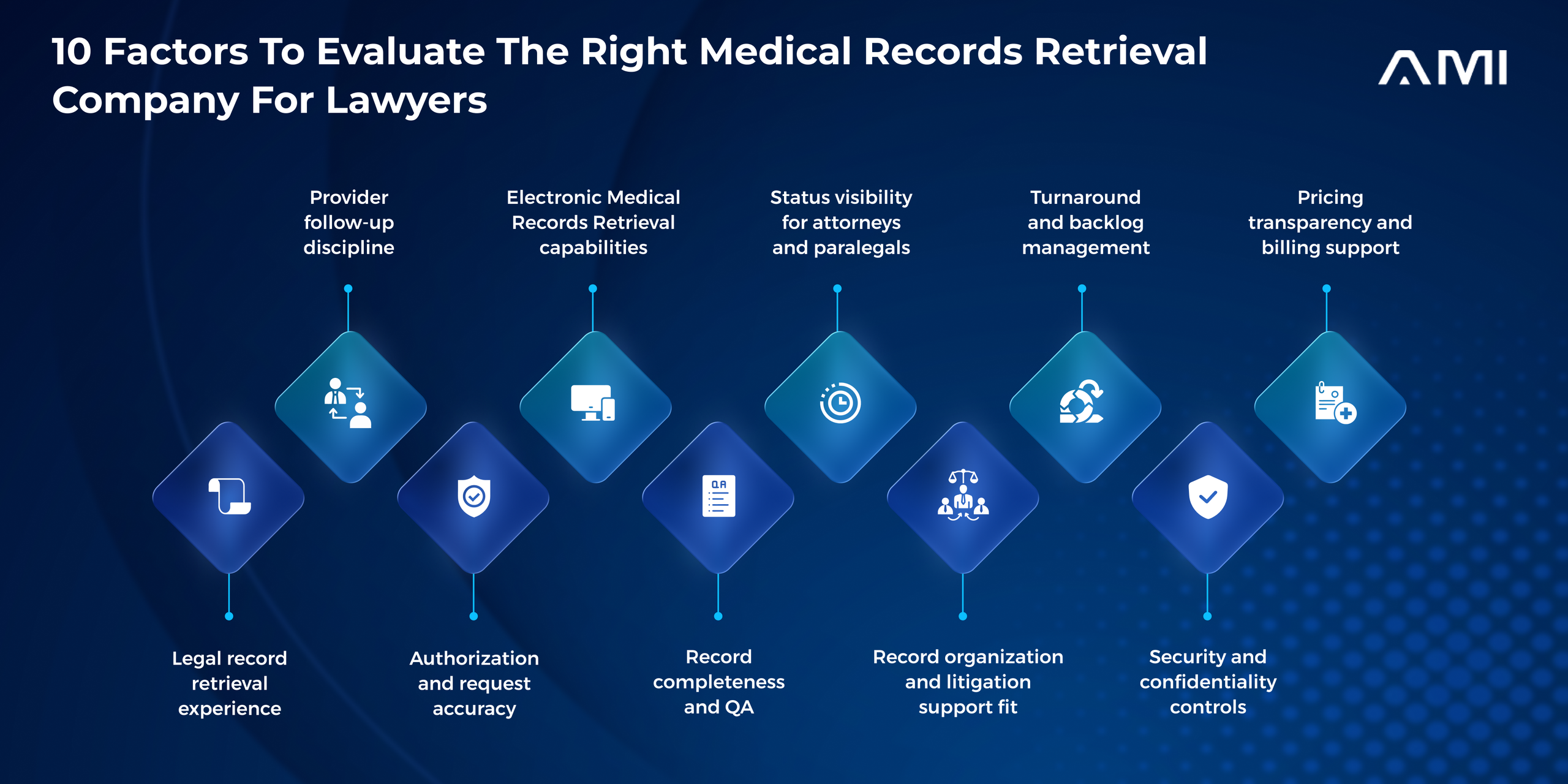
Finding Your Best Match: 10 Factors for Evaluating a Retrieval Partner
Choosing a retrieval company requires looking at how the vendor performs the work, not only how quickly or cheaply it promises to deliver records. The following factors help law firms evaluate whether a prospective partner can support legal timelines and downstream case preparation.
1. Legal record retrieval experience
A vendor should understand legal record retrieval, not only general healthcare administration.
Personal injury, workers’ compensation, disability, insurance defense, mass tort, and other matters may involve different provider networks, request volumes, timelines, and downstream review needs. The team should understand that each request supports a legal objective rather than an isolated administrative task.
Ask which types of firms and matters the vendor supports, how it documents provider responses, and how it handles requests that become urgent as deadlines approach.
2. Provider follow-up discipline
Request submission is only the beginning. Providers may require corrected documentation, additional identifiers, updated authorization, fee approval, custodian coordination, or repeated follow-up.
A strong vendor should use a defined follow-up cadence and record each contact attempt, provider response, pending requirement, and next action. Aging requests should have an escalation path rather than remaining untouched between periodic status checks.
The firm should be able to see whether the delay sits with the provider, requester, authorization, fee approval, or retrieval team.
3. Authorization and request accuracy
Incomplete request details can create avoidable delays before the provider begins locating records.
The vendor should confirm the client or patient name, date of birth, provider or facility, requested record category, date range, signature, date signed, expiration terms, delivery instructions, and whether billing records are also needed.
Authorization requirements may vary based on the request and applicable rules, so the partner should identify missing or inconsistent information rather than guessing. HHS states that the HIPAA Privacy Rule established national standards protecting medical records and individually identifiable health information.
4. Electronic Medical Records Retrieval capabilities
Modern electronic medical records retrieval may involve provider portals, digital request platforms, secure file transfers, online payment processes, electronic authorizations, and multiple document formats.
Electronic channels can improve transmission speed and request traceability, but they do not eliminate operational work. Teams still need to validate the patient, monitor provider responses, confirm the requested date range, review downloaded files, and organize the final record set.
Ask how the vendor manages portal credentials, secure downloads, file naming, digital delivery, and records received in separate batches.
5. Record completeness and QA
A completed request should mean more than “documents received.”
The retrieval team should confirm that the response came from the correct provider, covers the requested date range, includes the requested record categories, and belongs to the correct patient. It should also identify partial responses, duplicate files, unreadable pages, unexpected gaps, and situations where billing records arrived without the requested clinical records.
This matters because protected health information must be handled through appropriate safeguards. For electronic PHI, the HIPAA Security Rule requires administrative, physical, and technical measures that protect confidentiality, integrity, and availability.
6. Status visibility for attorneys and paralegals
Law firms should not need to email the vendor every time they want to know whether a request was submitted or why it remains open.
Useful reporting should show the provider, request date, current status, latest follow-up, pending issue, fee status, records received, partial-response status, and expected next action. Attorneys, paralegals, case managers, and legal operations leaders should be able to understand the report without translating internal vendor terminology.
Visibility turns retrieval from a black-box service into a manageable legal operations workflow.
7. Turnaround and backlog management
Turnaround depends on several factors, including provider responsiveness, authorization accuracy, record availability, copy fees, follow-up cadence, and delivery channel. A credible vendor should explain these dependencies rather than make vague speed guarantees.
Ask how the company reports average turnaround, aging requests, rejected submissions, provider delays, internal handling time, and unresolved bottlenecks. The firm should also know how the vendor prioritizes rush matters and what qualifies for escalation.
Strong backlog management makes delays visible early enough for the legal team to adjust.

Why does record retrieval become difficult to control at scale?
Delays, follow-ups, provider coordination, and documentation gaps can slow down litigation support workflows. AM InfoWeb helps legal and healthcare teams manage record retrieval with structured processes, experienced teams, and clear operational visibility.
8. Record organization and litigation support fit
Received records should be usable by the people preparing the case.
Depending on the matter, documents may need to be organized by provider, date, facility, record type, treatment episode, claim, or injury. Clear file naming, provider separation, duplicate removal, and consistent indexing make downstream review easier.
A retrieval partner that also understands litigation support services can better align the output with medical chronology development, medical summaries, demand packages, discovery review, and expert analysis.
9. Security and confidentiality controls
Medical records contain sensitive information, so law firms should understand how the vendor controls access, transmits files, trains employees, monitors activity, and documents incidents.
Ask about individual user access, secure delivery, data storage, confidentiality policies, subcontractors, retention, disposal, and escalation procedures. When a service provider handles PHI on behalf of a covered entity or business associate, it may qualify as a business associate and have obligations tied to that relationship.
The vendor should be able to explain these controls in workflow terms, not only provide broad policy statements.
10. Pricing transparency and billing support
Price matters, but a low per-request rate can be misleading when provider copy charges, portal fees, rush fees, cancellations, resubmissions, or separate billing-record requests are not clearly explained.
The law firm should understand what the base fee includes, which charges are passed through, when approval is required, how cancellations are handled, and whether incomplete or unsuccessful requests incur costs.
Transparent pricing allows firms to compare vendors based on the full retrieval workflow rather than one headline rate.
Questions to Ask Before Choosing Record Retrieval Services
A structured vendor conversation can reveal whether the company understands the firm’s workload and case-readiness needs.
Ask prospective record retrieval services providers:
- Do you specialize in medical record retrieval for law firms, and which case types do you support?
- How do you validate authorizations, submit requests, follow up with providers, manage fees, and escalate aging matters?
- Do you support secure electronic retrieval, and how do you review records for completeness, duplicates, wrong-patient files, and missing date ranges?
- What reporting will attorneys and paralegals receive, and can they see provider notes, request age, partial responses, and next actions?
- How do you protect sensitive information, manage subcontractors, document incidents, and control access?
- Can you support medical chronologies, summaries, demand preparation, or other downstream legal workflows?
The quality of the answers matters more than the number of features listed. Ask the vendor to walk through a real request from authorization review to final delivery.
Where AI-First Operations Can Support High-Volume Retrieval
High request volume can overwhelm retrieval teams when every case requires manual intake, status checks, document sorting, follow-up prioritization, and completeness review. AI-first operations can reduce this pressure by handling repetitive workflow tasks at scale while directing exceptions and higher-risk decisions to trained retrieval professionals.
AI can support high-volume retrieval through:
- Request intake: Classify requests and flag missing fields before submission.
- Queue prioritization: Surface aging, urgent, rejected, or stalled requests for follow-up.
- Provider follow-up: Trigger scheduled reminders and organize response histories.
- Document processing: Index files, detect duplicates, and separate medical and billing records.
- Completeness support: Flag missing date ranges, expected record categories, or partial responses.
- Operational reporting: Identify provider delays, backlog trends, and recurring request defects.
This model helps teams spend less time sorting queues and checking routine cases manually. Human reviewers remain responsible for authorization questions, provider coordination, unclear responses, wrong-patient risks, sensitive records, escalation, and final completeness decisions. The result is greater retrieval capacity without turning the workflow into an unmonitored automated process.
Red Flags When Comparing Medical Record Retrieval Companies
Vague turnaround promises are a warning sign when the vendor cannot explain its follow-up schedule or escalation process.
Other red flags include unclear pricing, no completeness review, limited law-firm experience, weak status reporting, shared or generic support channels, poor explanations of security controls, and no distinction between a partial response and a completed request.
Be cautious when a company describes retrieval primarily as request submission. Law firms need a partner that manages authorization issues, provider coordination, follow-up, record receipt, QA, reporting, and closure.
A vendor should reduce the firm’s follow-up burden, not create another party that attorneys and paralegals must chase.
How AM InfoWeb Supports Medical Record Retrieval for Law Firms
AM InfoWeb supports law firms with retrieval and litigation workflows designed to improve request accuracy, provider follow-up, record completeness, and case visibility.
With trained legal support teams, structured retrieval processes, secure document handling, electronic retrieval support, QA, and reporting discipline, AM InfoWeb helps attorneys and paralegals spend less time chasing providers and more time preparing matters.
AM InfoWeb support may include:
- Medical record retrieval for law firms and broader legal record retrieval
- Provider and facility follow-up
- Authorization review workflow support
- Electronic medical records retrieval
- Medical and billing record request processing
- Completeness checks and partial-response identification
- Duplicate and missing-record flagging
- Secure document handling
- Request status and aging reports
- Escalation support
- Medical chronology and summary support
- Connected litigation support services
Looking for Retrieval Built Around Case Readiness? AM InfoWeb helps law firms manage provider requests, authorization review, electronic retrieval, follow-up, completeness checks, secure handling, and status reporting through one coordinated workflow.
Get in TouchFinal Thoughts
The retrieval company a firm selects can affect record completeness, attorney confidence, case-review timing, and the amount of administrative work carried by paralegals. The best medical records retrieval companies for lawyers provide disciplined provider follow-up, transparent status reporting, electronic retrieval, quality review, secure handling, and litigation-aware support that moves each request toward case readiness.
Frequently Asked Questions
About the Author

Written by
Urza Dey
Urza Dey is a content and copywriter with over five years of experience across marketing, B2B SaaS, HealthTech, EdTech, and related industries. At AMI, they contribute to content strategy, blog development, and marketing communication focused on healthcare operations, business process management, and AI-enabled service delivery.