

Utilization Management: How Payers Improve Reviews Without Delaying Care
TL;DR: Utilization Management
Utilization management evaluates coverage, medical necessity, care setting, and service duration.
Review delay often begins with incomplete intake, unclear criteria, weak routing, and slow escalation.
Standardized intake should identify missing information before a case enters clinical review.
Automation can support routing and deadlines while qualified reviewers retain clinical judgment.
Balanced metrics combine turnaround with completeness, consistency, notice accuracy, and appeals.
Clear provider and member communication reduces avoidable follow-up and unresolved cases.
Utilization management helps health plans evaluate whether requested healthcare services are covered, appropriate, and supported by available clinical information. When the workflow is poorly designed, however, incomplete requests, unclear criteria, excessive handoffs, and slow escalation can delay decisions that affect care.
Effective utilization management does not mean approving every request or rushing clinical judgment. It means giving qualified reviewers complete information, consistent criteria, accountable deadlines, and a clear path for exceptions.
This guide explains how payers can strengthen utilization review while protecting timely access, consistency, and member communication.
Need structured operational support across healthcare workflows? Explore AMI’s healthcare services.
What Is Utilization Management in Healthcare?
Utilization management is the set of processes health plans use to evaluate the medical necessity, coverage, level, setting, and duration of care. It can include prospective review before service, concurrent review during treatment, and retrospective review after care has occurred.
The goal is to apply plan benefits and clinical criteria consistently while directing cases requiring judgment to appropriately qualified reviewers. Prior authorization is one utilization management mechanism, but utilization management also includes continued-stay review, discharge planning coordination, and other review activities.
Why Do Utilization Reviews Delay Care?
Delay often begins before clinical review. Requests may arrive without required documentation, use inconsistent channels, or lack a clear service code. Work can then sit in intake queues, move between teams, or wait for clarification without an accountable owner.
Other causes include outdated criteria, inadequate staffing by specialty, duplicate review, manual data entry, and unclear escalation for urgent or complex cases. These problems are operational, even when the final decision requires clinical expertise.
Which Controls Improve Utilization Management Turnaround?
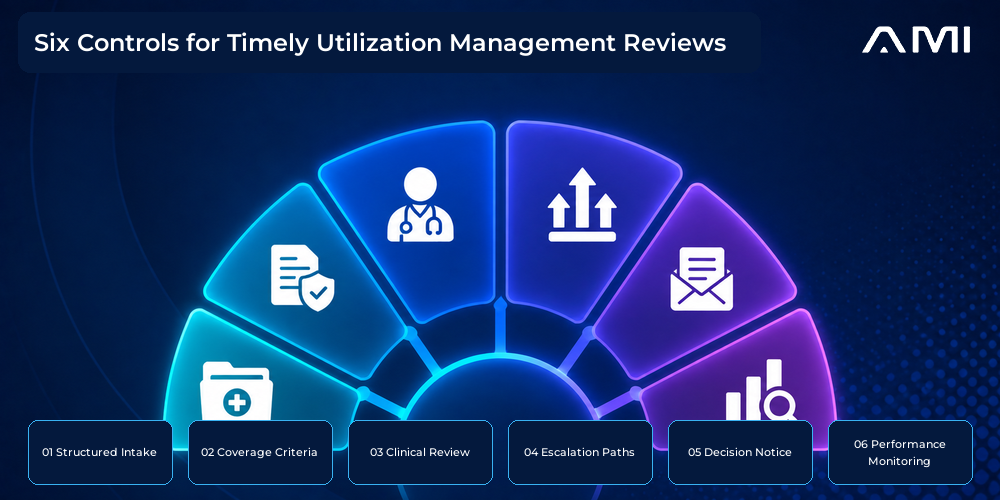
Payers can strengthen review through six connected controls:
- Structured intake and completeness checks
- Current, accessible coverage and clinical criteria
- Appropriate routing to qualified reviewers
- Defined escalation for urgent, complex, or ambiguous cases
- Clear, timely decision communication
- Performance monitoring by request type and outcome
| Review stage | Key control | Useful measure |
|---|---|---|
| Intake | Validate required fields and documents | First-pass completeness |
| Routing | Match case to reviewer expertise | Queue transfer rate |
| Review | Apply documented criteria consistently | Inter-reviewer agreement |
| Escalation | Prioritize urgent and exception cases | Escalation aging |
| Notice | Communicate decision and rationale | Notice accuracy |
| Oversight | Analyze delay and variation | End-to-end turnaround |
How Should Payers Standardize Review Intake?
A single intake framework should define required patient, provider, service, diagnosis, setting, urgency, and documentation fields. Automated checks can identify missing or invalid data before the request enters clinical review.
Standardization should not create a rigid barrier. When required information is absent, the workflow needs a documented outreach and escalation path so requests do not disappear into an unresolved queue.
How Do Clinical Criteria Support Consistent Decisions?
Reviewers need current criteria connected to plan benefits and applicable requirements. Version control should show which criteria applied on the decision date, who approved the criteria, and when the next review is due.
CMS utilization management requirements for Medicare Advantage include annual policy review by a utilization management committee and safeguards intended to reduce disruptions in care. Payers should map controls to the programs and jurisdictions they administer.
Where Should Automation Support Utilization Review?
Automation can validate intake, collect supporting data, route cases, calculate deadlines, surface criteria, and generate worklists. It should not conceal how a decision was reached or replace clinical review where judgment is required.
The strongest approach combines governed technology with accountable human oversight. The same principle applies to broader healthcare payer automation.
Need stronger intake, review, and escalation execution? Explore AMI’s Healthcare Payer Support services.

Why do payer operations slow down even with more resources?
Because claims, provider inquiries, member support, and policy workflows need more than added capacity. AMI helps payers improve accuracy, turnaround time, and operational visibility with co-managed support teams and workflow-focused execution.
How Should Urgent and Complex Cases Be Escalated?
Urgency definitions, clinical escalation paths, coverage exceptions, and supervisory review should be documented before cases arrive. Queue logic must distinguish genuinely urgent care from incomplete routine requests without downgrading either silently.
Escalation dashboards should show approaching deadlines, unassigned work, repeated transfers, and cases waiting for provider information.
Which Utilization Management Metrics Matter Most?
Measure end-to-end turnaround, first-pass completeness, touch time, queue time, pend reasons, transfer rate, escalation rate, adverse decision rate, overturn rate, and notice accuracy. Segment results by request type, urgency, product, provider, and reviewer group.
Speed alone is insufficient. A faster process that creates more appeals or inconsistent decisions does not improve the member experience.
How Can Payers Improve Provider and Member Communication?
Providers need clear submission requirements, status visibility, and specific requests for missing information. Members need understandable notices that explain the decision, rationale, next steps, and available appeal rights.
Coordinated communication supports the experience described in Healthcare Payer Services That Improve Provider and Member Experience.
How AM Infoweb Supports Utilization Management Operations
AM Infoweb supports payer teams with structured intake, queue management, provider outreach, documentation control, and operational reporting.
With two decades of experience in the U.S. healthcare industry, AM Infoweb uses a co-managed model that brings AI agents and skilled human agents together to eliminate process bottlenecks and execute secure healthcare workflows.
AMI can support:
- Request intake and completeness validation
- Document collection and provider follow-up
- Work routing and queue monitoring
- Deadline and escalation tracking
- Decision-notice preparation support
- Quality assurance and exception reporting
- Performance dashboards and root-cause analysis
Clinical and plan leaders retain responsibility for criteria, medical-necessity decisions, benefit interpretation, and regulatory compliance.
How Can Utilization Management Protect Timely Access?
Timely utilization management depends on more than reviewer capacity. Clear intake rules, current criteria, skilled routing, visible deadlines, governed automation, and understandable communication help payers improve review consistency without creating avoidable care delays.
Need more reliable utilization management workflows? AMI combines trained payer-support teams, structured execution, QA, and operational reporting to improve review visibility and turnaround.
Get in TouchFrequently Asked Questions
About the Author

Written by
Urza Dey
Urza Dey is a content and copywriter with over five years of experience across marketing, B2B SaaS, HealthTech, EdTech, and related industries. At AMI, they contribute to content strategy, blog development, and marketing communication focused on healthcare operations, business process management, and AI-enabled service delivery.