

Appeals and Grievances: Building Faster, Fairer Health Plan Resolutions
TL;DR: Appeals and Grievances
Appeals challenge adverse decisions, while grievances generally address service, access, communication, or quality concerns.
Accurate intake classification determines the applicable rights, deadlines, notices, and review path.
A complete case file preserves authority, evidence, outreach, criteria, rationale, and delivery history.
Independent and qualified review supports fair, defensible appeal decisions.
Clear notices explain the outcome, rationale, next steps, deadlines, and review rights.
Trend reporting should connect repeat disputes to upstream operational root causes.
Appeals and grievances give health plan members and their representatives a structured way to challenge decisions or raise concerns about service. These workflows influence access, trust, compliance, and the plan’s ability to identify recurring operational problems.
Delays often begin with misclassification, missing case information, unclear ownership, or weak deadline controls. Fair resolution requires more than a fast queue. It requires complete evidence, appropriate independence, understandable communication, and a defensible record of each action.
This guide explains how payers can improve appeals and grievance operations while preserving consistency and member rights.
Need structured operational support across healthcare workflows? Explore AMI’s healthcare services.
What Is the Difference Between Appeals and Grievances?
An appeal generally asks a plan to reconsider an adverse coverage, payment, or service decision. A grievance generally concerns dissatisfaction with service, access, communication, quality, or another issue that is not the specific subject of an appeal.
Definitions and procedures vary by program and jurisdiction. Intake teams must classify the issue correctly because rights, timelines, notices, and review requirements may differ.
Why Do Appeals and Grievances Become Delayed?
Cases may arrive through phone, portal, mail, provider submission, or regulator referral. Information can be incomplete, duplicated, or attached to the wrong member. A single complaint may also contain both grievance and appeal issues.
Delay increases when ownership is unclear, evidence collection is manual, deadline calculations are inconsistent, or urgent cases are not escalated. A centralized case record and milestone tracking reduce these risks.
What Does a Fair Resolution Workflow Include?
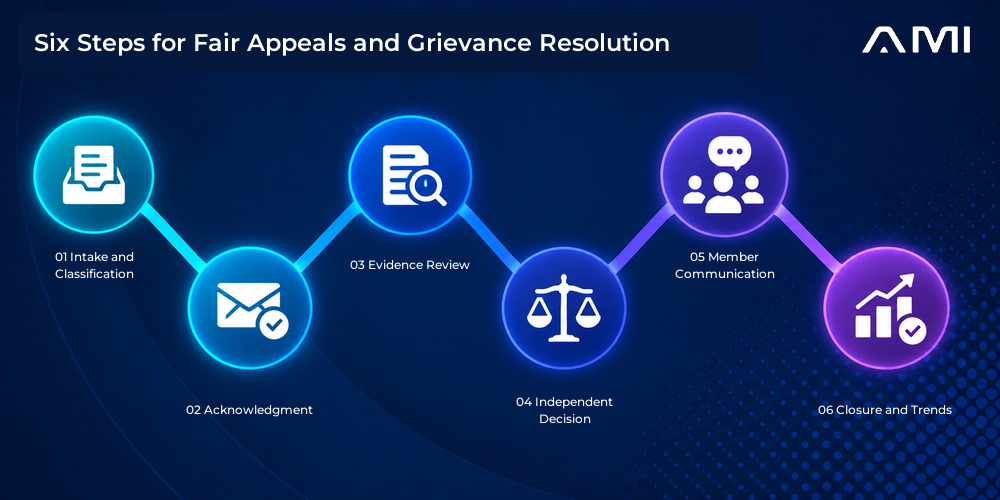
A controlled workflow includes intake and classification, acknowledgment, evidence collection, qualified review, decision communication, and closure with trend analysis.
| Stage | Core control | Quality question |
|---|---|---|
| Intake | Capture all issues and authority | Was the case classified correctly? |
| Acknowledgment | Confirm receipt and next steps | Were rights explained clearly? |
| Development | Collect complete evidence | Is the case file sufficient? |
| Decision | Apply independent review | Is the rationale supported? |
| Notice | Use understandable language | Can the recipient act on it? |
| Closure | Record outcome and trends | Was root cause captured? |
How Should Payers Classify Cases at Intake?
Intake should capture who submitted the issue, authorization to act, service or decision involved, dates, urgency, requested remedy, and supporting documents. Classification logic should account for mixed cases instead of forcing every contact into one category.
Staff need examples, decision trees, and escalation access. Quality checks should track reclassification because repeated errors may indicate unclear procedures or training gaps.
How Can Plans Maintain Complete Case Files?
The file should preserve the original request, acknowledgments, evidence, outreach, clinical or administrative reviews, decision rationale, notices, delivery evidence, and subsequent actions. Every document needs a source and date.
Missing evidence requests should be specific and tracked. Teams should avoid restarting the workflow whenever information arrives in a different channel.
What Makes an Appeal Decision Independent and Defensible?
The reviewer should have appropriate qualifications and sufficient independence from the original adverse decision, as required by the applicable program. The case file should identify the criteria, benefit provisions, evidence, and rationale supporting the outcome.
CMS Medicare managed care appeals and grievances guidance addresses requirements under 42 CFR Part 422, Subpart M. Plans should map controls to each product and jurisdiction they administer.
Need stronger case intake, review tracking, and member communication? Explore AMI’s Healthcare Payer Support services.

Why do payer operations slow down even with more resources?
Because claims, provider inquiries, member support, and policy workflows need more than added capacity. AMI helps payers improve accuracy, turnaround time, and operational visibility with co-managed support teams and workflow-focused execution.
How Should Payers Control Deadlines and Escalations?
Deadline logic should use the correct receipt date, case type, urgency, product, and applicable rule. Dashboards should show approaching deadlines, overdue evidence, unassigned work, and cases requiring expedited handling.
Escalations need named owners and response expectations. Simply flagging a case as urgent does not ensure action.
What Makes Member Notices Clear and Actionable?
A notice should state the decision, specific rationale, criteria or benefit basis, next steps, deadlines, and available review rights in understandable language. Templates improve consistency, but they must not produce generic explanations disconnected from the case.
Clear communication is central to payer services that improve provider and member experience.
Which Metrics Improve Appeals and Grievance Performance?
Track acknowledgment timeliness, resolution timeliness, classification accuracy, expedited-case handling, overturn rate, notice accuracy, reopen rate, repeat grievance categories, and member inquiry volume. Segment performance by product, issue, source, and operational team.
Trends should feed process improvement. High volumes linked to claims processing, provider data, or utilization decisions may reveal upstream defects.
How AM Infoweb Supports Appeals and Grievance Operations
AM Infoweb supports payer organizations with structured case intake, evidence coordination, deadline tracking, communication workflows, quality assurance, and reporting.
With two decades of experience in the U.S. healthcare industry, AM Infoweb uses a co-managed model that brings AI agents and skilled human agents together to eliminate process bottlenecks and execute secure healthcare workflows.
AMI can support:
- Multichannel case intake and indexing
- Appeal and grievance classification support
- Authorization and documentation checks
- Evidence collection and provider follow-up
- Deadline monitoring and escalation
- Notice preparation and delivery tracking
- Case-file quality assurance
- Trend reporting and root-cause analysis
Plan leaders retain responsibility for clinical or benefit decisions, reviewer independence, regulatory interpretation, and final approvals.
How Can Plans Build Faster, Fairer Resolutions?
Strong appeals and grievance operations combine accurate classification, complete evidence, independent review, deadline visibility, clear notices, and feedback into upstream workflows. This structure helps plans resolve cases faster while preserving fairness and accountability.
Need stronger appeals and grievance execution? AMI combines trained payer-support teams, structured case controls, QA, and reporting to improve resolution visibility.
Get in TouchFrequently Asked Questions
About the Author

Written by
Urza Dey
Urza Dey is a content and copywriter with over five years of experience across marketing, B2B SaaS, HealthTech, EdTech, and related industries. At AMI, they contribute to content strategy, blog development, and marketing communication focused on healthcare operations, business process management, and AI-enabled service delivery.