

Healthcare Denial Prevention: How Contact Centers Reduce Claim Risk
TL;DR — Healthcare Denial Prevention at a Glance
Healthcare denial prevention often starts before billing, during scheduling, intake, eligibility, authorization, documentation, and handoff workflows.
Many preventable denials come from incorrect patient details, inactive coverage, unclear benefits, missing authorizations, incomplete documentation, or weak front-end handoffs.
Contact center teams can act as an early control point by capturing accurate information, routing issues, documenting payer conversations, and escalating incomplete cases.
AI-first healthcare contact center operations can support structured intake, authorization follow-up, documentation summaries, QA visibility, and trend reporting.
AI should not make clinical, payer, billing, or claim decisions. Complex, denied, delayed, or exception-based cases should remain human-led.
Strong front-end RCM workflows help reduce avoidable denial risk before claims are submitted.
AMI supports cleaner front-end RCM through trained teams, AI-assisted workflows, authorization follow-up support, QA visibility, escalation, and co-managed operations.
Many healthcare claim denials do not begin at the billing stage. They often start earlier with incorrect patient details, missed eligibility checks, unclear benefits, missing authorizations, incomplete documentation, or weak handoffs between front-end and revenue cycle teams.
That is why healthcare denial prevention should not be treated only as a billing or appeals function. By the time a claim reaches submission, many avoidable issues may already be built into the workflow. Cleaner claims often depend on what happens during scheduling, registration, eligibility verification, benefits review, prior authorization follow-up, documentation, and escalation.
Healthcare contact center teams can play an important role here. They are often the first point of contact for patients, members, providers, and payer-related follow-ups. When supported with clear workflows, trained teams, and AI-assisted processes, they can help catch missing information earlier and reduce denial risk before the claim ever reaches billing.
Why Healthcare Denial Prevention Starts Before Claim Submission
Healthcare denial prevention starts before claim submission because many denials are created upstream. A claim may be denied later, but the root cause may come from front-end errors that were not corrected in time.
Common examples include outdated insurance details, inactive coverage, missing prior authorization, incorrect patient demographics, incomplete documentation, or unclear handoff notes. These issues may seem small at intake, but they can delay billing, trigger rework, or create preventable denials downstream.
This is why front-end RCM matters. Strong front-end workflows help healthcare teams verify information, confirm coverage, document payer requirements, and escalate incomplete cases before they become claim problems.
Denial prevention is not only about edits, appeals, or post-denial recovery. It is about reducing avoidable risk before the claim is submitted.
Where Preventable Denials Begin in Front-End RCM
Preventable denials often begin in routine workflows. These steps may happen before a biller ever touches the claim, but they directly affect clean claim submission.
Incorrect patient demographics at intake
Misspelled names, wrong dates of birth, outdated contact details, incorrect insurance information, and duplicate records can create downstream claim issues. If these errors are not caught during intake or registration, they can carry into eligibility checks, authorization workflows, billing systems, and payer submissions.
Better intake workflows help teams confirm key patient and insurance details early. This is one of the simplest but most important healthcare claim denial prevention strategies because inaccurate registration data can affect the entire revenue cycle.
Missed eligibility and benefits verification
Eligibility and benefits issues are a common source of preventable denials. Inactive coverage, plan limitations, payer changes, coordination of benefits issues, or missing payer details can create problems later if they are not identified early.
Strong verification workflows help teams confirm whether coverage is active, understand basic benefit requirements, and route unclear cases for follow-up. When eligibility issues are caught earlier, teams have more time to correct information before service delivery or claim submission.
Prior authorization gaps
Prior authorization gaps can create significant denial risk. Missing authorizations, delayed payer follow-ups, unclear status updates, incomplete documentation, or unresolved exceptions can all affect claim outcomes.
Contact center and front-end teams can support this workflow by tracking authorization status, documenting payer responses, escalating delayed cases, and making sure missing information is routed to the right team.
Automation can help here, but it should support the process around authorization. It should not make clinical, payer, or claim decisions.

Why do healthcare contact centers struggle even after adding more agents?
Because rising volume, fragmented systems, repeat calls, and delayed escalations need more than staffing. AMI combines AI voice, AI non-voice, and trained human agents to improve routing, documentation, QA visibility, and service execution.
Incomplete documentation before billing
Incomplete documentation can delay claim submission or increase denial risk. This may include missing service details, unclear payer notes, incomplete authorization information, or weak handoff context from the front-end team.
The goal is not to replace clinical documentation review. The goal is to make sure administrative, payer, and workflow details are captured clearly before the claim moves forward.
Weak handoffs between the contact center and RCM teams
Poor handoffs can create rework before submission. If notes are unclear, disposition codes are inconsistent, next steps are missing, or payer follow-up details are not documented, RCM teams may need to investigate the issue again.
Strong handoff documentation helps connect healthcare contact center operations with billing, authorization, eligibility, and revenue cycle teams. This improves continuity and reduces avoidable delays.
The Contact Center’s Role in Healthcare Claim Denial Prevention Strategies
The contact center can act as an early control point in denial prevention. It is often where patient details are captured, payer questions are routed, benefits issues are identified, authorization statuses are checked, and incomplete cases are escalated.
Strong healthcare contact center operations can support denial prevention by improving:
- Patient intake accuracy
- Insurance and payer detail capture
- Eligibility and benefits routing
- Prior authorization follow-up
- Payer call documentation
- Escalation for incomplete or delayed cases
- Handoff visibility between front-end and RCM teams
These are practical healthcare claim denial prevention strategies because they help teams catch issues before they become claim errors.
How AI-First Contact Center Operations Can Support Denial Prevention
AI-first contact center operations can support denial prevention by improving the workflows that happen before claim submission. The goal is not to automate claim decisions. The goal is to improve consistency, visibility, and follow-through across front-end tasks.
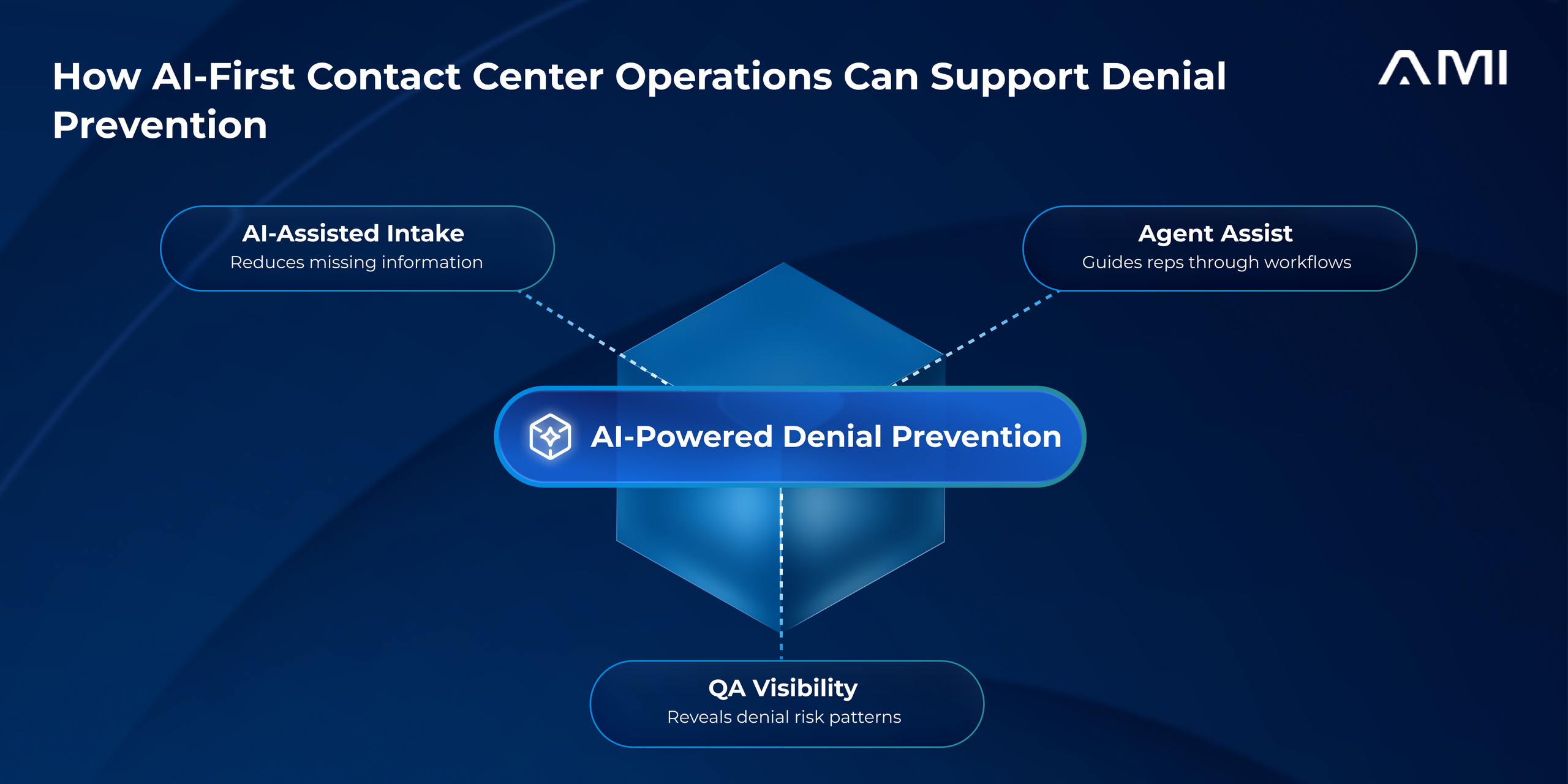
AI can help capture caller intent, structure intake questions, summarize payer calls, route eligibility or authorization issues, and surface repeat workflow gaps. When used carefully, AI-first healthcare contact center operations can help teams see where denial risk is forming earlier.
AI-assisted intake can reduce missing information
AI-assisted intake can help agents capture required patient, insurance, payer, and request details more consistently. Structured prompts can remind teams to confirm key fields, collect missing information, and document next steps.
This supports healthcare claims denial prevention AI by improving the quality of front-end information before it moves downstream.
Agent Assist can guide reps through approved front-end workflows
Agent Assist can support live teams with approved prompts, payer workflow guidance, eligibility steps, authorization follow-up reminders, documentation cues, and escalation triggers.
This is useful because front-end teams often handle several types of interactions in one day. Approved guidance helps reduce variation and keeps workflows more consistent.
QA visibility can surface repeat denial-risk patterns
AI-assisted QA can help leaders identify recurring intake errors, missed escalation signals, weak documentation, repeated payer issues, or workflow gaps that may contribute to preventable denials.
For example, if the same payer repeatedly causes authorization follow-up delays, or if certain intake fields are often missed, leaders can adjust training, scripts, workflows, or escalation rules.
This is where AI solutions that prevent healthcare claim denials before submission should be understood carefully. AI does not prevent every denial. It can help surface front-end risk patterns early enough for trained teams to act.
What Should Stay Human-Led in Denial Prevention Workflows
AI should not make clinical, payer, billing, or claim decisions. It should not decide whether a service is medically necessary, override payer requirements, determine claim validity, or handle complex exceptions without review.
Human teams should continue to manage:
- Denied or delayed authorization cases
- Complex coverage issues
- High-risk patient access concerns
- Incomplete medical necessity information
- Payer exceptions
- Ambiguous documentation gaps
- Escalations requiring judgment
- Anything that affects clinical, billing, or payer decision-making
The safest model uses AI to support workflow visibility and consistency while trained teams handle decisions, exceptions, and escalation.
How AMI Supports Cleaner Front-End RCM Workflows
AMI supports healthcare organizations with co-managed operations across Revenue Cycle Management and AI-first Healthcare Contact Center Operations. By combining trained healthcare support teams, AI-assisted intake, Agent Assist, documentation support, QA visibility, and escalation workflows, AMI helps teams reduce front-end friction that can lead to preventable denials before claim submission.
AMI’s model is designed for the operational pressure points that often create denial risk: incomplete intake, eligibility gaps, authorization delays, unclear payer follow-ups, weak handoffs, and limited workflow visibility. AI supports consistency and visibility. Human experts manage exceptions, escalations, and judgment-heavy cases. Leaders retain oversight through reporting, QA, and co-managed execution.
AMI supports:
- Patient intake and demographic accuracy support
- Eligibility and benefits verification workflow support
- Prior authorization follow-up support
- AI-assisted documentation and summaries
- Agent Assist for approved workflow guidance
- QA visibility into repeat denial-risk patterns
- Co-managed operations with client oversight
For healthcare teams asking how to prevent a denial in healthcare, the answer often starts before the claim is created. Cleaner front-end workflows help reduce avoidable denial risk before billing teams are forced into rework.
Want to reduce denial risk before claims reach billing?AMI helps healthcare teams strengthen front-end RCM with AI-assisted intake, eligibility support, authorization follow-up, documentation visibility, escalation, and co-managed operational control.
Frequently Asked Questions
About the Author

Written by
Urza Dey
Urza Dey is a content and copywriter with over five years of experience across marketing, B2B SaaS, HealthTech, EdTech, and related industries. At AMI, they contribute to content strategy, blog development, and marketing communication focused on healthcare operations, business process management, and AI-enabled service delivery.