
Healthcare Contact Center Outsourcing: When Should You Do It?
TL;DR — When Outsourcing Makes Sense
Healthcare contact center outsourcing should not be based only on cost or coverage. Leaders should also evaluate accuracy, documentation, escalation, QA visibility, compliance awareness, and operational control.
Outsourcing starts to make sense when call volume, wait times, repeat calls, staffing gaps, after-hours needs, or routine inquiries are putting pressure on internal teams.
A strong partner should do more than answer calls. It should improve intake, routing, documentation, escalation handling, reporting, and workflow consistency.
Outsourcing may not be the right move yet if SOPs, escalation rules, ownership, QA expectations, reporting goals, or internal governance are unclear.
Co-managed AI-first operations give healthcare teams external support without turning workflows into a black box.
AI can safely support caller intent capture, structured intake, smart routing, Agent Assist, documentation summaries, QA visibility, escalation signals, and trend reporting.
AMI helps healthcare organizations scale patient, member, and provider support with trained teams, AI-assisted workflows, QA visibility, escalation support, and co-managed operational oversight.
Healthcare contact centers are often the front line for patient, member, and provider experience. They manage scheduling questions, billing concerns, benefits inquiries, authorization follow-ups, provider requests, records-related support, and escalation workflows. When call volume rises or internal teams become stretched, healthcare contact center outsourcing may seem like the fastest answer.
But in healthcare, outsourcing should not be based only on cost or coverage. The bigger question is whether an external partner can maintain accuracy, documentation, escalation, QA, compliance awareness, and operational visibility.
AI-first healthcare contact center operations can help organizations expand support without fully handing control away. When combined with trained teams and co-managed oversight, AI-assisted workflows can support intake, routing, documentation, agent guidance, QA visibility, and escalation tracking while keeping sensitive and complex cases human-led.
What Healthcare Contact Center Outsourcing Means
Healthcare contact center outsourcing means working with an external partner to support patient, member, provider, scheduling, billing, benefits, authorization, records, and escalation-related interactions.
This can range from traditional call handling to co-managed, AI-assisted healthcare contact center operations. In a traditional model, the focus may be on staffing and coverage. In a stronger model, the focus is on workflow execution, documentation quality, escalation accuracy, QA visibility, and reporting.
The goal should not be to “send calls somewhere else.” The goal should be to improve how interactions are handled, tracked, escalated, and resolved.
When Healthcare Contact Center Outsourcing Starts To Make Sense
Outsourcing becomes worth evaluating when internal teams are struggling to manage volume, quality, response times, or workflow consistency. It is not always the first move, but it can be the right move when operational pressure starts affecting patient, member, provider, or staff experience.
1. Call volume is increasing faster than internal capacity
Rising call volume can overwhelm internal teams, increase abandoned calls, extend wait times, and reduce service quality. If demand is consistent and internal hiring cannot keep pace, outsourced contact center healthcare support may help stabilize coverage.
2. Wait times and repeat calls are affecting the experience
Long hold times and repeat calls often signal deeper workflow friction. Poor routing, unclear status visibility, and incomplete documentation can push patients, members, and providers to call again. A strong partner should help reduce repeat contact by improving workflow execution, not just answer speed.
3. Internal teams are spending too much time on routine inquiries
Internal teams may be pulled away from higher-value work because they are handling common scheduling, billing, benefits, status, or provider inquiry calls. AI-assisted intake and routing can help separate repeatable requests from complex cases.
4. After-hours or overflow coverage is becoming difficult
Healthcare organizations may need extended coverage during peak periods, after-hours windows, open enrollment, seasonal spikes, or staffing shortages. Contact center outsourcing in healthcare can support overflow when the partner has clear workflows, escalation rules, and reporting.

Why do healthcare contact centers struggle even after adding more agents?
Because rising volume, fragmented systems, repeat calls, and delayed escalations need more than staffing. AMI combines AI voice, AI non-voice, and trained human agents to improve routing, documentation, QA visibility, and service execution.
5. QA visibility is limited
Outsourcing may be worth evaluating when leaders cannot see what is happening across interactions, documentation quality, escalations, repeat-call drivers, or coaching needs. Adding support without QA visibility can create more risk than relief.
6. Documentation and handoffs are inconsistent
Inconsistent notes, missing next steps, and weak handoff context can create delays and repeat contact. A strong partner should bring structured documentation, disposition codes, and reporting discipline.
7. Patient, member, or provider workflows need specialized support
Healthcare contact centers are not generic customer service environments. Strong contact center services for healthcare should reflect caller type differences, workflow complexity, and escalation needs.
Inline CTA: Considering healthcare contact center outsourcing? AMI helps healthcare teams add capacity with AI-assisted workflows, trained support teams, QA visibility, and co-managed operational control.
When Healthcare Contact Center Outsourcing May Not Be The Right Move Yet
Outsourcing may not help if the internal workflow is not ready. If SOPs are unclear, escalation rules are missing, ownership is undefined, or QA expectations are not set, outsourcing may simply move the problem outside the organization.
Healthcare leaders should pause if there are:
- No clear SOPs
- No defined escalation rules
- No ownership for unresolved cases
- No QA expectations
- No reporting goals
- No agreement on which interactions stay internal
- No readiness to manage a partner relationship
This does not mean outsourcing is wrong. It means the organization needs to clarify the operating model before moving volume to an external team.
Traditional Outsourcing Vs Co-Managed AI-First Contact Center Operations
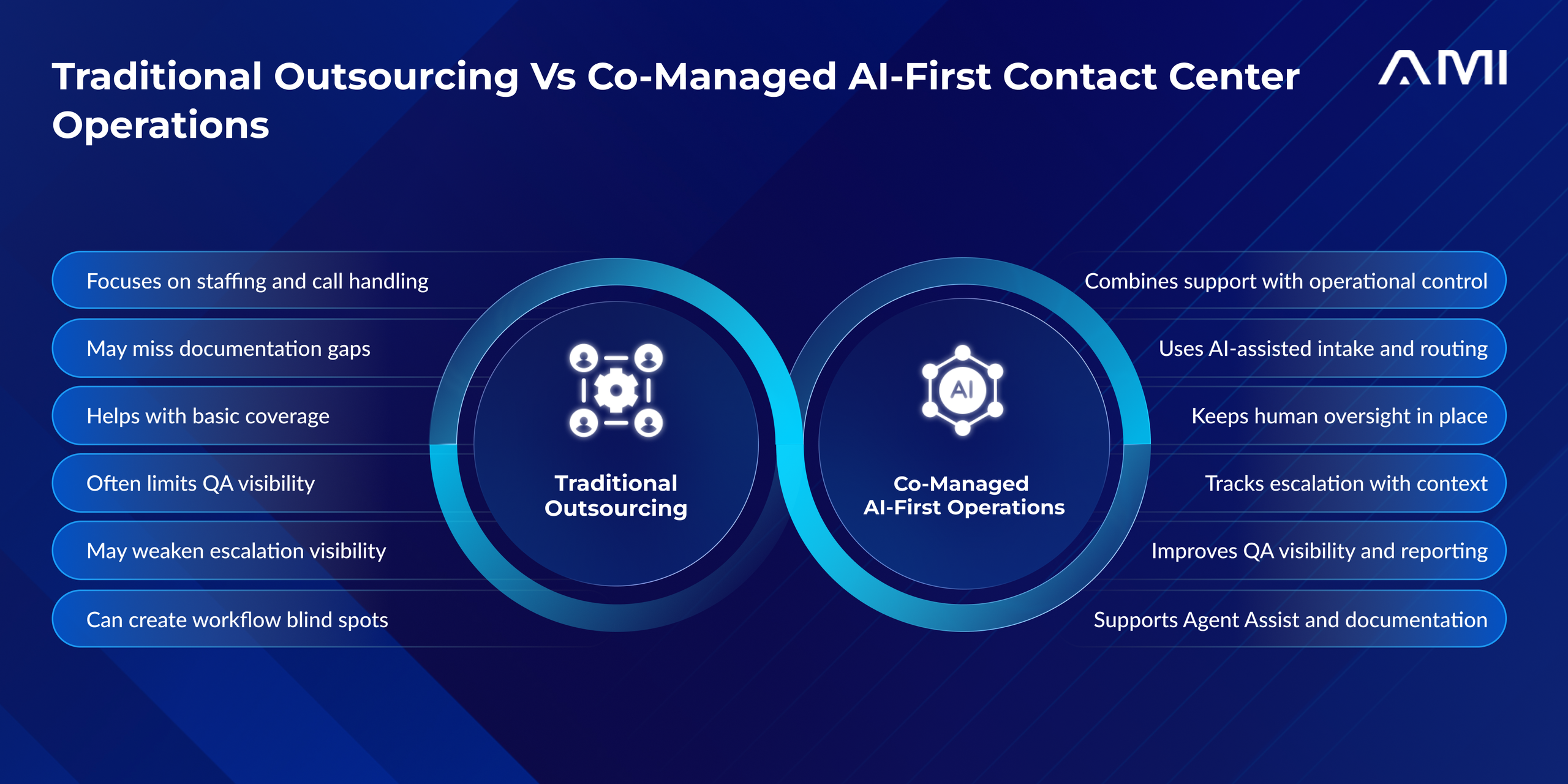
Traditional healthcare outsourcing may focus heavily on staffing and call handling. That can help with coverage, but it may not solve documentation gaps, escalation delays, limited QA visibility, or workflow bottlenecks.
Co-managed healthcare contact center operations are different. They give healthcare leaders external support without sending workflows into a black box. The model should include AI-assisted intake, routing, Agent Assist, documentation, QA visibility, escalation tracking, reporting, and human oversight.
This is especially important for organizations comparing BPO healthcare models. The strongest partner is not simply the lowest-cost option. It is the one that improves visibility, consistency, and control.
What AI Can Safely Support In Healthcare Contact Center Outsourcing
AI should be positioned as an operations support layer, not a replacement for healthcare support teams. In AI-first healthcare contact center operations, AI can help with repeatable, low-risk, workflow-supported areas while complex, sensitive, or exception-based interactions remain human-led.
AI can safely support:
| AI support area | How it helps |
|---|---|
| Caller intent capture | Identifies why the caller is reaching out before routing. |
| Intake consistency | Helps collect required information in a structured way. |
| Smart routing | Routes requests based on caller type, intent, urgency, and workflow. |
| Agent Assist | Supports live agents with guidance, prompts, and next steps. |
| Documentation summaries | Helps create clearer notes and reduce after-call work. |
| Status-based support | Supports simple, approved status updates when workflows are clear. |
| Escalation signals | Flags sensitive, urgent, unresolved, or exception-based cases. |
| QA visibility | Helps review more interactions and identify coaching or process gaps. |
| Trend reporting | Shows repeat-call drivers, bottlenecks, and workflow friction. |
AI should make support more visible and consistent. It should not block access to human help when callers need judgment, empathy, or escalation.
Inline CTA: AMI’s co-managed model helps healthcare leaders expand support while keeping visibility across documentation, escalation, QA, reporting, and workflow performance.
Risks To Evaluate Before Outsourcing Healthcare Contact Center Operations
Healthcare leaders should evaluate risks before choosing a partner. Poor outsourcing can create new problems if the model lacks healthcare workflow knowledge or oversight.
Risks to watch for include:
- Loss of operational control
- Generic call center experience
- Poor documentation
- Weak escalation rules
- Limited QA visibility
- Inconsistent answers
- Compliance concerns
- No reporting transparency
- No human oversight for AI-assisted workflows
This is why outsourcing in healthcare services needs more governance than general support outsourcing. The vendor must understand the work behind the call, not only the call itself.
How To Outsource Healthcare Contact Center Operations Without Losing Control
Healthcare contact center outsourcing should not mean handing workflows into a black box. Leaders should define which interactions can be supported externally, which cases stay internal, how escalation works, what documentation standards apply, and how QA will be reviewed.
- Decide which workflows can move first: Not every workflow should be outsourced at once. Start with defined, repeatable inquiry types such as appointment support, status updates, billing questions, benefits inquiries, provider routing, or after-hours overflow.
- Keep sensitive and complex cases human-led: Urgent, unresolved, compliance-sensitive, or exception-heavy conversations should have clear human review and escalation paths.
- Set escalation rules before moving volume: Outsourcing fails when external teams do not know when to escalate, who owns unresolved cases, or how context should transfer.
- Require structured documentation and QA visibility: Leaders should be able to review call notes, dispositions, next steps, QA findings, and recurring workflow gaps.
- Use AI as an operations support layer: AI can support intake, routing, Agent Assist, summaries, QA visibility, and trend reporting without replacing trained teams.
- Keep governance co-managed: The strongest model gives healthcare leaders continued oversight through reporting, workflow reviews, QA visibility, and shared improvement cycles.
Considering healthcare contact center outsourcing without losing control? AMI helps healthcare organizations scale support with trained teams, AI-assisted workflows, QA visibility, escalation support, and co-managed operational oversight.
Get in TouchHow AMI Supports AI-First Healthcare Contact Center Operations
AMI supports healthcare organizations with AI-first Healthcare Contact Center Operations built around service consistency, workflow visibility, and human oversight. The model combines trained healthcare support teams, AI-assisted workflows, clear escalation rules, QA visibility, and co-managed execution to help organizations manage patient, member, and provider interactions more effectively.
AMI’s approach is designed for the pressure points that make outsourcing worth considering: high call volume, staffing constraints, long wait times, repeat calls, documentation gaps, after-hours coverage needs, limited QA visibility, and complex escalations. AI supports structured, high-volume work. Human experts handle sensitive, urgent, unresolved, or exception-based cases. Leaders retain oversight through reporting, governance, and shared operational control.
AMI supports:
- Patient, member, and provider inquiry support
- AI-assisted intake and caller intent capture
- Agent Assist for live support workflows
- Smarter routing and escalation with context
- AI-assisted documentation and summaries
- QA visibility and interaction trend reporting
- Compliance-aware workflow support
- Co-managed operations with client oversight
For healthcare organizations evaluating healthcare BPO, the goal should not be outsourcing for the sake of reducing internal workload. The goal should be building a safer, more visible operating model that improves service consistency without losing control.
Frequently Asked Questions
About the Author

Written by
Urza Dey
Urza Dey is a content and copywriter with over five years of experience across marketing, B2B SaaS, HealthTech, EdTech, and related industries. At AMI, they contribute to content strategy, blog development, and marketing communication focused on healthcare operations, business process management, and AI-enabled service delivery.