
The Ultimate Contact Center Evaluation Checklist for AI-First Healthcare Workflows
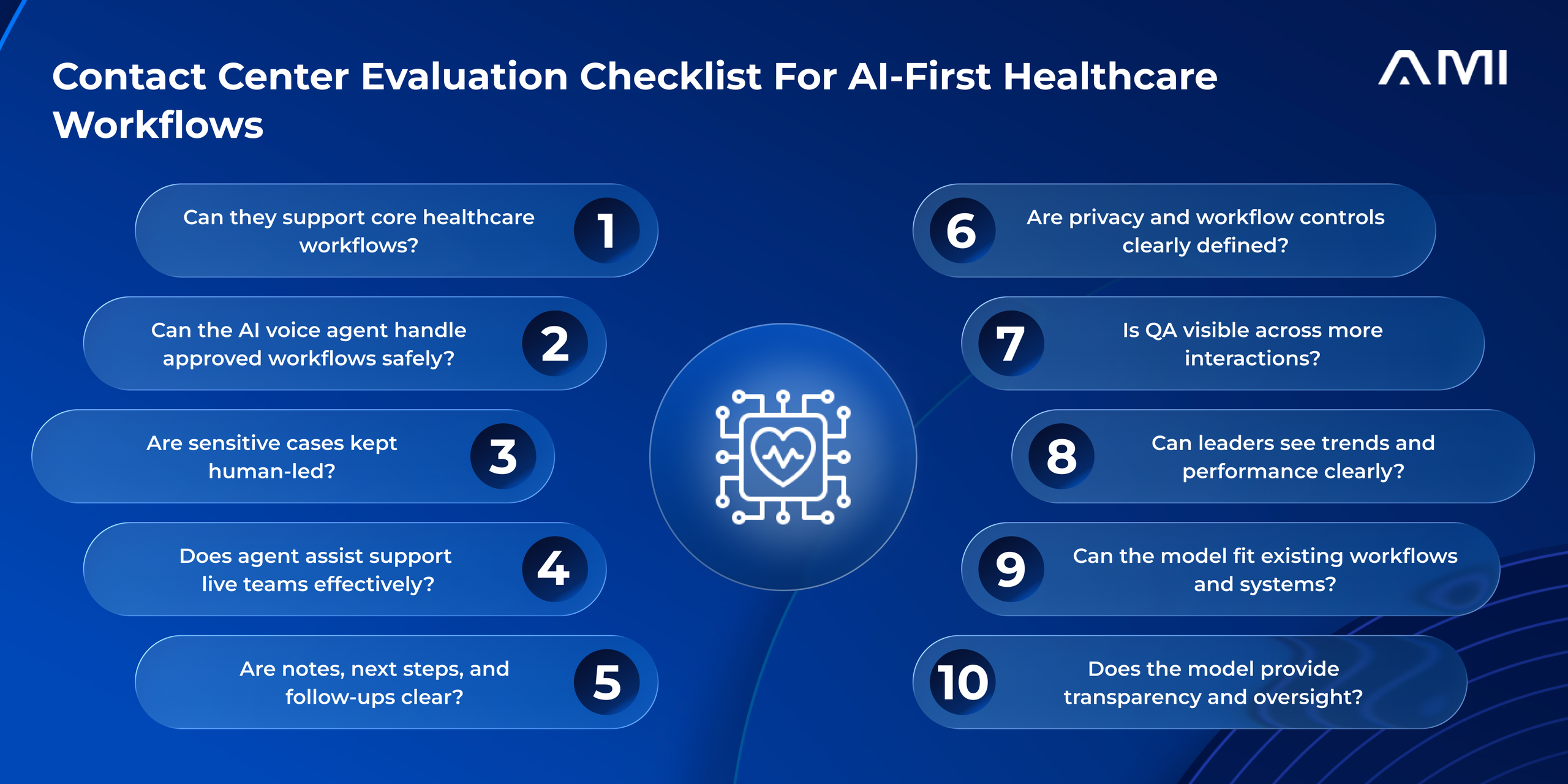
TL;DR — Evaluation Checklist at a Glance
Healthcare contact center evaluation should go beyond staffing, cost, call handling, and average speed to answer. Leaders should assess workflow fit, documentation, escalation, QA, reporting, and human oversight.
AI-first healthcare contact center operations should not mean AI-only. AI should support intake, routing, Agent Assist, documentation, QA visibility, analytics, and repeatable workflows while trained teams handle sensitive or complex cases.
A strong partner should understand patient, member, provider, billing, benefits, authorization, scheduling, medical records, and escalation workflows.
Healthcare leaders should evaluate AI voice agents based on caller intent accuracy, structured intake, approved workflow handling, documentation quality, and safe escalation.
Agent Assist, structured documentation, QA visibility, and reporting help teams improve consistency, reduce after-call work, identify workflow gaps, and support better coaching.
Red flags include AI-only positioning, no healthcare workflow experience, weak QA, poor documentation standards, unclear escalation rules, limited reporting, and black-box outsourcing.
AMI helps healthcare organizations evaluate and build AI-first contact center operations with trained teams, AI-assisted workflows, QA visibility, escalation support, reporting, and co-managed operational control.
The healthcare contact center evaluation process has changed. Traditional criteria like staffing coverage, call handling, and average speed to answer still matter, but they are no longer enough for healthcare workflows that involve patients, members, providers, billing, benefits, authorizations, scheduling, medical records, and escalations.
Healthcare leaders now need to evaluate whether a contact center partner can support complex workflows, AI-assisted operations, escalation with context, QA visibility, reporting, and human oversight. AI-first operations can improve speed, consistency, documentation, and visibility, but only when implemented carefully. In healthcare, AI should support workflows, not remove accountability.
The strongest models combine AI-assisted intake, routing, agent support, documentation, QA, analytics, and trained human teams that manage complex, sensitive, or exception-based interactions.
Why Contact Center Evaluation is Different for Healthcare Workflows
A healthcare contact center evaluation cannot be based only on cost, staffing, or call volume. Healthcare contact centers handle sensitive and workflow-heavy interactions where accuracy, privacy, empathy, documentation, and operational follow-through matter.
A patient may call about an appointment or a billing concern. A member may need benefits or eligibility support. A provider may ask about authorization status, documentation, or claim follow-up. Each interaction may involve multiple systems, approved workflows, escalation rules, and documentation requirements.
That is why evaluating healthcare contact center services requires a deeper look at workflow fit, service consistency, QA coverage, escalation control, and reporting visibility.
What AI-first Contact Center Operations Should Actually Mean
AI-first should not mean AI-only. In healthcare, AI-first healthcare contact center operations should mean that AI supports the operating model while trained teams remain responsible for judgment-based work.
A strong AI-first model supports intake, routing, documentation, agent guidance, QA, analytics, and repeatable workflows. Human teams should still manage sensitive, urgent, unresolved, or exception-based conversations.
This matters because many healthcare leaders are rightly skeptical of automation-heavy models. The right approach does not force callers away from human support. It uses AI to improve speed, structure, and visibility while keeping escalation paths clear.
Evaluation Area 1: Healthcare Workflow Understanding
A contact center partner should understand healthcare workflows, not just general customer service. This includes patient inquiries, member support, provider inquiries, scheduling, benefits questions, authorization follow-up, billing inquiries, and record request support.
Checklist questions:
- Does the partner understand healthcare-specific workflows?
- Can they support patient, member, and provider interactions?
- Can they handle billing, benefits, authorization, and records-related inquiries?
- Can they separate simple requests from complex exceptions?
This is especially important when comparing contact center services for healthcare, because generic call center experience does not always translate into healthcare workflow accuracy.
Evaluation Area 2: AI Voice Agent Evaluation Criteria for Contact Center Workflows
When reviewing AI voice agents, do not evaluate only voice quality, response speed, or demo performance. The real question is whether the AI voice agent can support approved workflows safely.
The right AI voice agent evaluation criteria contact center teams should use include workflow fit, caller intent accuracy, structured intake, escalation support, documentation quality, and approved response handling.
Checklist questions:
- Can the AI voice agent identify caller intent accurately?
- Can it collect structured intake information?
- Can it follow approved workflows?
- Can it document outcomes clearly?
- Can it route complex cases to trained teams?
- Can it support escalation instead of blocking callers?
Strong AI voice agent evaluation criteria contact center reviews should test real healthcare scenarios, not just scripted demos.
Evaluation Area 3: Human Oversight and Escalation Control
AI-first does not mean removing people from healthcare support. Human oversight is essential for sensitive, urgent, unresolved, or exception-based interactions.
Healthcare leaders should ask which interactions remain human-led, when escalation happens, and whether escalation is based on urgency, sentiment, complexity, missing information, or caller risk.
Checklist questions:
- What types of interactions stay human-led?
- When does escalation happen?
- Does the human team receive full context?
- Can leaders review escalation performance?
- Are escalation rules visible and adjustable?
This is one of the clearest differences between controlled AI-first healthcare contact center operations and risky AI-only automation.
Evaluation Area 4: Agent Assist for Live Support Teams
AI-first operations should also support human agents. Agent assist can help live teams with real-time guidance, knowledge prompts, next steps, summaries, and documentation support.
This helps improve consistency across teams without taking control away from agents. It also reduces after-call work and helps newer agents follow approved workflows more confidently.
Checklist questions:
- Does the model include agent assist?
- Can agents receive real-time guidance?
- Can AI suggest next steps without taking control?
- Can summaries reduce after-call work?
- Can the agent assist in improving consistency across teams?
Agent assist is especially useful in healthcare contact center operations where agents often move between policies, portals, systems, and escalation rules.
Evaluation Area 5: Documentation and Workflow Follow-Through
A strong contact center evaluation should look at what happens after the interaction, not only how the call is answered. Documentation quality affects handoffs, follow-ups, reporting, repeat calls, and downstream workflows.
If notes are incomplete, disposition codes are inconsistent, or next steps are unclear, the contact center may appear active but still fail to move work forward.
Checklist questions:
- Are call notes structured and complete?
- Are the next steps documented clearly?
- Are disposition codes consistent?
- Can follow-up actions be tracked?
- Can documentation support downstream workflows?
This is where many healthcare contact center professional services create value: by improving workflow continuity, not just call coverage.
Evaluation Area 6: Contact Center Quality Assurance
QA should be central to every healthcare contact center evaluation. In AI-first workflows, QA should cover interaction quality, documentation accuracy, escalation handling, workflow adherence, and coaching visibility.
Checklist questions:
- Does the partner offer QA visibility?
- Can more interactions be reviewed with AI-assisted QA?
- Are missed escalation signals flagged?
- Are documentation gaps visible?
- Can QA insights support coaching and workflow improvement?
Good QA helps leaders understand whether interactions are being resolved safely and consistently. This is especially important for healthcare contact center best practices, where quality depends on both agent behavior and workflow execution.
Evaluation Area 7: Reporting and Operational Visibility
Healthcare leaders need visibility into call drivers, repeat inquiries, escalation patterns, wait-time drivers, documentation gaps, and workflow bottlenecks.
Checklist questions:
- What dashboards are available?
- Can leaders see inquiry trends?
- Can they identify repeat-call drivers?
- Can they track escalation patterns?
- Can they measure quality, resolution, and follow-up performance?
Without reporting, healthcare contact center operations can become a black box. Leaders may know volume is rising, but not why it is rising or which workflows are creating pressure.
Evaluation Area 8: Integration Readiness and Workflow Fit
AI-first operations should fit into existing healthcare workflows. Full system integration may not always happen immediately, but the partner should understand handoffs, SOPs, data needs, and context preservation.
Checklist questions:
- Can the partner support existing workflows?
- Can they work with client SOPs?
- Can they support API or system integration where needed?
- Can they preserve context across handoffs?
- Can they adapt across departments or service lines?
This matters when comparing contact center solutions for healthcare, because workflow fit often determines whether the model can scale without creating operational friction.
Evaluation Area 9: Compliance-aware operations
Healthcare contact center partners should have privacy-aware processes, access controls, QA practices, and documentation discipline. This does not mean making vague compliance promises. It means showing how sensitive workflows are governed.
Checklist questions:
- Does the partner understand healthcare privacy expectations?
- Are access controls and workflow rules defined?
- Are teams trained on approved processes?
- Are sensitive interactions escalated appropriately?
- Can QA support compliance-aware workflows?
Whether evaluating US-based medical call center services, offshore support, or hybrid models, leaders should look for process discipline and clear governance.

Evaluation Area 10: Co-Managed Control Instead of Black-Box Outsourcing
Many healthcare leaders are not only evaluating capabilities. They are evaluating control. A strong partner should not take workflows into a black box.
Checklist questions:
- Can the client retain oversight?
- Are workflows transparent?
- Are reporting and QA visible?
- Can SOPs be customized?
- Can the model scale without losing control?
- Can leaders review performance and improve workflows over time?
This is especially important when organizations consider whether to outsource healthcare call center services. The safer model gives clients visibility, governance, reporting, QA, and the ability to improve workflows over time.
Red Flags to Watch for During Contact Center Evaluation
Healthcare leaders should be cautious if a partner shows any of these warning signs:
- AI-only positioning with no human escalation
- No healthcare workflow experience
- No clear QA model
- No documentation standards
- No reporting visibility
- No escalation rules
- No support for patient, member, and provider workflows
- Generic call center approach
- No co-managed governance model
These red flags can make healthcare call center outsourcing services feel cheaper upfront, but harder to control later.
How to Evaluate AI-first Contact Center Operations Before Choosing a Partner
To evaluate AI-First contact center operations, start with workflow fit. Define which interactions AI can support, which must remain human-led, and how escalation should work.
Then review the QA model, documentation standards, reporting dashboards, and governance process. Test the model against real scenarios: authorization follow-up, billing confusion, appointment rescheduling, provider inquiry, benefits questions, records requests, and escalation cases.
The best way to evaluate AI-First Contact Center Operations is to ask whether the model improves control, not just automation. Strong partners should help leaders see more, route better, document clearly, and keep human oversight in place.
Evaluating AI-first contact center operations for healthcare workflows? AMI helps healthcare organizations build safer, more visible contact center operations with trained teams, AI-assisted workflows, QA visibility, escalation support, and co-managed control.
Get in TouchHow AMI Supports AI-first Healthcare Contact Center Operations
AMI supports healthcare organizations with AI-first Healthcare Contact Center Operations designed around workflow visibility, service consistency, and human oversight. The model combines trained healthcare support teams, AI-assisted intake, routing, documentation, QA, agent assist, and co-managed execution to help organizations support patient, member, and provider interactions without losing operational control.
AMI’s model is built for healthcare leaders evaluating safer alternatives to generic outsourcing or AI-only contact center models. AI supports structured workflows. Human experts manage sensitive, urgent, unresolved, or exception-based interactions. Leaders retain oversight through QA, reporting, governance, and co-managed operations.
AMI supports:
- Patient, member, and provider inquiry support
- AI-assisted intake and caller intent capture
- AI voice agent support for approved workflows
- Agent assist for live support teams
- Smarter routing and escalation with context
- AI-assisted documentation and summaries
- QA visibility and interaction trend reporting
- Co-managed operations with client oversight
For healthcare organizations, the goal is not only to answer more calls. The goal is to create a controlled operating model where AI, human agents, QA, and reporting work together.
Frequently Asked Questions
About the Author

Written by
Urza Dey
Urza Dey is a content and copywriter with over five years of experience across marketing, B2B SaaS, HealthTech, EdTech, and related industries. At AMI, they contribute to content strategy, blog development, and marketing communication focused on healthcare operations, business process management, and AI-enabled service delivery.