
Why Contact Center Quality Assurance Matters in Healthcare
TL;DR — Contact Center Quality Assurance at a Glance
Contact center quality assurance in healthcare is not just about scoring calls; it protects accuracy, trust, documentation quality, escalation handling, and operational visibility.
Healthcare QA is more complex because calls often involve billing, benefits, authorizations, medical records, patient access, member support, provider inquiries, and sensitive information.
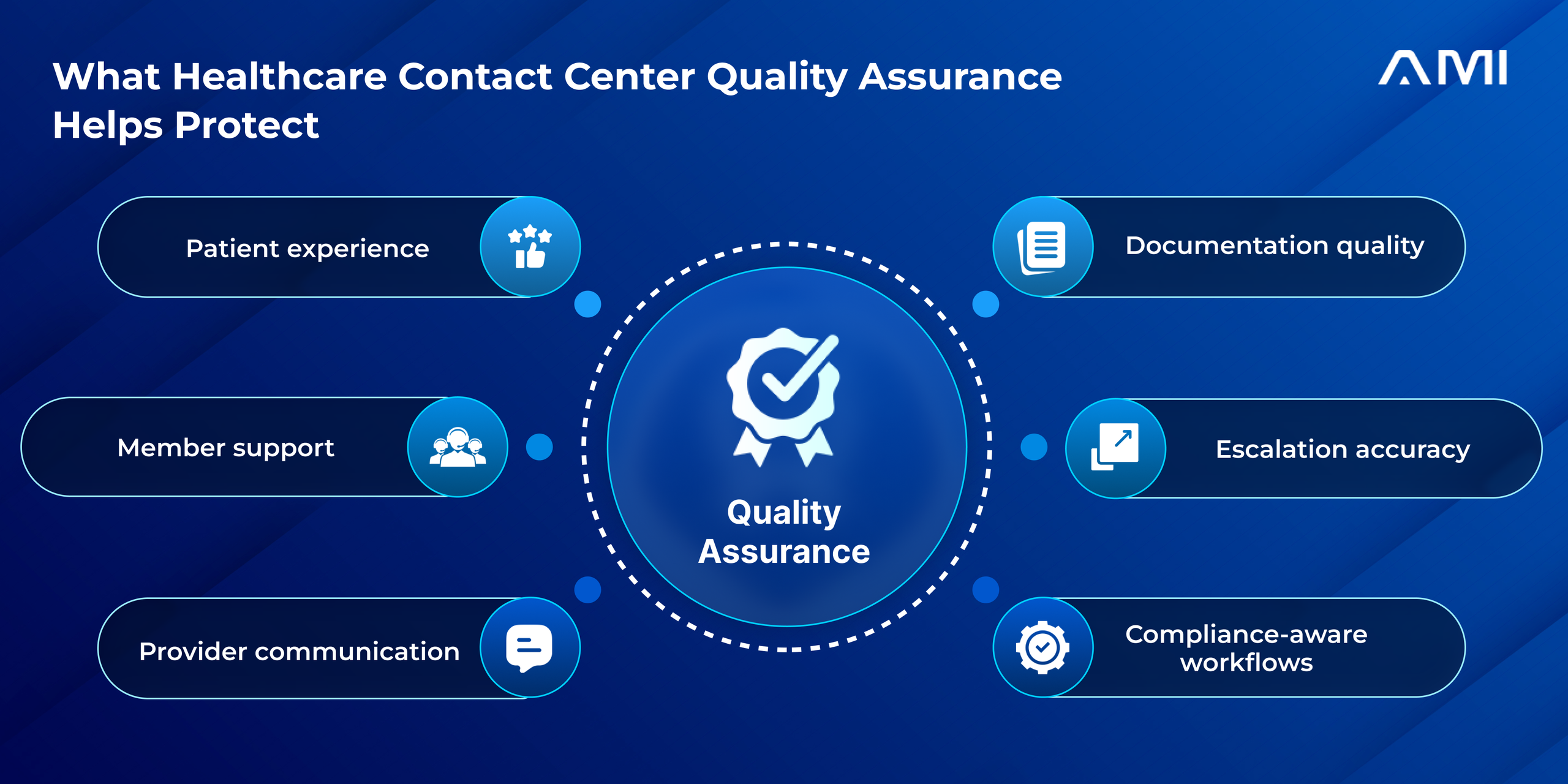
Strong QA helps improve patient experience, member support, provider communication, documentation quality, escalation accuracy, and compliance-aware workflows.
Common QA gaps include incomplete documentation, missed escalation triggers, unclear next steps, incorrect routing, inconsistent answers, repeat calls, and poor handoff context.
Manual QA is still important, but reviewing only a small sample of calls can hide larger trends across patient, member, and provider workflows.
AI-assisted quality assurance helps teams review more interactions, flag documentation gaps, detect escalation signals, surface coaching themes, and identify workflow bottlenecks.
AMI supports AI-first healthcare contact center operations by combining trained teams, AI-assisted QA, structured documentation, escalation support, trend reporting, and co-managed human oversight.
Healthcare contact center interactions are not ordinary customer service conversations. They often involve scheduling, billing, benefits, authorizations, medical records, patient access, member support, provider follow-up, and escalations. A missed detail, unclear next step, or incorrect handoff can create repeat calls, operational delays, caller frustration, and compliance risk.
That is why contact center quality assurance matters in healthcare. It is not only about scoring calls or checking whether agents followed a script. It is about protecting accuracy, trust, documentation quality, escalation handling, and operational visibility across every patient, member, and provider interaction.
Traditional QA is still important, but manual review often covers only a small percentage of interactions. AI-assisted quality assurance can help healthcare contact center teams improve visibility by surfacing documentation gaps, escalation signals, repeated issues, and coaching opportunities while keeping human oversight at the center.
What is Contact Center Quality Assurance?
Contact center quality assurance is the process of reviewing interactions, measuring performance against defined standards, identifying improvement opportunities, and ensuring teams follow approved workflows, documentation rules, escalation steps, and service expectations.
In healthcare, QA helps leaders understand whether an interaction was handled clearly, accurately, and responsibly. It checks if the agent captured the right information, gave the caller a clear next step, documented the interaction properly, and routed any unresolved or sensitive issues to the right team.
A strong contact center QA process helps contact center leaders move beyond surface-level performance. It shows whether the support operation is truly helping patients, members, and providers move forward.
Why Quality Assurance is Different in Healthcare Contact Centers
Healthcare contact centers operate in a more sensitive environment than general customer service teams. A caller may be asking about a bill they do not understand, an authorization that is delaying care, a benefits question, a records request, or a provider follow-up that needs accurate status information.
That makes healthcare contact center quality assurance more complex. QA must look at communication quality, but it also needs to evaluate accuracy, privacy expectations, workflow completion, documentation, empathy, and escalation.
In a general support environment, an unclear answer may create frustration. In healthcare, it can also create repeat calls, delayed follow-up, missed documentation, or incorrect routing. This is why healthcare call center quality assurance needs to be tied to operational outcomes, not just agent behavior.
What Healthcare Contact Center Quality Assurance Helps Protect
Strong QA protects more than call quality. It helps strengthen the entire support experience across healthcare contact center operations.
Patient experience
In a patient support call center, QA helps ensure callers receive respectful communication, accurate answers, and clear next steps. It can also identify where patients are being transferred too often, asked to repeat information, or left without a clear resolution path.
Member support
For member support, QA helps improve consistency in benefits-related conversations, plan questions, eligibility inquiries, claims-related concerns, and issue routing. It also helps leaders see where members may be confused by unclear answers or incomplete follow-up.
Provider communication
Provider inquiries often involve authorizations, claims status, documentation requests, and payer communication. QA helps ensure member and provider inquiry support is routed correctly, documented properly, and followed up with the right context.
Documentation quality
Documentation is one of the most important parts of healthcare QA. Complete notes, disposition codes, next steps, and handoff details help prevent repeat work and downstream delays across healthcare contact center services.
Escalation accuracy
QA helps identify whether agents recognized escalation triggers and moved complex, sensitive, urgent, or unresolved cases to the right team. This protects both the caller experience and the internal workflow.
Compliance-aware workflows
QA also helps confirm whether teams follow approved processes when handling sensitive information, caller verification, billing questions, records, benefits, authorizations, and other healthcare-related conversations.
Common QA Gaps Healthcare Leaders Cannot Afford to Miss
Many quality issues are not obvious from a single call review. A conversation may sound polite, but the documentation may be incomplete. An agent may answer quickly, but the case may still be unresolved. A caller may receive information, but not a clear next step.
Common QA gaps include:
- Documentation gaps: Missing notes, incomplete summaries, or unclear disposition codes make handoffs harder.
- Missed escalation triggers: Sensitive or complex cases may not reach the right team quickly enough.
- Unclear next steps: Callers may leave the interaction without knowing what happens next.
- Incorrect routing: Patients, members, or providers may be transferred to the wrong queue or workflow.
- Inconsistent answers: Different agents may give different information for the same type of request.
- Repeat calls: Callers may contact the team again because the original issue was not fully addressed.
- Long or unresolved interactions: Extended calls may signal knowledge gaps, system friction, or unclear workflows.
- Incomplete intake: Missing caller details can delay follow-up and create rework.
- Poor handoff context: Downstream teams may not have enough information to act.
- Limited coaching visibility: Leaders may not see repeated coaching needs across teams or inquiry types.
These gaps affect patient trust, member experience, provider relationships, and the overall performance of healthcare contact center operations.
Why Manual QA Alone is Not Enough
Manual QA remains valuable because healthcare conversations often require human judgment. However, manual review is usually limited by sample size, reviewer capacity, and time.
If leaders only review a small percentage of calls, they may miss larger patterns across patient, member, and provider workflows. They may not see which inquiry types create repeat calls, which teams need coaching, or where documentation problems are happening most often.
Delayed review is another challenge. If feedback comes days or weeks after the interaction, agents may continue repeating the same issue. Process gaps may also remain hidden until they create larger operational pressure.
Manual QA should not disappear. But in high-volume healthcare contact center services, it needs better visibility around it.

Why do healthcare contact centers struggle even after adding more agents?
Because rising volume, fragmented systems, repeat calls, and delayed escalations need more than staffing. AMI combines AI voice, AI non-voice, and trained human agents to improve routing, documentation, QA visibility, and service execution.
How AI-Assisted Quality Assurance Improves Visibility
AI-assisted quality assurance gives healthcare leaders a broader view of what is happening across contact center interactions. It can help QA teams review more conversations, identify recurring issues, flag documentation gaps, and organize coaching themes faster.
AI can help identify:
- Documentation gaps
- Missed escalation signals
- Long or repeated interactions
- Sentiment and frustration signals
- Unclear next steps
- Policy or workflow deviations
- Common caller questions
- Training and coaching opportunities
- Process bottlenecks
- Repeat-contact drivers
This makes contact center QA more proactive. Instead of relying only on small samples, leaders can see patterns across larger interaction volumes and decide which areas need human review, coaching, or workflow improvement.
The important point is control. AI should support QA visibility. It should not make final judgments on sensitive healthcare conversations without trained human review.
Where AI Fits into Healthcare Contact Center QA
AI works best as a behind-the-scenes operations layer. It helps QA teams see more, organize more, and act faster without removing human responsibility.
| AI support area | How it supports QA |
|---|---|
| Interaction review | Helps review a larger share of interactions instead of relying only on small manual samples. |
| Documentation checks | Identifies missing notes, unclear summaries, inconsistent disposition codes, or incomplete next-step documentation. |
| Escalation signals | Flags calls where urgency, complexity, sentiment, or unresolved issues may require review. |
| Coaching themes | Surfaces recurring coaching needs across agents, teams, inquiry types, or workflows. |
| Workflow trends | Helps leaders identify repeated issues caused by process gaps, unclear routing, outdated knowledge bases, or high-friction workflows. |
When used carefully, AI-first healthcare contact center operations can strengthen QA coverage, improve coaching visibility, and help leaders understand where quality issues are coming from.
Why Human Oversight Still Matters in Healthcare QA
AI-assisted contact center quality assurance should not mean handing judgment over to automation. In healthcare, the stronger model is human-led QA supported by AI visibility.
AI can help find patterns, flag concerns, and organize interaction data. Trained QA leaders should still review sensitive, complex, or compliance-related conversations and make the final judgment.
This balance matters because healthcare interactions often require context, empathy, process knowledge, and discretion. A patient complaint, a benefits dispute, a provider escalation, or a records-related issue cannot be evaluated only through automation.
AI can help teams see more. Human reviewers decide what it means.
What Healthcare Leaders Should Look for in a QA-Focused Contact Center Partner
A QA-focused contact center partner should bring more than staffing capacity. The right partner should understand healthcare workflows, support secure processes, and help leaders improve visibility across interactions.
Key capabilities to look for include:
- Healthcare workflow understanding across patient, member, provider, billing, authorization, and records-related interactions
- HIPAA-aware processes for handling sensitive information
- Trained support and QA teams
- Structured QA scorecards by interaction type
- AI-assisted quality assurance and quality monitoring
- Clear escalation protocols
- Reporting dashboards for trends, coaching, and workflow issues
- Human oversight for sensitive and complex cases
- Co-managed operations with client visibility
A strong partner should help improve healthcare contact center quality assurance without reducing human control.
Want stronger contact center quality assurance without losing human oversight?AMI helps healthcare organizations improve QA visibility, documentation consistency, escalation accuracy, and coaching with trained teams, AI-assisted review, and co-managed operational control.
Improve QA VisibilityHow AMI Supports AI-first Healthcare Contact Center Operations
AMI supports healthcare organizations with AI-first healthcare contact center operations built around service consistency, workflow visibility, and human oversight. The model combines trained healthcare support teams, AI-assisted quality monitoring, structured documentation, escalation support, and co-managed execution to help improve patient, member, and provider interactions.
AMI’s approach is designed for real healthcare contact center challenges: limited QA coverage, documentation gaps, repeat calls, escalation delays, uneven agent performance, and limited visibility into interaction trends. AI supports review and pattern detection. Human experts handle sensitive, urgent, unresolved, or exception-based interactions. Leaders retain oversight through reporting, governance, QA processes, and co-managed execution.
AMI supports:
- Patient, member, and provider inquiry support
- AI-assisted QA and interaction review
- Documentation quality visibility
- Escalation support with interaction context
- Agent Assist feature in healthcare contact centers for live support workflows
- Trend reporting for coaching and workflow improvement
- Co-managed operations with client oversight
For healthcare organizations, QA is not just about finding mistakes. It is about building a more consistent, visible, and accountable operating model across the patient support call center, member services, provider communication, and other healthcare workflows.
Frequently Asked Questions
About the Author

Written by
Urza Dey
Urza Dey is a content and copywriter with over five years of experience across marketing, B2B SaaS, HealthTech, EdTech, and related industries. At AMI, they contribute to content strategy, blog development, and marketing communication focused on healthcare operations, business process management, and AI-enabled service delivery.