

Contact Center Cost Per Interaction: Measure True Healthcare Value
TL;DR: contact center cost per interaction
Use completed interactions and consistent allocation rules in the denominator.
Separate channel costs before combining them into one enterprise average.
Pair unit cost with quality, resolution, and repeat-demand measures.
Lower cost is valuable only when service outcomes remain protected.
Contact center cost per interaction helps healthcare leaders understand what it takes to complete a patient, member, or provider contact. The measure becomes misleading when it treats every channel and every outcome as equivalent.
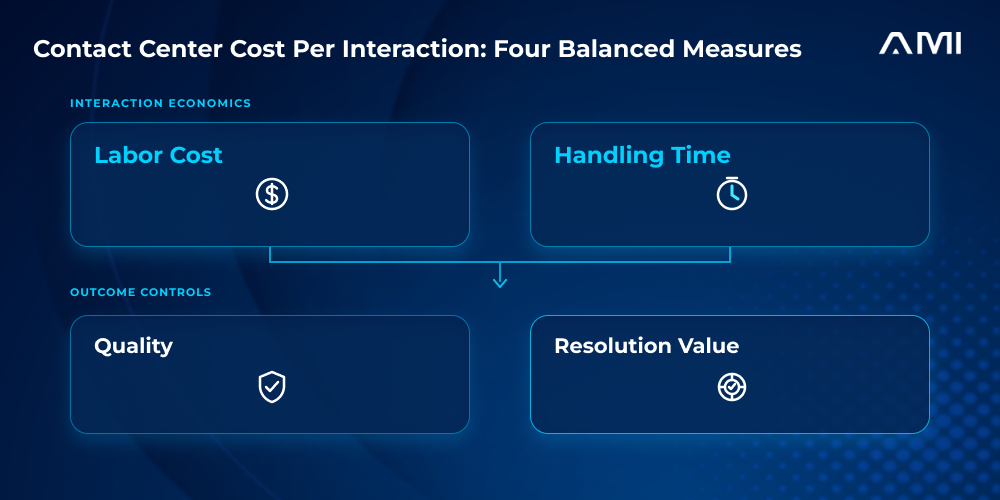
A useful calculation connects labor and technology cost with handling time, quality, escalation, repeat demand, and resolution. That balanced view shows whether lower unit cost reflects real efficiency or simply moves work elsewhere.
What Is Contact Center Cost Per Interaction?
Contact center cost per interaction is the total allocated operating cost divided by the number of completed interactions during the same period. The numerator and denominator must use the same scope, time period, channels, and completion rules.
Define whether an interaction means an offered contact, handled contact, completed case, or resolved need. A large denominator based on incomplete contacts can make cost appear lower without improving access or service.
Which Costs Belong in the Calculation?
Include frontline labor, supervision, quality assurance, training, workforce management, telephony, contact-center platforms, AI tools, licenses, facilities, and appropriate shared support. Document how indirect costs are allocated.
Separate one-time transformation costs from recurring operating costs. Leaders can then understand current run rate without hiding implementation, integration, or change-management investment.
How Should Healthcare Teams Calculate the Metric?
Start with a clearly bounded service and calculate channel-level cost before creating a blended figure. Review monthly trends alongside volume, case mix, staffing, and service outcomes.
| Measure | Calculation input | Why it matters |
|---|---|---|
| Labor cost | Paid hours, benefits, supervision | Largest operating input in many centers |
| Technology cost | Platforms, telephony, AI, licenses | Shows channel and automation economics |
| Quality | Accuracy, compliance, documentation | Prevents savings through avoidable errors |
| Resolution value | Resolved needs, repeat demand, escalations | Connects cost with useful outcomes |
How Does Channel Mix Change Interaction Cost?
Voice, chat, messaging, email, and self-service have different staffing, concurrency, technology, and escalation patterns. A blended average can hide an expensive transfer path or make a high-value complex call look inefficient.
Measure channel cost and journey cost. A patient may begin in self-service, move to chat, and finish with a skilled agent. Counting three cheap interactions instead of one completed journey can reward fragmentation.
Why Must Cost Be Balanced With Quality?
A lower cost per interaction can coincide with repeat contacts, abandoned calls, documentation errors, incorrect routing, or unresolved needs. Pair cost with quality scores, first-contact resolution, repeat demand, transfers, escalations, complaints, and downstream corrections.
Review severe errors separately from average quality. A high overall score can conceal a small number of privacy, identity, or access failures that carry disproportionate risk.
How Should Leaders Use the Metric in Governance?
Use cost per interaction as a diagnostic measure, not a single target. Operating reviews should explain material changes in demand, staffing, handle time, channel mix, automation, and outcome quality.
When a cost improvement is reported, ask what changed, which work moved, and whether patients, providers, or downstream teams absorbed additional effort. A credible benefit has evidence across the full journey.

Why does contact center cost rise without better outcomes?
Repeat contacts, transfers, fragmented channels, and unresolved exceptions increase effort without improving service. AM InfoWeb combines AI-assisted workflows, skilled human agents, QA, and performance visibility to strengthen contact center value.
How Can Contact Centers Improve Economic Value?
Reduce avoidable demand, improve knowledge access, guide routing, simplify documentation, and create reliable handoffs between AI-supported and human-led work. Focus automation on repetitive tasks with clear rules and preserve skilled support for sensitive or complex needs.
Measure cost per resolved need alongside capacity, experience, accuracy, and escalation. The objective is not the cheapest contact; it is the most efficient safe path to a useful outcome.
How AM InfoWeb Supports Contact Center Economics
AM InfoWeb has two decades of experience in the U.S. healthcare industry and uses a co-managed model where AI agents and skilled human agents work together to eliminate process bottlenecks and execute secure healthcare workflows.
AM InfoWeb can support:
- Channel-level cost, demand, handling, and resolution visibility
- AI-assisted intake, routing, documentation, and quality support
- Skilled human agents for complex, sensitive, and exception-driven interactions
- Governance reporting across cost, quality, capacity, escalation, and outcomes
What Makes Interaction Cost a Useful Metric?
A useful interaction-cost metric has clear boundaries, consistent allocation, and an outcome-based denominator. When leaders review it with quality, resolution, channel mix, and repeat demand, they can improve economics without weakening healthcare service.
Need a clearer view of contact center economics? AM InfoWeb can connect cost, quality, capacity, and resolution.
Get in TouchFrequently Asked Questions
About the Author

Written by
Urza Dey
Urza Dey is a content and copywriter with over five years of experience across marketing, B2B SaaS, HealthTech, EdTech, and related industries. At AMI, they contribute to content strategy, blog development, and marketing communication focused on healthcare operations, business process management, and AI-enabled service delivery.
Related Posts
Healthcare Call Center Metrics: 12 KPIs That Actually Matter
Measure healthcare call center access, resolution, quality, compliance, and efficiency.
Outsourcing Metrics: Better Healthcare Scorecards for Quality and Speed
Measure healthcare outsourcing quality, speed, productivity, and governance.