
Centralized Call Center in Healthcare: When Does It Work?
TL;DR: Centralized Call Center in Healthcare
Centralization works best for repeatable patient-access tasks with clear routing and ownership.
Local teams should retain clinical, sensitive, and provider-specific decisions.
AI can assist intent capture and documentation under approved workflows.
Balanced metrics reveal whether access, resolution, quality, and escalations improve.
A centralized call center in healthcare can give patients one reliable entry point for routine questions, scheduling, and follow-up. It can also create distance from local clinical context if every call is routed through the same script. The design question is not whether all calls should move to one team. It is which tasks benefit from shared capacity and which decisions must stay with people who understand the patient's needs and provider-specific rules.
Explore AM InfoWeb's services if your organization needs structured, secure support across these handoffs.
What Is a Centralized Healthcare Call Center?
A centralized healthcare contact center uses a shared team and operating platform to receive, classify, route, document, and resolve interactions across multiple sites or departments. It may handle patient access, member support, provider inquiries, or administrative follow-up. The central team needs approved knowledge, identity-verification steps, and escalation paths; a common phone number alone is not an operating model.
An effective model separates routine work from clinical and provider-specific exceptions. Healthcare contact center best practices provide the broader operating principles; this article focuses on centralization as an organizational choice.
When Does Centralization Improve Patient Access?
Centralization works best when call volume varies across sites, routine questions are repeatable, and patients otherwise face inconsistent hours or handoffs. Shared capacity can absorb peaks, keep a consistent intake record, and route a request to the right local owner. It is less useful if the hub cannot see local appointment rules, referral constraints, language needs, or current service changes.
Before consolidating queues, map the questions the team can fully resolve and the exceptions that require a warm transfer. A call wait-times guide explains why faster pickup alone is not the same as better resolution.
How Should Central and Local Teams Divide Work?
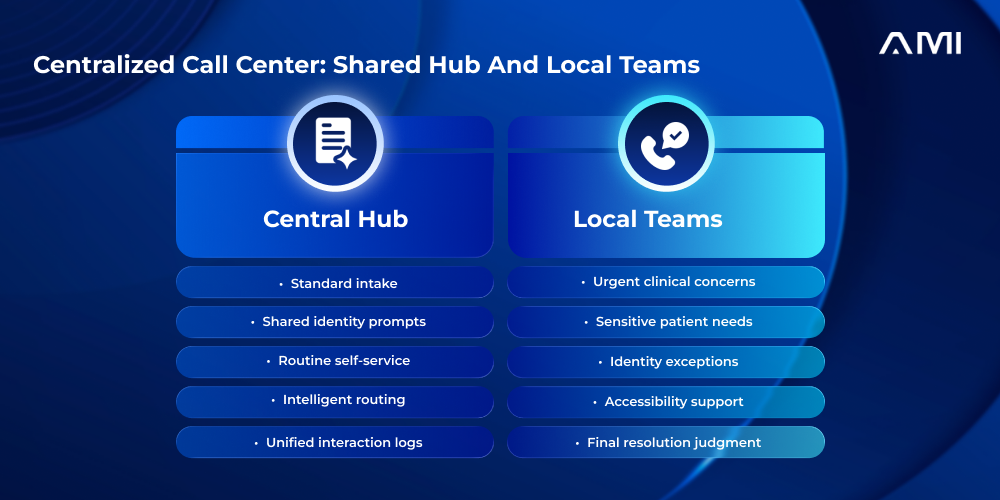
The shared hub should own consistent intake, routine status checks, identity prompts, documentation, and routing. Local or specialized staff should retain clinical triage, urgent safety decisions, complex access exceptions, and final decisions based on provider-specific rules. Both sides need one visible interaction history, not two disconnected notes.
| Workflow | Shared hub role | Local or specialist role |
|---|---|---|
| Scheduling | Collect intent and offer approved slots. | Resolve provider-specific restrictions and complex access needs. |
| Routine inquiries | Use approved answers and document the outcome. | Handle exceptions or policy changes not in the knowledge base. |
| Urgent concerns | Recognize an escalation signal and transfer promptly. | Make the clinical judgment and direct care response. |
| Quality review | Flag recurring handoff and documentation defects. | Validate clinical and site-specific correctness. |
Where Can AI Support a Centralized Contact Center?
AI agents can help identify caller intent, suggest an approved response, summarize administrative interactions, and prioritize routing. They can also make queue trends visible to supervisors. Every automated action needs limits: known source material, identity controls, confidence thresholds, and a route to a skilled agent when the answer is uncertain.
A conversational IVR workflow is one possible entry tool, not a replacement for experienced staff. It should not independently decide clinical urgency or promise an appointment that a local team cannot honor.
For a co-managed operating model, review AI contact center operations.
Need a shared patient-access model without losing local context? AM InfoWeb combines consistent intake, AI-assisted routing, skilled human escalation, and quality reporting.
Get in TouchWhat Must Skilled Human Agents Still Own?
Human agents should take over when a caller describes symptoms or distress, identity verification fails, a language or accessibility need complicates the interaction, or a provider-specific policy conflicts with the central script. They also need authority to correct an AI suggestion and explain the next step to the caller.
The central hub should make the transfer useful. Send the verified details and reason for escalation, but avoid unnecessary protected health information in open notes or messages. A local agent should not have to ask the patient to start the story again merely because the systems do not connect.
Which Metrics Show Whether Centralization Is Working?
Measure outcomes by request type and site, not only at the combined queue level. Watch answer speed, abandonment, first-contact resolution, correct routing, repeat contacts, appointment accuracy, escalation timeliness, documentation quality, and patient feedback. A central model can look efficient overall while one location experiences poor transfers.
The healthcare call center metrics guide covers KPI definitions. For this decision, segment those KPIs by local destination so leaders can see whether shared coverage is actually improving access.
How Can Leaders Roll Out a Centralized Model Safely?
Start with a bounded set of routine interactions, published knowledge, and a clear local-owner directory. Pilot at a few sites, review failed transfers and incomplete resolutions weekly, and expand only when quality and escalation outcomes hold. Centralization should be reversible at the workflow level: if a task requires more local context than the hub can access, assign it back to the right team.

How AM InfoWeb Supports Centralized Contact Center Operations
AM InfoWeb has two decades of experience in the U.S. healthcare industry. Its co-managed model brings AI agents and skilled human agents together to eliminate process bottlenecks and execute secure healthcare workflows. For centralized contact centers, support can include:
- Shared intake and documentation standards across locations.
- AI-assisted intent capture and routing under approved rules.
- Skilled human escalation for sensitive and provider-specific needs.
- QA reporting that highlights repeat contacts and transfer defects.
Conclusion
A centralized healthcare call center works when common tasks become easier for patients without weakening local ownership. The strongest design uses shared capacity for repeatable work, keeps human decisions close to clinical and provider context, and measures whether callers reach a correct resolution.
Frequently Asked Questions
About the Author

Written by
Urza Dey
Urza Dey is a content and copywriter with over five years of experience across marketing, B2B SaaS, HealthTech, EdTech, and related industries. At AMI, they contribute to content strategy, blog development, and marketing communication focused on healthcare operations, business process management, and AI-enabled service delivery.