
7 Strategies to Reduce Call Wait Times in Healthcare
TL;DR — Healthcare Wait Time Reduction at a Glance
Long healthcare call wait times are usually caused by workflow friction, not call volume alone.
Common causes include unclear routing, repeat status calls, fragmented systems, incomplete intake, and limited visibility.
Healthcare teams can reduce delays by segmenting calls by intent, urgency, caller type, and workflow ownership.
Clearer status updates help reduce repeat calls from patients, members, and providers.
Real-time agent guidance, standardized documentation, and smarter routing can reduce handle time and improve service consistency.
AI-assisted operations can support intake, routing, documentation, QA, and analytics without replacing human agents.
AMI helps healthcare organizations reduce wait-time drivers through trained support teams, AI-assisted workflows, QA visibility, and co-managed operational control.
Long call wait times in healthcare are rarely caused by call volume alone. They often happen because of unclear routing, repeated status requests, fragmented systems, incomplete intake, limited self-service options, and agents needing to search for information while callers wait.
For patients, members, and providers, waiting on hold can quickly turn into frustration. A patient may be trying to confirm an appointment. A member may need benefits information. A provider may be following up on an authorization or claim status. Each delay affects trust, satisfaction, and operational efficiency.
Strong healthcare contact center operations can help reduce these delays by improving how calls are classified, routed, documented, escalated, and reviewed. AI can also support this effort when it is used carefully. The goal is not to remove people from healthcare support. The goal is to help teams identify intent faster, route calls more accurately, support agents with context, automate simple status-based interactions, and escalate complex cases with better information.
For healthcare leaders, reducing wait times is not just about answering faster. It is about fixing the workflows behind the call.
Why Call Wait Times are Difficult to Reduce in Healthcare Contact Centers
Healthcare interactions are more complex than general customer service calls. A single call may involve scheduling, benefits, billing, authorizations, medical records, patient access, member support, or provider follow-up.
This complexity makes queue management harder. Agents often need to check multiple systems, confirm sensitive information, document the interaction, and determine whether the request needs escalation. When workflows are unclear, calls take longer and queues build faster.
Many healthcare contact centers also face staffing pressure, peak call periods, limited visibility into inquiry patterns, and disconnected tools. These issues make it harder to reduce patient wait times through staffing alone.
Modern healthcare call center services need to focus on both response speed and workflow accuracy. Faster answering helps, but callers still need the right resolution, the right documentation, and the right next step.
The Real Causes of Long Healthcare Call Wait Times
Long wait times are often symptoms of deeper operational friction. High call volume may be visible, but the root causes usually sit inside process design, system access, routing logic, and documentation quality.
Common causes include:
- Repeat calls: Patients, members, and providers call back because status updates are unclear or follow-ups are delayed.
- Poor routing: Callers reach the wrong queue and need to be transferred.
- Insufficient caller context: Agents start from scratch because previous details are not visible.
- Manual documentation: Agents spend time writing notes instead of moving to the next interaction.
- Knowledge gaps: Teams need to search for policies, scripts, or next steps during live calls.
- Disconnected systems: EHRs, CRMs, payer portals, billing systems, and trackers do not work together smoothly.
- Limited escalation rules: Complex cases wait too long before reaching the right team.
- Weak visibility: Leaders cannot always see which inquiries are driving wait times.
The fastest way to reduce healthcare call volume is not to discourage callers. It is to resolve the reason they are calling in the first place.
7 Ways to Reduce Call Wait Times in Healthcare
Reducing wait times is not only about answering more calls. Healthcare teams need better intake, clearer routing, stronger documentation, faster escalation, and more visibility into the workflows, creating repeated contact.
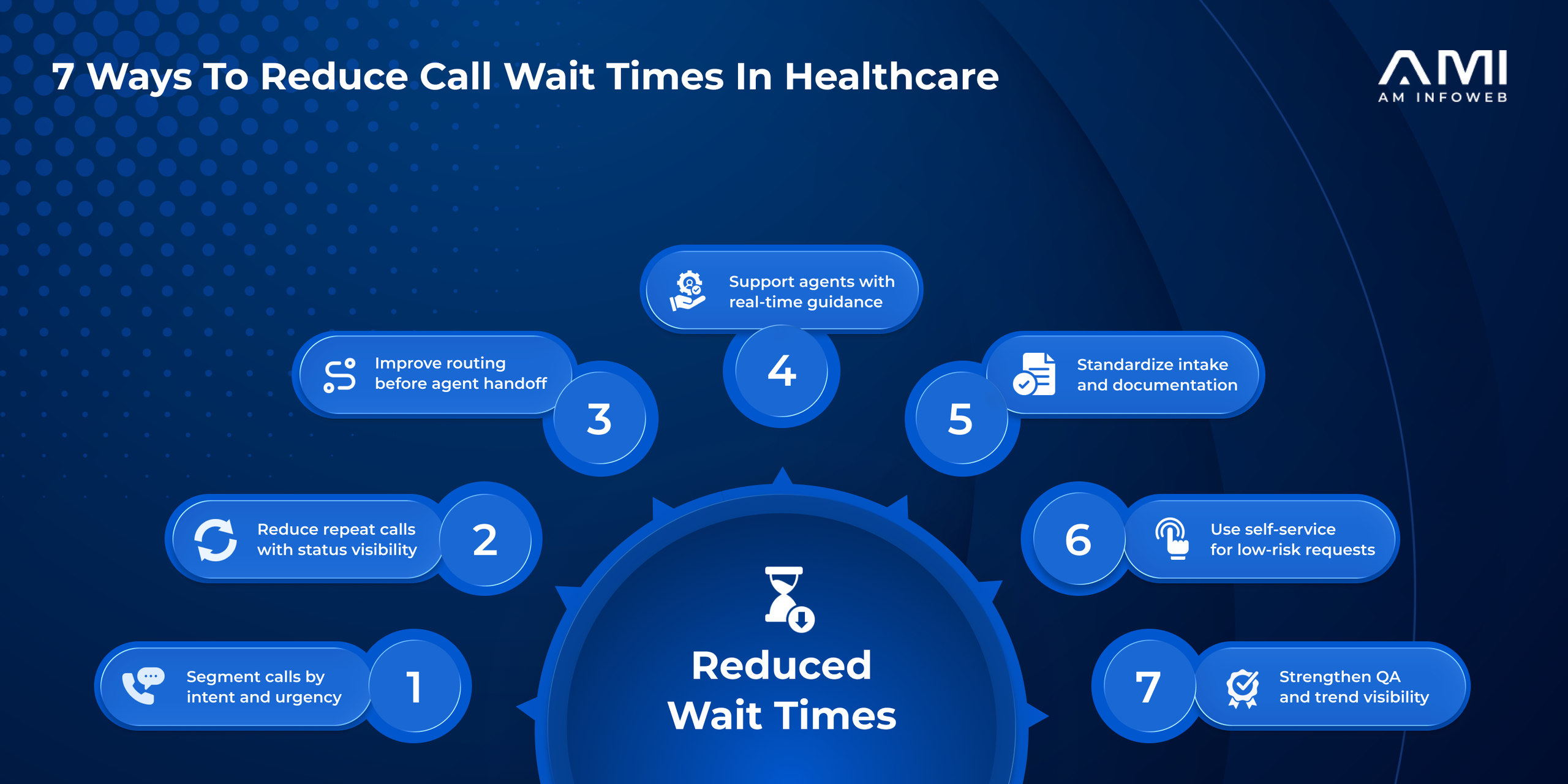
1. Segment calls by intent and urgency
Not every healthcare call should follow the same path. Appointment questions, billing status requests, benefits questions, provider inquiries, and urgent exceptions each need different handling.
A strong intake model segments calls by intent, urgency, caller type, and workflow ownership. Simple requests can move through faster paths, while sensitive or complex cases can be routed to trained teams with the right context.
2. Reduce repeat calls with clearer status visibility
Many wait-time problems come from repeat calls. Patients, members, and providers call again when they do not know the status of a request, do not trust the previous answer, or did not receive a clear next step.
Common drivers include authorization follow-up, billing updates, appointment confirmations, record request status, and claim-related inquiries. Better status visibility helps reduce healthcare call volume without pushing callers away from support.
3. Improve routing before the caller reaches an agent
Poor routing increases transfers, handle time, and caller frustration. A patient with a scheduling question should not wait in the same queue as a provider checking authorization status.
Routing should account for inquiry type, language, caller category, urgency, and workflow ownership. Strong routing helps callers reach the right team earlier and reduces the need for repeated explanations.
4. Support agents with real-time guidance
Wait times do not end when the call is answered. Long handle times also increase queue pressure, especially when agents must search for policies, scripts, next steps, or escalation rules during live calls.
Agent support should include knowledge base access, workflow prompts, policy guidance, and suggested next steps. This helps agents respond with more confidence and consistency.
5. Standardize intake and documentation
Incomplete intake creates downstream delays. When required details are missing, teams may need to call back, reopen cases, transfer work, or delay follow-up.
Standardized intake should define required information by request type. Documentation should include caller intent, key details, disposition codes, next steps, ownership, and escalation status.
6. Use self-service carefully for simple, low-risk requests
Self-service can help reduce wait times, but only when it is designed carefully. In healthcare, automation should not block people from reaching support when a request is sensitive, urgent, confusing, or exception-based.
Low-risk self-service can work well for appointment reminders, basic status updates, intake collection, office hours, and simple routing questions. The key is to make escalation easy when human help is needed.
7. Strengthen QA and trend visibility
Leaders need to know why calls are happening, where queues are building, and which workflows create repeat contact. Manual QA alone often reviews only a small sample of interactions, which can hide larger patterns.
Strong healthcare contact center quality assurance should evaluate documentation quality, escalation accuracy, compliance signals, caller experience, and workflow completion.

Why Do Healthcare Contact Centers Struggle Even After Adding More Agents?
Because rising volume, fragmented systems, repeat calls, and delayed escalations need more than staffing. AMI combines AI voice, AI non-voice, and trained human agents to improve routing, documentation, QA visibility, and service execution.
Where AI Can Help Reduce Healthcare Call Wait Times
AI can help reduce wait times when it works as a behind-the-scenes operations layer. The safest and most useful approach is to support intake, routing, documentation, agent guidance, QA, and analytics while keeping human oversight in place.
| AI support area | How it helps reduce wait times |
|---|---|
| Intake and intent capture | Collects basic caller information, understands the reason for the call, and prepares the interaction before routing. |
| Smarter routing | Routes callers based on intent, complexity, risk, and the right support team, reducing transfers and misrouted calls. |
| Status updates and follow-up support | Supports approved status-based interactions such as appointment confirmations, record request updates, and routine follow-up prompts. |
| Agent Assist | Guides live agents with prompts, knowledge support, suggested responses, and next steps while keeping human judgment in control. |
| Documentation support | Summarizes calls, structures notes, and reduces after-call work, helping reduce repeat calls and poor handoffs. |
| QA and analytics | Reviews more interactions, identifies trends, and improves visibility into wait-time drivers, QA gaps, and operational issues. |
Intake and intent capture
AI can collect basic information, understand why the caller is reaching out, and prepare the interaction before routing. This reduces the time agents spend identifying the issue.
Smarter routing
AI can help route callers based on intent, complexity, risk, and the required support team. This helps reduce transfers and misrouted calls.
Status updates and follow-up support
AI can support approved status-based interactions where the workflow is clear. Examples include appointment confirmations, record request updates, and routine follow-up prompts.
Agent assist
Agent Assist can guide live agents with prompts, knowledge support, suggested responses, and next steps. This helps agents work faster while keeping human judgment in control.
Documentation support
AI can summarize calls, structure notes, and reduce after-call work. Better documentation also reduces repeat calls and poor handoffs.
QA and analytics
AI can help review more interactions, identify trends, and improve visibility into wait-time drivers. This strengthens healthcare contact center quality assurance and operational planning.
What Healthcare Leaders Should Look for in a Contact Center Partner
A modern contact center partner should do more than add staffing capacity. The right partner should understand healthcare workflows, protect sensitive information, support complex escalations, and provide visibility into performance.
Key capabilities to look for include:
- Healthcare workflow knowledge: Support across patient, member, provider, billing, authorization, and records-related interactions.
- HIPAA-aware processes: Secure handling of sensitive healthcare information.
- Trained support teams: Agents who understand healthcare communication and escalation needs.
- AI-assisted execution: Support for intake, routing, documentation, QA, and analytics.
- Clear escalation protocols: Defined paths for urgent, sensitive, unresolved, or complex requests.
- Reporting dashboards: Visibility into volume, trends, wait-time drivers, and service performance.
- Scalable delivery: Support for peak periods, after-hours needs, and changing demand.
The best contact center services for healthcare combine trained people, workflow discipline, AI-assisted execution, and client oversight.
Struggling to reduce healthcare call wait times without losing control? AMI helps healthcare organizations improve routing, documentation, QA visibility, and escalation through AI-assisted workflows, trained support teams, and co-managed operations.
Reduce Wait TimesHow AMI Supports AI-First Healthcare Contact Center Operations
AMI supports healthcare organizations with AI-first healthcare contact center operations designed to reduce operational friction across patient, member, and provider interactions. The model combines trained healthcare support teams, AI-assisted intake, routing, documentation, QA visibility, and co-managed execution so organizations can improve response times without losing human oversight.
AMI’s approach supports the real causes of long wait times: repeated status calls, unclear routing, fragmented documentation, after-hours demand, limited QA visibility, and complex escalations. AI supports structured, high-volume workflows. Human experts handle sensitive, urgent, unresolved, or exception-based cases. Leaders retain control through reporting, governance, and co-managed operations.
AMI’s healthcare contact center operations support:
- Patient, member, and provider inquiry support
- AI-assisted intake and caller intent capture
- Smarter routing and escalation with context
- Agent Assist for live support workflows
- AI-assisted documentation and summaries
- QA visibility and interaction trend reporting
- Co-managed operations with client oversight
For healthcare teams, the goal is not to replace agents. The goal is to build a stronger operating model where AI helps reduce avoidable delays, human teams manage judgment-based interactions, and leaders gain clearer visibility into what is driving wait times.
Frequently Asked Questions
About the Author

Written by
Urza Dey
Urza Dey is a content and copywriter with over five years of experience across marketing, B2B SaaS, HealthTech, EdTech, and related industries. At AMI, they contribute to content strategy, blog development, and marketing communication focused on healthcare operations, business process management, and AI-enabled service delivery.