
Contact Center Compliance Checklist for Healthcare Vendor Evaluation
TL;DR — Compliance Checklist at a Glance
Contact center compliance should be part of every healthcare vendor evaluation because vendors may handle PHI, billing details, benefits questions, authorizations, records requests, and sensitive patient, member, or provider interactions.
Healthcare leaders should evaluate more than cost and coverage. They should review workflow knowledge, HIPAA-aware processes, PHI handling, security certifications, access controls, QA, escalation, reporting, and audit readiness.
A strong vendor should support structured documentation, standardized disposition codes, clear next steps, secure handoffs, and documentation quality review.
Compliance-ready contact centers need defined escalation rules for sensitive, urgent, unresolved, or exception-based cases, with trained human oversight and full interaction context.
AI can support compliance monitoring through intake consistency, caller intent capture, documentation summaries, escalation signal detection, Agent Assist, QA review coverage, and trend reporting.
AI should improve visibility and consistency, but it should not become the sole decision-maker for sensitive healthcare interactions.
AMI helps healthcare organizations evaluate and run compliance-ready contact center operations with PHI-aware workflows, trained teams, AI-assisted QA, escalation support, reporting, and co-managed oversight.
Healthcare contact centers handle sensitive interactions across patient support, member services, provider inquiries, billing questions, benefits, authorizations, scheduling, medical records, and escalation workflows. Choosing the wrong vendor can create documentation gaps, weak handoffs, inconsistent answers, privacy concerns, PHI handling risks, and poor operational visibility.
That is why contact center compliance should be part of every healthcare vendor evaluation. Compliance is not only about policies on paper. Healthcare leaders need to know whether a vendor can protect sensitive information, adhere to approved workflows, properly document interactions, escalate sensitive cases, monitor quality, and provide clear reporting.
AI-first healthcare contact center operations can support compliance-aware delivery by improving intake consistency, documentation quality, QA visibility, escalation tracking, and reporting. But in healthcare, AI should support trained teams and leadership oversight, not replace human review.
Why Contact Center Compliance Matters in Healthcare
Contact center compliance matters because healthcare conversations often involve sensitive information, caller verification, benefits questions, billing concerns, authorization updates, records requests, and provider follow-ups. A small mistake can create repeat calls, workflow delays, trust issues, or privacy risk.
A compliant healthcare contact center partner should help protect patient and member experience, provider communication, documentation quality, escalation accuracy, and operational accountability. For healthcare contact centers, compliance is not separate from service quality. It is part of how the work gets done every day.
What Healthcare Leaders Should Evaluate Before Choosing a Contact Center Vendor
A strong vendor evaluation should review people, processes, technology, security posture, QA practices, escalation models, reporting visibility, and healthcare workflow experience. The goal is to understand whether the vendor can support real healthcare contact center operations, not just general customer service.
1. Healthcare workflow understanding
A vendor should understand healthcare-specific workflows across patient inquiries, member support, provider inquiries, billing questions, benefits, authorization follow-up, scheduling, and records-related requests. A generic call center experience may not be enough for contact center services for healthcare, where accuracy, documentation, and workflow follow-through matter.
Ask whether the vendor can support patient, member, and provider interactions; separate simple requests from complex exceptions; and align workflows with your SOPs.
Questions to ask:
- Can the vendor support patient, member, and provider workflows separately?
- How do they handle billing, benefits, authorization, scheduling, and records-related inquiries?
- Can they identify which requests are routine and which need escalation?
2. HIPAA, PHI, security certifications, and audit readiness
A HIPAA-compliant contact center should have clear processes for handling sensitive patient, member, provider, billing, benefits, authorization, and records-related information. Leaders should verify actual controls, not rely only on verbal claims.
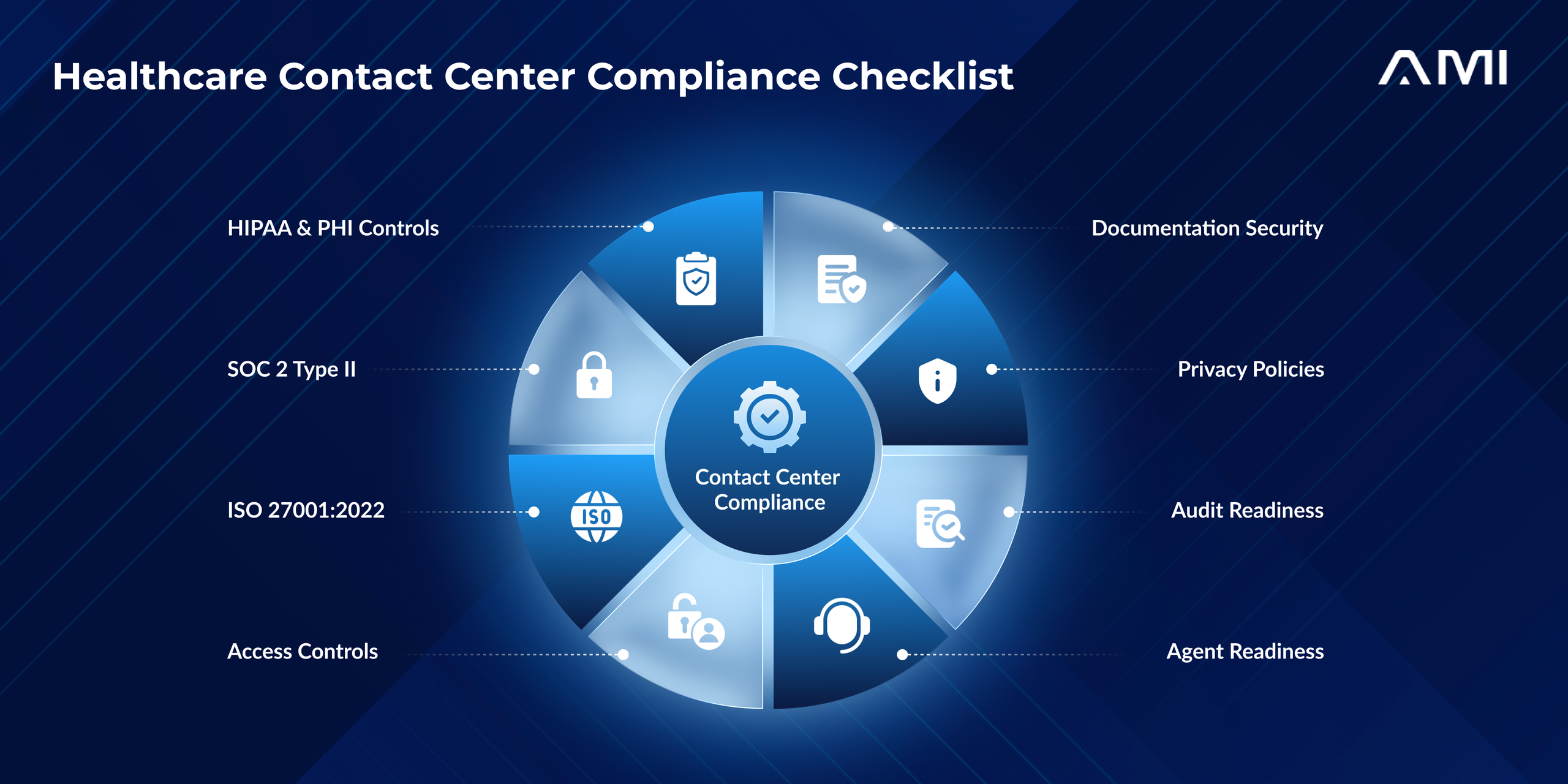
A practical certification and compliance checklist should include:
- HIPAA-compliant processes
- PHI handling in healthcare contact centers
- SOC 2 Type II certification
- ISO 27001:2022 certification
- Role-based access control
- Secure documentation practices
- Data privacy and protection policies
- Audit documentation availability
- Access monitoring and review
- Incident response documentation
- Data retention and disposal controls
- Approved scripts and workflows
- Agent training on sensitive data handling
These controls help reduce risk across protected health information contact center workflows and support stronger healthcare data security contact center standards.
Questions to ask:
- Can the vendor provide evidence of HIPAA-aware processes, SOC 2 Type II, or ISO 27001:2022 certification?
- How do they control access to PHI and sensitive workflow information?
- What audit documentation, access monitoring, and incident response processes are available?
3. Documentation standards
Documentation gaps can create repeat calls, poor handoffs, unresolved issues, and downstream delays. A compliant vendor should support structured notes, disposition codes, next-step documentation, and clear handoff context.
This matters across healthcare contact center services because one incomplete note can delay billing follow-up, authorization status, records requests, or provider communication.
Questions to ask:
- What information must agents capture for each request type?
- Are notes, disposition codes, next steps, and handoff details standardized?
- Can documentation quality be reviewed through QA or reporting?
4. Escalation rules and human oversight
Not every interaction should be handled the same way. Sensitive, urgent, unresolved, or exception-based cases need defined escalation paths and trained human review.
A vendor should be able to explain when escalation happens, who owns the case, what context is transferred, and how escalation performance is reviewed. This is especially important when evaluating healthcare call center outsourcing services or deciding whether to outsource healthcare call center services.
Questions to ask:
- What types of cases are automatically escalated to trained human teams?
- Does the escalation include full interaction context and documentation?
- Can leaders review escalation trends, delays, and outcomes?
5. Contact center compliance monitoring
Contact center compliance monitoring should not depend only on occasional reviews. Leaders need visibility into whether teams are following approved workflows, documenting correctly, escalating properly, protecting sensitive information, and maintaining consistent service quality.
AI-assisted QA can help review more interactions and surface documentation gaps, escalation signals, repeat issues, and coaching themes. This supports contact center compliance risk reduction strategies without removing human oversight.
Questions to ask:
- How often are interactions reviewed for workflow, documentation, and escalation quality?
- Can the vendor monitor compliance across more than a small sample of interactions?
- How are potential compliance or quality issues flagged and reviewed?
6. Contact center compliance auditing and reporting
Contact center compliance auditing should provide clear evidence of quality, process adherence, escalation patterns, documentation consistency, and compliance-aware workflow execution. Reporting should be useful for operational review, not hidden inside vague performance summaries.
A vendor should be able to show QA findings, call trends, escalation reports, documentation issues, repeat-call drivers, and corrective action visibility.
Questions to ask:
- What audit reports are available to healthcare leaders?
- Can reporting show documentation gaps, escalation patterns, and workflow deviations?
- How does the vendor track corrective actions after audit findings?
7. Quality assurance model
QA protects service consistency, documentation quality, escalation accuracy, and caller trust. A strong vendor should have structured QA scorecards and healthcare-specific review criteria.
This is part of healthcare contact center best practices because quality is not only about agent tone. It is about whether the interaction was accurate, documented, routed, and resolved correctly.
Questions to ask:
- Does the vendor use healthcare-specific QA scorecards?
- Does QA measure documentation, escalation, workflow adherence, and resolution quality?
- How are QA findings used for coaching and process improvement?
8. AI-assisted QA and compliance visibility
AI-assisted QA can help review more interactions, flag documentation gaps, detect escalation signals, identify repeated issues, and surface coaching themes. It can also support contact center compliance monitoring by giving leaders broader visibility across interaction volume.
AI should support visibility, not final judgment. Sensitive, complex, or compliance-related conversations still need trained human review.
Questions to ask:
- What does AI review, and what still requires human QA judgment?
- Can AI-assisted QA flag documentation gaps, escalation signals, and repeated issues?
- How does the vendor prevent AI from becoming a black-box scoring process?

Why do healthcare contact centers struggle even after adding more agents?
Because rising volume, fragmented systems, repeat calls, and delayed escalations need more than staffing. AMI combines AI voice, AI non-voice, and trained human agents to improve routing, documentation, QA visibility, and service execution.
9. Agent assist and approved guidance
Agent Assist can help live agents follow approved workflows, access correct information, and document interactions consistently. This keeps humans in control while helping teams reduce variation across scripts, next steps, and escalation handling.
For healthcare contact center professional services, this is a practical way to use AI without handing sensitive interactions fully to automation.
Questions to ask:
- Does Agent Assist guide agents with approved scripts, knowledge, and next steps?
- Can it support documentation consistency during or after the interaction?
- How are agent guidance materials reviewed, updated, and governed?
10. Reporting dashboards and workflow visibility
Healthcare leaders should not lose visibility after outsourcing or co-managing contact center operations. Reporting should show inquiry trends, repeat-call drivers, escalation patterns, QA findings, documentation quality, and workflow bottlenecks.
This is important when comparing contact center solutions for healthcare because the safest partner is not always the one that promises the most automation. It is the one that gives leaders the clearest visibility and control.
Questions to ask:
- Can leaders see inquiry trends, repeat-call drivers, and escalation patterns?
- Do dashboards show QA findings, documentation quality, and workflow bottlenecks?
- Can reports be used to improve SOPs, staffing, training, and service design?
11. Co-managed control instead of black-box outsourcing
A vendor should not take healthcare workflows into a black box. Leaders should evaluate whether the partner provides oversight, workflow transparency, QA visibility, reporting, and room for process improvement.
A co-managed model gives clients visibility into what is happening, how workflows are performing, and where quality can improve over time.
Questions to ask:
- Can the client retain visibility into workflows, QA, reporting, and escalation performance?
- Can SOPs, scripts, escalation rules, and reporting views be customized?
- Does the model allow continuous improvement without losing operational control?
Where AI Fits Into a Compliance-Ready Healthcare Contact Center Model
| AI support area | How it supports a compliance-ready contact center model |
|---|---|
| Intake consistency | Helps collect the right information in a more structured and consistent way. |
| Caller intent capture | Identifies why the caller is reaching out before routing or escalation. |
| Documentation summaries | Supports clearer notes, summaries, and next-step documentation. |
| Escalation signal detection | Flags interactions that may need human review based on urgency, complexity, or unresolved issues. |
| Agent Assist guidance | Helps live agents follow approved workflows, scripts, and next steps. |
| QA review coverage | Supports broader review of interactions beyond small manual samples. |
| Compliance monitoring support | Helps surface documentation gaps, workflow deviations, and potential quality issues. |
| Trend reporting for leaders | Shows patterns across inquiries, repeat calls, escalations, and workflow bottlenecks. |
For healthcare leaders, the key is control. AI should help teams see more, document better, route faster, and monitor quality more consistently. It should not become the sole decision-maker for sensitive healthcare interactions.
Why Human Oversight Still Matters for Contact Center Compliance
AI can support compliance-aware workflows, but human oversight remains essential. Healthcare interactions often require context, empathy, discretion, and judgment. A patient complaint, benefits dispute, provider escalation, or PHI-related concern should not be handled as a fully automated decision.
Human teams should review sensitive conversations, exceptions, escalation decisions, QA findings, and compliance-sensitive concerns. AI can help identify patterns and risks. Trained teams decide what those findings mean and what action should follow.
Evaluating a healthcare contact center vendor for compliance-ready operations?AMI helps healthcare organizations improve PHI-aware workflows, QA visibility, documentation quality, escalation control, and co-managed oversight through trained teams and AI-assisted operations.
Get in TouchHow AMI Supports AI-First Healthcare Contact Center Operations
AMI supports healthcare organizations with AI-first Healthcare Contact Center Operations built around workflow visibility, service consistency, compliance-aware delivery, and human oversight. The model combines trained healthcare support teams, AI-assisted workflows, QA visibility, escalation support, and co-managed execution to help organizations manage patient, member, and provider interactions with more control.
AMI supports:
- HIPAA-compliant healthcare contact center operations
- SOC 2 Type II and ISO 27001:2022 certified delivery environment
- PHI-aware intake, routing, documentation, and escalation workflows
- Patient, member, and provider inquiry support
- AI-assisted intake and caller intent capture
- Agent Assist for live support teams
- Smarter routing and escalation with context
- AI-assisted documentation and summaries
- QA visibility and interaction trend reporting
- Compliance-aware workflow support
- 100% work-from-office operations
- Co-managed operations with client oversight
For healthcare organizations, vendor evaluation should not stop at cost, coverage, or call volume. The stronger question is whether the vendor can support healthcare contact center compliance requirements with secure processes, trained teams, QA visibility, PHI-aware workflows, and operational control.
Frequently Asked Questions
About the Author

Written by
Urza Dey
Urza Dey is a content and copywriter with over five years of experience across marketing, B2B SaaS, HealthTech, EdTech, and related industries. At AMI, they contribute to content strategy, blog development, and marketing communication focused on healthcare operations, business process management, and AI-enabled service delivery.