

Process Improvement in Healthcare: Diagnose Bottlenecks and Sustain Change
TL;DR: process improvement in healthcare
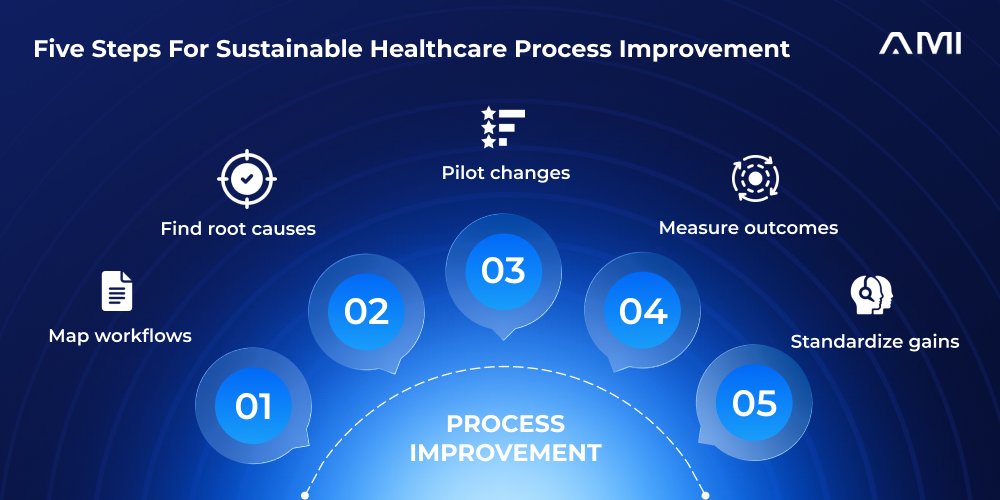
Map the real workflow before choosing a solution.
Separate root causes from symptoms such as backlog or overtime.
Pilot changes with outcome, process, and balancing measures.
Standardize only after gains persist under normal operating conditions.
Process improvement in healthcare is a disciplined way to make work safer, more reliable, more timely, or less costly. It begins with a defined problem and a measurable aim, not with a preferred technology.
The strongest improvement efforts examine the whole workflow. They test whether a local change reduces the real constraint or merely sends work, risk, or delay somewhere else.
Explore how AM InfoWeb supports healthcare operations with a co-managed delivery model.
What Is Process Improvement in Healthcare?
Process improvement uses observation, data, structured analysis, testing, and standardization to change how work is performed. The goal is a measurable improvement in outcomes, flow, quality, experience, or resource use.
It differs from a one-time fix because the team studies causes, tests a change, monitors its effects, and builds the successful practice into daily operations.
How Do Teams Find the Real Bottleneck?
Map the workflow from trigger to completed outcome, including waits, handoffs, rework loops, approvals, and exceptions. Speak with the people who do the work and review actual cases instead of relying only on a written procedure.
AHRQ notes that workflow mapping can reveal inefficiency and support redesign. Queue aging, repeat contact, error reasons, and touch counts help confirm where flow truly slows.
Primary source: AHRQ Workflow Mapping.
Which Process Improvement Methods Work in Healthcare?
Methods such as process mapping, root-cause analysis, Plan-Do-Study-Act cycles, Lean techniques, and statistical quality tools answer different questions. Teams should choose the lightest method that can test the problem reliably.
The method matters less than disciplined use. A clear aim, defined measures, frontline participation, and leadership support are more valuable than applying a branded framework without operational evidence.
| Method | Best use | Common mistake |
|---|---|---|
| Process mapping | Reveal steps, waits, and handoffs | Mapping the ideal instead of actual work |
| Root-cause analysis | Investigate recurring defects | Stopping at the first plausible cause |
| PDSA cycle | Test a change on a small scale | Scaling before results are stable |
| Standard work | Preserve a proven method | Freezing a process that still fails exceptions |
How Should Teams Pilot a Process Change?
Define the change, target group, owner, duration, expected result, data source, and stop conditions. Pilot on a representative slice of work that includes common exceptions, not only the easiest cases.
Keep the test small enough to learn quickly but large enough to expose practical constraints. Record deviations and frontline feedback so the next cycle improves both the workflow and the implementation plan.
Explore related capabilities across AM InfoWeb's healthcare services.
What Measures Prove the Process Improved?
Use outcome measures for the result, process measures for whether the new method was followed, and balancing measures for unintended effects. CMS connects quality improvement to measurable improvement; the same logic prevents teams from declaring success based only on activity.
For administrative workflows, useful measures include turnaround, backlog aging, first-pass quality, rework, escalation resolution, repeat contact, cost per completed outcome, and staff effort.
Primary source: CMS Quality Measurement and Quality Improvement.
How Do Healthcare Teams Sustain Improvement?
Convert the tested method into accessible standard work, training, ownership, dashboards, and routine review. Define what performance drift looks like and who responds when it appears.
Sustainment also requires capacity for exceptions and changes in demand. A process that works only with unusually high staffing or constant leadership attention is not yet stable.

How AM InfoWeb Supports Healthcare Process Improvement
AM InfoWeb has two decades of experience in the U.S. healthcare industry and uses a co-managed model where AI agents and skilled human agents work together to eliminate process bottlenecks and execute secure healthcare workflows.
AM InfoWeb can support:
- Current-state workflow mapping and operational baseline analysis
- Root-cause identification using queue, quality, and exception data
- Pilot execution with AI-assisted tasks and skilled human oversight
- Standard work, quality review, and performance-governance support
Healthcare organizations retain responsibility for their own clinical, legal, privacy, policy, and final operational decisions.
What Turns Process Improvement Into Durable Change?
Durable improvement links a real bottleneck to a tested change and measurable outcome. It equips frontline teams to follow the new method, gives leaders balancing measures, and assigns ownership for drift. Improvement becomes sustainable when the process performs reliably without constant rescue work.
Ready to improve a healthcare workflow? AM InfoWeb can help diagnose friction, pilot change, and sustain measurable gains.
Get in TouchFrequently Asked Questions
About the Author

Written by
Urza Dey
Urza Dey is a content and copywriter with over five years of experience across marketing, B2B SaaS, HealthTech, EdTech, and related industries. At AMI, they contribute to content strategy, blog development, and marketing communication focused on healthcare operations, business process management, and AI-enabled service delivery.
Related Posts
AI Workflow Orchestration: Coordinating Healthcare Tasks and Human Decisions
Connect tasks, exceptions, and human ownership across healthcare workflows.
Revenue Cycle Management Automation for AI-First Healthcare Operations
Revenue Cycle Management Automation is often discussed as a billing or software topic, but many...