

AI Workflow Orchestration: Coordinating Healthcare Tasks and Human Decisions
TL;DR: AI workflow orchestration
Orchestration coordinates work across systems, agents, and people.
A workflow needs explicit states, owners, and exception routes.
AI can prepare and route, but authority boundaries remain human-defined.
Measure completion, rework, queue aging, and exception outcomes.
AI workflow orchestration is the coordination layer between an incoming request and a completed outcome. It determines what information is needed, which routine steps can be prepared automatically, when a person should take over, and how the result is recorded. In healthcare operations, the value is often less about a single model and more about connecting fragmented work.
A patient call, payer inquiry, authorization request, or billing exception can cross several teams and systems. Orchestration only helps when every handoff preserves context and every action has a clear owner.
Explore how AM InfoWeb supports AI-assisted healthcare contact center operations with skilled human oversight.
What Is AI Workflow Orchestration in Healthcare?
It is the design and execution of a multi-step workflow in which AI supports tasks such as classification, extraction, summarization, and routing. Rules, systems, and human teams still govern what may happen next. The orchestrated process tracks state from intake to resolution rather than treating each automation as an isolated tool.
For example, a contact-center inquiry can be classified, checked against known information, placed in the appropriate queue, escalated if uncertain, and documented after a human resolves it. The same pattern can support nonclinical administrative work in revenue cycle or payer operations.
How Does Orchestration Differ From Task Automation?
Task automation completes one activity, such as extracting a member ID or drafting a call summary. Orchestration decides when that activity runs, what data it may use, what result is acceptable, what happens on failure, and who takes responsibility next.
A useful design distinguishes triggers, inputs, states, decision points, service-level expectations, exception queues, and closure evidence. Without those elements, several automated tasks can still leave a broken end-to-end process.
| Question | Task automation | Workflow orchestration |
|---|---|---|
| What is optimized? | One repeatable task | End-to-end work progression |
| What happens on uncertainty? | Often stops or produces an output | Routes to a defined owner and next state |
| What gets measured? | Task speed and accuracy | Completion, rework, aging, and outcome quality |
What Are the Three Stages of an Orchestrated Workflow?
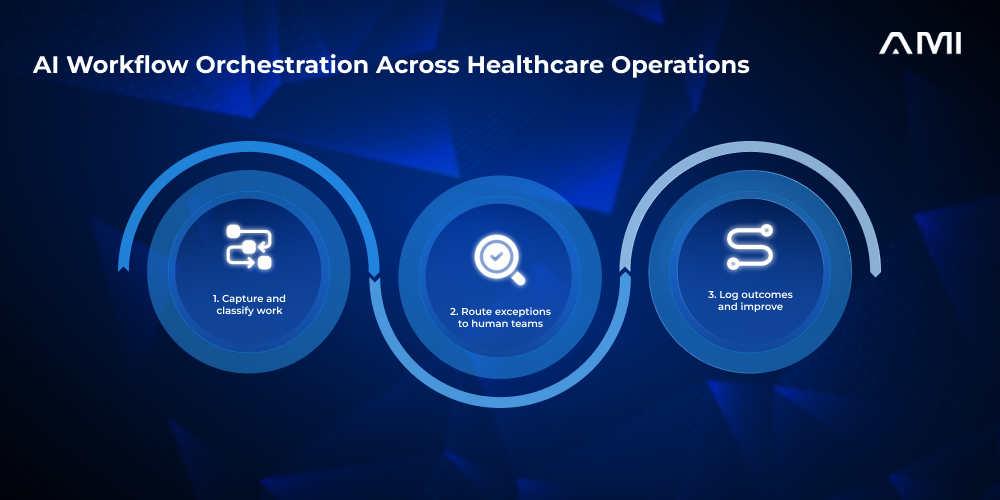
First, capture the request and classify it using the minimum necessary information. Second, route the work: rules-based tasks proceed within approved limits, while uncertainty or sensitive cases move to a qualified person. Third, record the outcome, corrections, and unresolved causes so the process can improve.
Each stage needs an explicit state and a timestamp. A case should not disappear between an AI action and a human queue. Leaders should be able to see what is waiting, why it is waiting, and who can unblock it.
How Should Orchestration Handle Exceptions and Failed Tasks?
Define a safe fallback before deployment. Missing identifiers, conflicting records, integration failures, and low-confidence outputs should create visible exception work rather than silent retries or guessed answers. The person receiving a case should see the original request and the steps already attempted.
Use a reason-code taxonomy to identify whether the bottleneck is data quality, policy ambiguity, system access, or staffing. Repeated exceptions may justify redesigning the workflow instead of adding more ad hoc manual fixes.
See related implementation ideas in AM InfoWeb’s healthcare services.
Which Metrics Reveal Whether Orchestration Is Working?
Track time from intake to completion, queue aging, first-pass resolution, automation success within policy, handoff completeness, rework, error correction, and repeat contact. Segment by request type and risk level so the average does not conceal high-friction cases.
Balance throughput with quality. A workflow is not better because it closes more tickets if a greater share reopens, escalates late, or cannot be explained after the fact.
How Can Healthcare Teams Implement Orchestration Safely?
Start with a process map and a bounded pilot. Name the system of record, permitted data, AI-supported steps, human decision gates, access controls, and recovery path. Test normal, incomplete, contradictory, and high-risk cases before scaling.
NIST’s AI Risk Management Framework emphasizes documented roles, oversight, measurement, and post-deployment monitoring. When protected health information is processed by a service provider, evaluate the applicable business-associate arrangements and safeguards with qualified privacy and legal teams.
For a primary reference, see the NIST AI Risk Management Framework.

How AM InfoWeb Supports AI Workflow Orchestration
AM InfoWeb has two decades of experience in the U.S. healthcare industry and uses a co-managed model where AI agents and skilled human agents work together to eliminate process bottlenecks and execute secure healthcare workflows.
AM InfoWeb can support:
- AI-assisted intake, classification, and context preparation
- Defined human queues for ambiguous and sensitive exceptions
- Operational state tracking, QA review, and reason-code analysis
- Secure documentation and reporting across handoffs
Healthcare organizations retain responsibility for their own clinical, legal, privacy, policy, and final operational decisions.
Where Should an Orchestration Pilot Begin?
Choose a workflow with repeatable steps, visible pain, and a clear human owner. Map its states and exceptions before selecting tools. A successful pilot should show not only faster movement but fewer lost handoffs, less rework, and reliable evidence of who made each decision.
Need a clearer path from intake to resolution? AM InfoWeb can help coordinate AI-assisted steps, human exceptions, quality checks, and secure documentation.
Get in TouchFrequently Asked Questions
About the Author

Written by
Urza Dey
Urza Dey is a content and copywriter with over five years of experience across marketing, B2B SaaS, HealthTech, EdTech, and related industries. At AMI, they contribute to content strategy, blog development, and marketing communication focused on healthcare operations, business process management, and AI-enabled service delivery.
Related Posts
Healthcare Contact Center Automation: 9 Workflows With Human Oversight
Automation can reduce friction, improve consistency, and support faster service, but it should not replace trained...
Revenue Cycle Management Automation for AI-First Healthcare Operations
Revenue Cycle Management Automation is often discussed as a billing or software topic, but many...