

Healthcare Outsourcing Transition Methodology: From Discovery Through Stable Operations
TL;DR: outsourcing transition methodology
Baseline the current operation before transferring responsibility.
Move knowledge with observed practice, testing, and documented exceptions.
Use readiness gates instead of calendar dates alone.
Keep hypercare visible until quality and service levels stabilize.
An outsourcing transition methodology gives healthcare leaders a controlled way to move operational responsibility without losing context, service continuity, or accountability. The work begins before training and continues after go-live, when actual volumes, exceptions, and quality patterns become visible.
A strong transition does not simply copy tasks from one team to another. It establishes a baseline, clarifies ownership, validates access and documentation, tests the future workflow, and defines evidence for stabilization.
Explore how AM InfoWeb supports healthcare operations with a co-managed delivery model.
What Is an Outsourcing Transition Methodology?
It is a structured sequence for discovering the current operation, designing the future operating model, transferring knowledge, testing readiness, moving work, and stabilizing performance. The methodology connects project milestones to operational evidence so leaders can decide whether each phase is ready to advance.
Healthcare transitions need extra attention to protected information, role-based access, service continuity, exception ownership, and auditability. Those controls should be designed into the transition rather than added after work moves.
What Should Discovery and Baseline Assessment Capture?
Discovery should document volumes, demand patterns, queues, roles, applications, source data, dependencies, quality definitions, escalation routes, turnaround expectations, and known failure points. Interviews are useful, but teams should also observe work and compare stated procedures with actual cases.
The baseline should include outcome measures and downstream effects. A fast upstream task may still generate rework, repeat contacts, or avoidable denials elsewhere. Leaders need a shared starting point before they can claim the transition improved performance.
How Should Knowledge Transfer and Workflow Design Work?
Knowledge transfer should move from documentation to demonstration, supervised practice, independent execution, and validation. Standard cases build familiarity; exceptions reveal whether the receiving team understands the real operating environment.
The future workflow should name every handoff, system of record, approval point, escalation path, and completion signal. AHRQ workflow-mapping guidance emphasizes documenting the people, steps, and interactions in a process so teams can identify inefficiency and redesign opportunities.
Primary source: AHRQ Workflow Mapping.
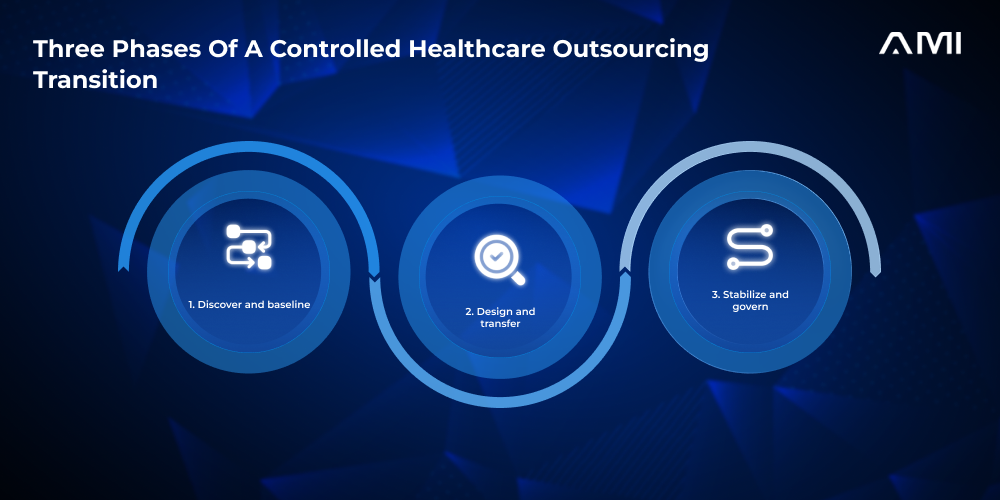
| Transition phase | Required evidence | Exit gate |
|---|---|---|
| Discover and baseline | Validated volumes, workflow maps, risks, and service measures | Current state and scope approved |
| Design and transfer | Procedures, access, training results, and exception tests | Receiving team demonstrates readiness |
| Stabilize and govern | Quality, backlog, turnaround, and escalation trends | Performance remains within agreed thresholds |
How Does an Outsourcing Transition Plan Control Risk?
The plan should convert discovered risks into owners, controls, deadlines, and contingency actions. Typical risks include delayed system access, incomplete procedures, untested volume peaks, unclear approvals, and exceptions that have no qualified destination.
Readiness reviews should use evidence rather than optimism. If access is missing, quality sampling is incomplete, or a critical exception cannot be resolved, the organization should narrow the wave, extend parallel work, or delay the affected scope.
Explore related capabilities across AM InfoWeb's healthcare services.
What Belongs in Stabilization and Hypercare?
Hypercare is the period of heightened support after work moves. Teams monitor daily volumes, aging, errors, rework, escalations, and unresolved dependencies. Short feedback loops allow specialists to correct misunderstandings before they become recurring defects.
Stabilization is complete only when performance is consistent across normal demand and exceptions. A single good week does not prove the operating model is durable, especially when backlog has been temporarily suppressed by extra staffing.
Which Transition Governance Metrics Show Readiness?
Use measures that cover quality, turnaround, productivity, backlog, staffing, access, training, exceptions, and downstream outcomes. Report definitions and data sources with every metric so both organizations interpret results consistently.
Governance should also track decisions, risks, corrective actions, and changes to scope. Executive reviews can focus on trends and unresolved exposure, while operating reviews examine root causes and specific recovery work.

How AM InfoWeb Supports Healthcare Outsourcing Transitions
AM InfoWeb has two decades of experience in the U.S. healthcare industry and uses a co-managed model where AI agents and skilled human agents work together to eliminate process bottlenecks and execute secure healthcare workflows.
AM InfoWeb can support:
- Current-state discovery, workflow mapping, and baseline definition
- Structured knowledge transfer with observed practice and readiness checks
- Wave planning, hypercare support, and exception ownership
- Quality, turnaround, backlog, and governance reporting
Healthcare organizations retain responsibility for their own clinical, legal, privacy, policy, and final operational decisions.
What Makes an Outsourcing Transition Sustainable?
A sustainable transition makes hidden work visible before responsibility moves. It gives the receiving team tested knowledge, gives leaders objective readiness gates, and keeps accountability clear through stabilization. The methodology succeeds when service quality holds without permanent crisis staffing or repeated downstream correction.
Planning a healthcare outsourcing transition? AM InfoWeb can help structure discovery, transfer, stabilization, and governance.
Get in TouchFrequently Asked Questions
About the Author

Written by
Urza Dey
Urza Dey is a content and copywriter with over five years of experience across marketing, B2B SaaS, HealthTech, EdTech, and related industries. At AMI, they contribute to content strategy, blog development, and marketing communication focused on healthcare operations, business process management, and AI-enabled service delivery.
Related Posts
Healthcare Contact Center Outsourcing: When Should You Do It?
But in healthcare, outsourcing should not be based only on cost or coverage. The bigger question is whether...
Medical Billing Outsourcing: Control, Cost, and Revenue Performance
Medical billing outsourcing can reduce operational friction without sacrificing control...