

Human AI Collaboration: How Healthcare Teams Share Operational Decisions
TL;DR: human AI collaboration
Human AI collaboration works best when tasks and decision rights are explicit.
AI can prepare and route work; people retain context-sensitive judgment.
A useful handoff preserves source, confidence, exceptions, and ownership.
Quality measures must include outcomes, not just automation volume.
Human AI collaboration in healthcare is not a contest between automation and staff. It is a way to assign repeatable preparation to AI while giving skilled people the context, authority, and time to handle ambiguity. In patient access, revenue cycle, payer support, and record workflows, the critical design question is who decides what happens next.
A co-managed workflow needs more than a human approval button. Teams should know which inputs an AI agent may use, what it may recommend or execute, what triggers review, and how to recover when the information is incomplete.
Explore how AM InfoWeb supports AI-assisted healthcare contact center operations with skilled human oversight.
What Does Human AI Collaboration Mean in Healthcare Operations?
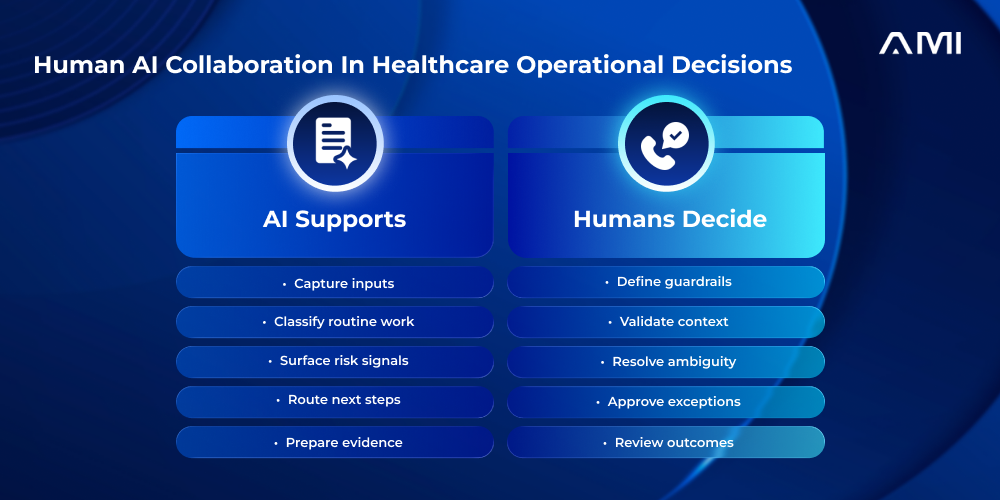
It means AI agents and human agents contribute different capabilities to a shared process. AI can classify a request, identify a missing field, draft a summary, or queue a next step. A person can interpret unusual context, speak with a patient or payer, decide whether an exception is justified, and remain accountable for the final action.
The distinction matters because an accurate-looking output is not the same as an authorized decision. A healthcare organization must define permitted tasks, escalation rules, and the human owner before work is delegated to any automated system.
Which Decisions Should AI Support and Which Require People?
A practical division starts with reversibility, potential harm, and uncertainty. Routine data preparation is easier to automate than a decision that changes a patient’s access, a claim’s disposition, or the release of protected health information. The table is a starting framework, not a universal permission list.
| Workflow step | AI contribution | Human responsibility |
|---|---|---|
| Intake and classification | Extract stated intent and required fields | Verify ambiguous identity or purpose |
| Work routing | Suggest queue, priority, and missing information | Approve nonstandard routing and escalation |
| Documentation | Prepare a draft and source references | Validate meaning, completeness, and accuracy |
| Sensitive decision | Surface relevant policy and evidence | Make and document the authorized decision |
How Can Teams Prevent Context Loss Between AI and People?
The handoff should carry the request, source documents, actions already attempted, confidence or uncertainty signals, open questions, and an accountable owner. Without that packet, staff must reconstruct the case, which erases the productivity benefit and increases the chance of a wrong response.
Design the collaboration around the exception, not the happy path. Make it easy for a person to correct an AI-generated classification, override a recommendation, and record why. Those corrections should feed quality review rather than disappear after the task closes.
Where Can Healthcare Teams Apply This Shared-Decision Model?
In a contact center, AI can recognize a caller’s topic and prepare account context while a human agent handles a sensitive or unresolved request. In revenue cycle work, AI can flag missing claim information while a specialist determines the appropriate correction. In payer operations, AI can organize documentation while an authorized reviewer evaluates an exception.
These examples share one rule: the AI output is operational support, not an independent clinical, legal, or coverage determination. The exact boundary depends on the organization’s policies, contracts, risk assessment, and applicable law.
See related implementation ideas in AM InfoWeb’s healthcare services.
Which Metrics Show Whether Collaboration Is Actually Working?
Measure first-contact or first-pass resolution, exception rate, rework, correction frequency, handoff completeness, time to qualified review, and the share of decisions with an identified owner. Segment by workflow and risk tier; one aggregate automation rate can hide poor performance in sensitive cases.
Pair efficiency measures with outcome checks. A shorter handling time is not an improvement if patients repeat their story, employees reverse more AI suggestions, or auditors cannot trace why a decision was made.
What Governance Keeps Human AI Collaboration Accountable?
Document allowed uses, access controls, review thresholds, training, monitoring, and incident escalation. NIST’s AI Risk Management Framework calls for defined human oversight and post-deployment monitoring; the framework is voluntary, but its control questions are useful for operational design.
When a vendor processes protected health information for a covered entity, HIPAA business-associate obligations may apply. Healthcare teams should evaluate the data flow, permitted uses, agreements, safeguards, and subcontractors with their privacy and legal teams.
For a primary reference, see the NIST AI Risk Management Framework.

Where does AI support end and human judgment begin?
Healthcare teams need clear ownership when requests become sensitive, ambiguous, or high impact. AM InfoWeb combines AI-assisted intake and routing with skilled human agents, QA, and operational visibility so the right decisions reach the right people.
How AM InfoWeb Supports Human AI Collaboration
AM InfoWeb has two decades of experience in the U.S. healthcare industry and uses a co-managed model where AI agents and skilled human agents work together to eliminate process bottlenecks and execute secure healthcare workflows.
AM InfoWeb can support:
- AI-assisted intake, classification, and routing with defined human review points
- Context-rich handoff packets for exceptions and sensitive requests
- Quality sampling, correction feedback, and operational reporting
- Controlled workflows with role-based access and documented ownership
Healthcare organizations retain responsibility for their own clinical, legal, privacy, policy, and final operational decisions.
How Should Healthcare Leaders Start Sharing Decisions?
Start with one bounded workflow. Write down the AI task, the person’s decision authority, the escalation trigger, the evidence that must travel with a handoff, and the measures that would show better outcomes. Expand only after quality and exception reviews confirm the design works in practice.
Build clearer AI and human decision boundaries across healthcare operations. AM InfoWeb can help map tasks, escalation rules, quality checks, and accountable handoffs.
Get in TouchFrequently Asked Questions
About the Author

Written by
Urza Dey
Urza Dey is a content and copywriter with over five years of experience across marketing, B2B SaaS, HealthTech, EdTech, and related industries. At AMI, they contribute to content strategy, blog development, and marketing communication focused on healthcare operations, business process management, and AI-enabled service delivery.
Related Posts
Healthcare Contact Center Automation: 9 Workflows With Human Oversight
Automation can reduce friction, improve consistency, and support faster service, but it should not replace trained...
AI in Healthcare Compliance: Balancing Automation, Oversight, and Accountability
Govern healthcare AI through controlled data, oversight, evidence, and monitoring.