

Healthcare Outsourcing ROI: Calculate Costs, Capacity, Quality, and Risk
TL;DR: healthcare outsourcing ROI
ROI begins with a complete current-state cost baseline.
Include transition, management, technology, quality, and recovery costs.
Value can come from released capacity and avoided failure demand.
Model quality and risk instead of treating them as footnotes.
Healthcare outsourcing ROI compares the financial and operational value created by an outsourcing model with its full cost. The calculation should include more than vendor fees and labor-rate differences.
Transition effort, retained management, technology, quality control, rework, service outcomes, capacity, and risk all affect the result. A narrow savings estimate can overstate value and weaken the business case.
Explore how AM InfoWeb supports healthcare operations with a co-managed delivery model.
What Does Healthcare Outsourcing ROI Measure?
ROI measures the net value produced by an outsourcing initiative relative to the investment required. The numerator should include measurable savings, avoided costs, productivity gains, released internal capacity, and relevant outcome improvements.
The denominator should include implementation and ongoing costs. Buyers should state the time horizon, assumptions, baseline, volume range, and treatment of benefits that cannot be converted confidently into dollars.
Which Costs Belong in the ROI Baseline?
Start with internal labor, overtime, recruiting, training, technology, facilities, quality review, management time, backlog recovery, and the cost of preventable errors. Use the current process, not an idealized budget, as the baseline.
Separate fixed, variable, and one-time costs. That distinction matters when volume changes or the organization retains specialists and systems after outsourcing.
How Should Transition and Operating Costs Be Calculated?
Transition costs may include discovery, documentation, access, training, testing, parallel operations, change management, and temporary productivity loss. Ongoing costs include vendor fees, retained oversight, technology, reporting, quality assurance, and exception support.
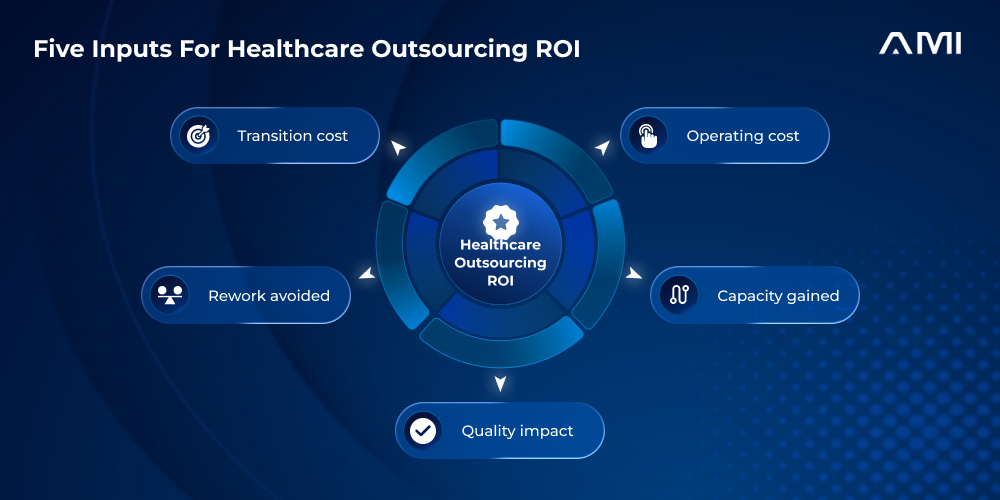
| ROI input | Examples | Evidence source |
|---|---|---|
| Transition investment | Discovery, training, testing, parallel work | Project plan and labor hours |
| Ongoing operating cost | Fees, retained team, technology, QA | Invoices and internal cost data |
| Capacity gained | Specialist hours released, backlog reduced | Workforce and queue data |
| Failure demand avoided | Rework, repeat contact, corrections | Quality and workflow records |
| Quality and risk impact | Errors, incidents, complaints, control findings | Audits and governance reporting |
How Can Released Capacity Become Measurable Value?
Released capacity has value when the organization uses it for higher-priority work, absorbs growth, reduces overtime, or avoids additional hiring. Estimate the hours released, the realistic utilization rate, and the activity that replaces the outsourced work.
Do not count the same benefit twice. For example, a staffing reduction and capacity redeployment may describe two uses of the same hours.
Explore related capabilities across AM InfoWeb's healthcare services.
How Should Quality and Risk Affect the ROI Model?
Model the cost of rework, repeat contact, delays, denials, service recovery, audit remediation, and incidents. A model that ignores quality assumes every completed unit has equal value, even when some require correction.
When protected health information is involved, buyers should evaluate business-associate responsibilities, permitted uses, safeguards, subcontractors, and breach obligations. Those requirements affect operating design and cost.
Primary source: HHS guidance on business associates.
How Should Leaders Test ROI Assumptions?
Build conservative, expected, and upside scenarios. Stress-test volume, wage inflation, transition duration, productivity ramp, error rates, retained-team cost, and expected benefit realization.
Review actual results after transition and stabilization. The original business case should become a living benefits register with owners, evidence, timing, and corrective actions when assumptions do not materialize.

Why does an outsourcing business case lose credibility?
Vendor fees alone do not capture transition effort, retained oversight, quality, rework, or risk. AM InfoWeb helps healthcare teams connect operating evidence to a transparent and measurable outsourcing value case.
How AM InfoWeb Supports Healthcare Outsourcing Economics
AM InfoWeb has two decades of experience in the U.S. healthcare industry and uses a co-managed model where AI agents and skilled human agents work together to eliminate process bottlenecks and execute secure healthcare workflows.
AM InfoWeb can support:
- Current-state cost, capacity, backlog, and quality baselining
- Transition planning with visible one-time and ongoing operating costs
- Co-managed execution that combines AI agents with skilled human agents
- Performance reporting across savings, capacity, quality, turnaround, and risk
Healthcare organizations retain responsibility for their own clinical, legal, privacy, policy, and final operational decisions.
What Makes Healthcare Outsourcing ROI Credible?
A credible ROI model is transparent about costs, assumptions, timing, and tradeoffs. It connects financial estimates to operating evidence and continues after contract signature. Buyers gain a stronger decision when savings, capacity, quality, and risk are measured together.
Building a healthcare outsourcing business case? AM InfoWeb can help baseline costs, capacity, quality, and measurable value.
Get in TouchFrequently Asked Questions
About the Author

Written by
Urza Dey
Urza Dey is a content and copywriter with over five years of experience across marketing, B2B SaaS, HealthTech, EdTech, and related industries. At AMI, they contribute to content strategy, blog development, and marketing communication focused on healthcare operations, business process management, and AI-enabled service delivery.
Related Posts

Medical Billing Outsourcing: Control, Cost, and Revenue Performance
Medical billing outsourcing can reduce operational friction without sacrificing control...
Revenue Cycle Management Automation for AI-First Healthcare Operations
Revenue Cycle Management Automation is often discussed as a billing or software topic, but many...