


Medical Billing Collections Increase Through Better Claims Processing Workflows
$4.2M
Monthly collections, up from $3M
15%
Rejection rate, down from 32%
90%
First-pass performance, up from 70%
60
Claims per day, up from about 35
A medium-sized healthcare facility was losing momentum in its revenue cycle. Claim rejections, manual billing work, and gaps in communication slowed medical claims processing and constrained cash collections. AM InfoWeb helped the facility connect data analysis, coding accuracy, staff training, and workflow automation. Monthly medical billing collections increased from $3 million to $4.2 million, while the reported rejection rate fell from 32% to 15%.
Client Context
The client was a medium-sized healthcare facility offering multiple specialties to a varied patient population. Its operational challenge was to translate delivered care into more reliable billing, claims processing, and collections.
- Operational focus: Billing, coding, accounts receivable, and claim submission workflows.
- Business need: Reduce rejected claims, improve first-pass performance, and increase collections.
- Starting position: Monthly cash collections of $3 million, first-pass performance of 70%, and daily processing capacity of approximately 35 claims.
The case connects financial performance to execution across the revenue cycle. Coding, charge entry, eligibility verification, documentation, and follow-up all contributed to how effectively claims moved toward payment.
Where Operations Were Struggling
The facility faced a reported rejection rate of 32%, alongside recurring denial-related issues. Its teams needed a clearer view of the patterns behind unsuccessful claims and a more consistent way to address them.
- Rejections and denials: Root causes were difficult to identify and resolve, affecting revenue realization.
- Manual billing work: Outdated software and limited automation contributed to coding and billing errors.
- Weak first-pass performance: Only 70% of claims met the reported first-pass measure.
- Communication gaps: Billing and clinical teams did not consistently exchange complete, accurate billing information.
- Limited throughput: Repeated manual tasks and documentation gaps constrained daily claims processing.
Improving medical billing collections required attention to both claim quality and processing capacity. Claims that needed correction consumed time that teams could otherwise spend advancing the rest of the inventory.
How AM InfoWeb Stepped In
AM InfoWeb analyzed claims data to identify denial patterns and root causes. CRCS-certified associates worked with the facility’s revenue cycle teams on denial management, while coding accuracy and staff education on payer policies supported better claim acceptance.
The intervention connected coding, charge entry, and eligibility verification teams from the outset. Training for billing and accounts receivable staff improved communication and documentation, with updates on coding requirements shared as part of the operating process.
The team also reviewed the claims inventory and implemented a workflow plan supported by automation tools. Prioritizing claims and reducing repeated data entry, duplicate verification, and repetitive status checks helped redirect staff effort toward work requiring attention. Coordination with the client’s onshore team supported the changes.
The Optimized Workflow
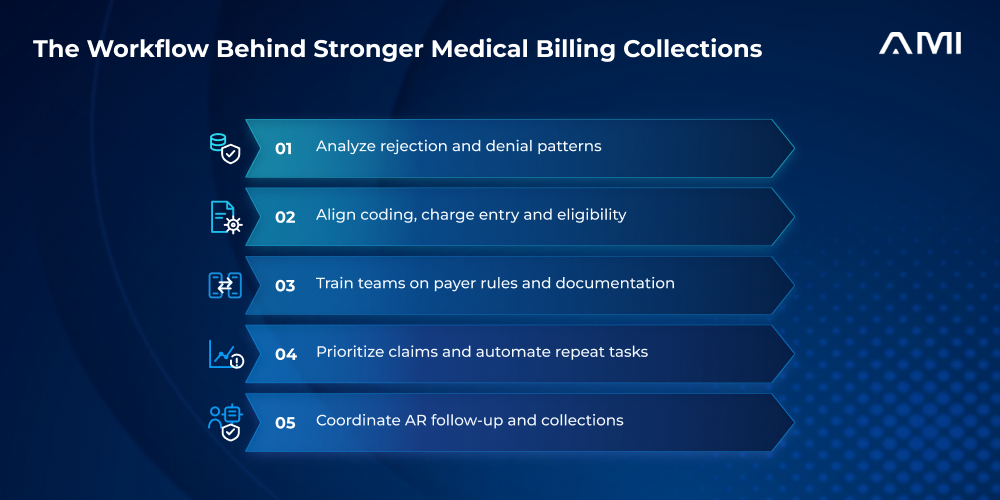
The revised workflow linked prevention, execution, and follow-up. It addressed the underlying causes of rejected claims while improving the amount of work teams could process.
- Analyze rejection and denial patterns. Review claims data to identify recurring issues and direct improvement work toward their causes.
- Align coding, charge entry, and eligibility. Coordinate these functions so claim preparation draws on consistent information.
- Train teams on payer rules and documentation. Reinforce coding accuracy, communication, and the capture of chargeable services.
- Prioritize claims and automate repeat tasks. Use inventory analysis and workflow tools to reduce duplicated work and focus staff effort.
- Coordinate AR follow-up and collections. Bring trained associates and client revenue cycle teams together to address unresolved claims and support cash flow.
This approach made medical claims processing a coordinated activity across teams. The same workflow that reduced preventable rework also created more room for staff to process claims and pursue collections.
What Changed: Before and After
The source reports improvements in four distinct measures. Each comparison retains its original baseline and outcome.
Before AMI | After AMI |
|---|---|
Monthly cash collections were $3 million. Rejection-related issues and inefficient claims workflows constrained revenue realization. | Monthly cash collections increased to $4.2 million within the first few months. The $1.2 million increase represents 40% growth from the original baseline. |
The reported claim rejection rate was 32%. Identifying and resolving recurring claim issues remained difficult. | The reported rejection rate fell to 15% within the first three months. Better coding accuracy, payer-policy training, and root-cause analysis supported the improvement. |
First-pass performance was 70%. Manual errors and poor coordination increased the need for additional handling. | The reported first-pass measure improved to 90%. Coordination across coding, charge entry, and eligibility helped claims move through the workflow more effectively. |
Daily claims processing capacity was approximately 35 claims. Communication gaps and repetitive manual work limited team output. | Daily processing capacity increased to 60 claims. Training, inventory prioritization, and automation of repeat tasks supported the higher throughput. |
Results and Business Impact
The facility improved both the financial output of its revenue cycle and the operating capacity behind it. The original case account reports:
- Monthly collections: Increased from $3 million to $4.2 million, a 40% improvement.
- Claim rejection rate: Reduced from 32% to 15% within the first three months.
- First-pass performance: Improved from 70% to 90%.
- Daily processing capacity: Increased from approximately 35 to 60 claims.
These results reflect different parts of the workflow. Higher collections describe the cash outcome, while fewer rejections and stronger first-pass performance describe improvements in claims handling. Increased daily output shows the additional processing capacity made available through the operating changes.
The engagement illustrates how denial management and workflow coordination can reinforce one another. Addressing recurring claim issues reduced friction, while training and automation helped teams use their available time more effectively.
How AM InfoWeb Supports Revenue Cycle Operations
AM InfoWeb has two decades of experience in the U.S. healthcare industry and uses a co-managed model that brings AI agents and skilled human agents together to eliminate process bottlenecks and execute secure healthcare workflows. Its current revenue cycle management services support:
- Billing and coding workflows aligned to client requirements.
- Claims analysis, denial management, and accounts receivable follow-up.
- Coordination across charge entry, eligibility, and documentation.
- Staff training, workflow improvement, and automation of repetitive tasks.
In this engagement, the documented changes combined claims analysis, qualified associates, training, cross-team coordination, and workflow automation.
Conclusion
The facility needed to improve the way claims were prepared, processed, and followed through to collection. AM InfoWeb connected those activities through analysis, training, coordination, and automation. The resulting workflow supported higher medical billing collections, fewer rejections, and greater daily processing capacity.