


Medical Record Retrieval Services Improve Turnaround for Healthcare Teams
≤5 days
Request turnaround target achieved
Backlogs cleared
Pending requests addressed
100%
Voice and non-voice cross-skilling
Centralized SOPs
Shared, updated workflow reference
A healthcare technology company was helping U.S. clinical teams obtain the records needed for patient referrals and continuity of care, but its own retrieval operation was under strain. Turnaround averaged eight to nine days, pending requests were accumulating, and teams were working with inconsistent procedures. AM InfoWeb helped reorganize staffing, cross-skill resources, and standardize execution. The engagement cleared backlogs and brought medical record retrieval turnaround time to the client's target of five days or less.
Client Context
The client supports hospital clinical teams across the United States, from individual departments to large hospital systems. Its Connect Solution gives providers access to medical records, images, and pathology information used in specialties including oncology, cardiology, and radiology.
- Client: A healthcare technology company serving U.S. hospitals and clinical teams.
- Operational focus: Medical record retrieval services supporting referrals and continuity of care.
- Business need: Clear pending requests, improve turnaround, and create consistent execution across teams.
The original case account describes the client's broader reach as 2.8 million-plus patients helped, more than 7.5 million medical records delivered annually, and 65,000 healthcare locations accessed monthly. It also reports adoption by 75% of the top U.S. News & World Report Best Hospitals. These figures describe the client's platform reach at the time of the case, rather than results delivered by this engagement.
At that scale, a medical record retrieval process depends on coordinated capacity and communication. Inconsistent handling across queues can make it harder for teams to keep existing requests moving while accepting new work.
Where Operations Were Struggling
The client's average retrieval turnaround of eight to nine days was affecting timely access to historical medical information. A growing backlog added pressure to an operation already facing gaps in skills, procedures, and performance management.
- Slow turnaround: Pending records delayed the information available for referral and continuity-of-care workflows.
- Backlog pressure: Outstanding requests competed with new volumes for limited capacity.
- Separate skill sets: Limited voice capabilities and insufficient cross-skilling made it harder to support multiple queues.
- Inconsistent instructions: Generic SOPs did not address the specific needs of each team.
- Changing performance measures: Shifting objectives made consistent measurement and quality alignment more difficult.
- Limited oversight: Remote operations complicated real-time coaching, productivity monitoring, and quality control.
Faster medical record retrieval required a coordinated response to these issues. Adding capacity alone would leave the same procedural and communication gaps in place.
How AM InfoWeb Stepped In
AM InfoWeb combined staffing changes with a more consistent operating framework. Teams were aligned to U.S. time zones, additional resources supported backlog clearance, and voice and non-voice staff were cross-skilled to handle work across queues.
Team leads and staff coordinated with the client's onshore team through daily and weekly discussions. Trainers and team leads also worked with onshore managers to develop team-specific SOPs, making instructions easier to use, review, and update.
- Volume projections informed resource ramp-up and the skills required for backlog work.
- Staffing flexibility and skill-based overtime supported workload coverage.
- Full cross-skilling strengthened the connection between voice and non-voice operations.
- Calibration calls aligned operations and quality teams.
- A work-from-office model supported real-time coaching and operational monitoring.
The Optimized Workflow
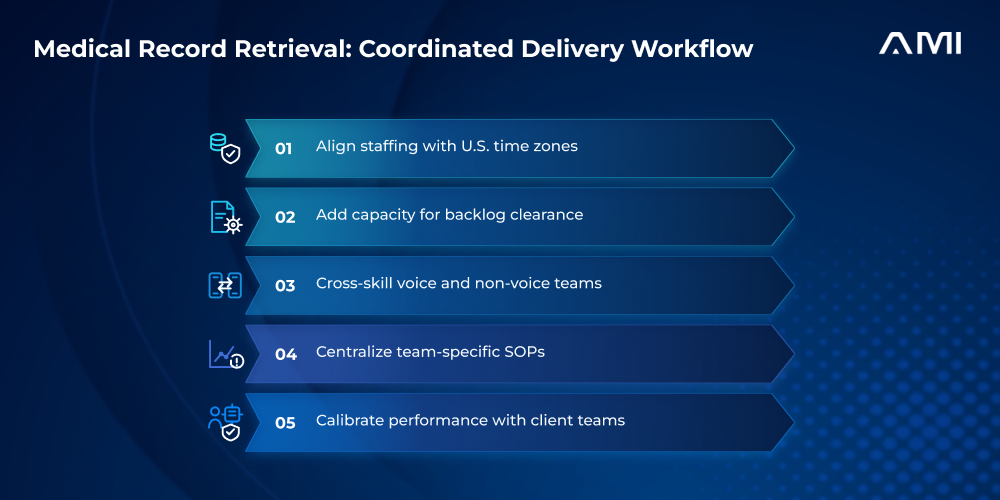
The improved delivery model linked staffing, queue capacity, team capability, and process control. These five actions summarize how AM InfoWeb strengthened the medical record retrieval workflow.
- Align staffing with U.S. time zones. Match available resources to geographic workload needs and use skill-based support when extra coverage is required.
- Add capacity for backlog clearance. Use volume projections and the necessary support roles to address outstanding work while continuing to handle new requests.
- Cross-skill voice and non-voice teams. Enable resources to support multiple queues without disrupting their primary operations.
- Centralize team-specific SOPs. Give internal and onshore teams a shared reference that reflects the actual requirements of each workflow.
- Calibrate performance with client teams. Use regular review discussions, quality checks, and coaching to keep execution consistent as operating needs change.
This combination connected the people handling requests with the information and oversight they needed. It made the operation more flexible while improving consistency across medical record retrieval tasks.
What Changed: Before and After
The changes addressed both speed and the way work was coordinated across the operation.
Before AMI | After AMI |
|---|---|
Retrieval turnaround averaged eight to nine days. These delays slowed access to records needed for referrals and continuity of care. | Retrieval turnaround reached the client’s target of five days or less. Clinical teams gained more timely access to the records supporting referrals and continuity of care. |
A high volume of pending requests strained available capacity. Existing backlogs competed with new retrieval requests for team attention. | The team cleared the retrieval backlog. Additional capacity also supported incoming continuity-of-care requests. |
Voice support capabilities and cross-skilling were limited. Separate skill sets restricted the team’s ability to move work across queues. | Voice and non-voice resources achieved 100% cross-skilling. Teams could support multiple queues while maintaining their primary operations. |
Generic SOPs did not address each team’s workflow requirements. These gaps contributed to inconsistent handling of retrieval tasks. | Team-specific SOPs were centralized and updated. Internal and onshore teams gained a shared reference for more consistent execution. |
Performance objectives changed while remote oversight remained limited. This made consistent measurement, coaching, and quality alignment more difficult. | Regular calibration, coaching, and quality checks aligned execution with client expectations. Stronger operational oversight supported more consistent performance. |
Results and Business Impact
The engagement achieved the client's turnaround target while clearing pending work. It also created a more coordinated support model for future retrieval volumes.
- Five days or less: Request turnaround reached the desired target, compared with the previous eight-to-nine-day average.
- Backlogs cleared: Teams addressed pending requests and supported new continuity-of-care work.
- 100% cross-skilling: Voice and non-voice resources could support multiple operational queues.
- Shared process reference: Centralized SOPs supported quicker access to current instructions across teams.
The improvement was broader than a faster queue. Staffing flexibility, shared procedures, and regular calibration helped make daily execution more consistent. For the client's clinical customers, the operating model supported more timely access to the records used in referrals and continuity of care.
This case shows how medical record retrieval services can improve when capacity planning and process standardization are addressed together. The documented outcomes concern retrieval operations; the case does not quantify changes in clinical outcomes.
How AM InfoWeb Supports Medical Record Retrieval
AM InfoWeb has two decades of experience in the U.S. healthcare industry and uses a co-managed model that brings AI agents and skilled human agents together to eliminate process bottlenecks and execute secure healthcare workflows.
Its current support capabilities include:
- Medical record retrieval operations aligned to U.S. healthcare workflows.
- Voice and non-voice coordination supported by experienced teams.
- Capacity planning and backlog support based on client requirements.
- SOP development, quality calibration, and operational reporting.
In this engagement, the documented improvements came from staffing alignment, cross-skilling, standardized procedures, and stronger operational oversight.
Explore AM InfoWeb's record retrieval support services.
Conclusion
The client needed to move from delayed requests and inconsistent execution to a more dependable retrieval operation. AM InfoWeb helped connect staffing, skills, procedures, and oversight into one coordinated model. With backlogs cleared and turnaround brought to five days or less, the client had a stronger basis for supporting continuing demand.