


Revenue Cycle Management Services Strengthen Performance Against EBITDA Goals
99%
Quality accuracy
95%
NCR, FPR, and clean claims rate
97%
AR collector resolution rate
4%
Denial rate at the time of the case
A healthcare provider had two quarters to meet an EBITDA target set by its private equity investor. Unresolved claims, underpayments, inconsistent patient follow-up, and high rejection and denial rates were putting pressure on revenue cycle execution. AM InfoWeb developed a customized operating approach that connected accounts receivable follow-up, denial management, departmental coordination, and quality controls.
Client Context
The provider delivered advanced care across Florida, California, Texas, Arizona, Nevada, Utah, and Puerto Rico, meeting patients where they were. Leadership identified revenue cycle management as a practical area to improve financial and operational performance while enhancing the patient experience.
- Business objective: Work toward a specific EBITDA target within the next two quarters.
- Delivery requirement: Address outstanding claims and collection-process gaps with a solution tailored to the provider’s operations.
- Partner selection: AM InfoWeb was selected after a review of multiple vendors, based on domain expertise, a customized solution, automation capabilities, and streamlined operations.
The original client profile also reports one million advanced care encounters and 44% to 72% cost savings associated with operational improvements. These profile figures are separate from the detailed revenue cycle measures below.
Where Operations Were Struggling
The difficulties extended across the revenue cycle. Approximately $4.34 million in accounts receivable (AR) was more than 90 days old, and the internal team was struggling to manage those unresolved claims. Payments below contracted payer rates created another source of revenue leakage.
Net collection rate (NCR), first-pass ratio (FPR), and clean claims rate (CCR) were each below 95%. The clean claim rate measures claim quality at submission; it remains a separate measure from collection performance and AR resolution. Keeping these measures separate distinguishes submission quality, collection performance, and account resolution.
- Patient statements and collections lacked a standardized process.
- AR collectors’ resolution rate was below 80%.
- Authorization and reauthorization rejections exceeded 50%, creating difficulties for patients.
- Daily operations lacked quality audits, and the denial rate exceeded 43%.
These issues called for coordinated revenue cycle management services across follow-up, claims handling, and quality assurance. Working each queue without connecting the underlying processes would leave recurring problems unresolved.
How AM InfoWeb Stepped In
AM InfoWeb combined specialized revenue cycle knowledge, automation capabilities, and operational discipline in a customized solution. CRCS-certified AR leaders used payer portals and communication tools to work aged claims, while associates followed updated standard operating procedures and coordinated with payer counterparts.
The team reviewed settled claims for underpayments and worked with payer provider-relations teams to pursue corrections. In parallel, a communication grid connected AR with other departments so that updates from follow-up activity could inform the next operational action.
- A three-step disposition method identified denials and their root causes.
- Structured patient statements and follow-up brought consistency to patient collections.
- Live audits, real-time feedback, and training workshops strengthened authorization workflows.
- Quality monitoring used the source’s DPO methodology for non-fatal defects and DPU methodology for fatal errors.
The Optimized Workflow
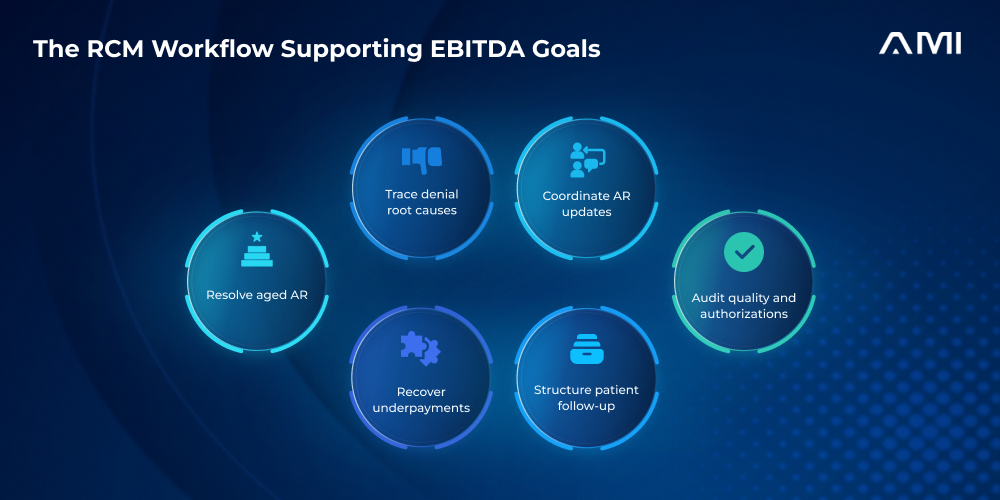
The operating model connected six workstreams. Each addressed a documented source of delayed collection, preventable rework, or inconsistent execution.
- Resolve aged AR: Use payer portals, communication tools, and CRCS-certified leaders to move unresolved claims toward resolution.
- Trace denial root causes: Apply the three-step disposition method to identify why claims were denied and direct corrective work.
- Coordinate department updates: Share AR findings with other teams and follow updated SOPs to support timely action.
- Recover underpayments: Compare settled claims with contracted rates and coordinate with payer provider-relations teams.
- Structure patient follow-up: Apply a consistent approach to patient statements and collection activity.
- Audit quality and authorizations: Use live audits, immediate feedback, and repeated training to reinforce process accuracy.
What Changed: Before and After
The changes below show how targeted process improvements affected aged receivables, claims performance, patient follow-up, and operational quality.
Before AMI | After AMI |
|---|---|
AR older than 90 days totaled approximately $4.34 million. The internal team struggled to manage the unresolved claims effectively. | AR older than 90 days fell to $3.25 million in three months. Payer portals, communication tools, and CRCS-certified AR leaders supported the reduction. |
Some payer payments were below contracted rates. These underpaid claims left reimbursement gaps that required targeted review. | AM InfoWeb identified more than 1,700 underpaid claims totaling over $204,000 during its initial review. Ongoing coordination with payer provider-relations teams enabled recovery activity on the underpaid claims. |
NCR, FPR, and CCR were each below 95%. Collection-process inefficiencies and claims with large outstanding balances affected performance. | NCR, FPR, and CCR were each maintained at 95%. Timely follow-up, work on rejections and denials, and cross-department updates supported consistent execution. |
Patient statements were handled through an incorrect process. A standardized patient collection process had not been implemented. | The reported patient collections amount fell from $700,000 to below $350,000 in three months. The team applied structured follow-up to bring consistency to the process. |
The AR collectors’ resolution rate was below 80%. Unresolved accounts required a more effective approach to follow-up and resolution. | The AR collectors’ resolution rate rose to 97%. CRCS-certified associates followed updated SOPs and maintained communication with payer counterparts. |
Authorization and reauthorization rejections exceeded 50%. The high rejection level placed additional burden on patients. | The rejection ratio fell to 10%. Full live-audit coverage, real-time feedback, and training workshops supported the improved authorization process. |
Daily operations lacked a quality-audit layer. Process defects therefore needed a more structured method of monitoring and control. | Quality accuracy reached 99%. The team used DPO for non-fatal defects and DPU for fatal errors to strengthen quality management. |
The denial rate exceeded 43%. Recurring denials created additional claims work and made revenue cycle execution harder to manage. | The denial rate fell to 10% in two months and later reached 4% at the time of the case account. A three-step disposition method helped the team identify denials and their root causes. |
Results and Business Impact
The detailed results show stronger claim handling and AR execution across the provider’s revenue cycle. The improvements supported the financial objective through lower aged receivables, more consistent collection and submission performance, and tighter operational controls.
- Aged AR: The balance older than 90 days decreased from $4.34 million to $3.25 million in three months.
- Quality accuracy: 99%, supported by a structured quality management approach.
- Collection and submission measures: 95% NCR, 95% FPR, and 95% CCR.
- AR resolution: 97%, compared with a starting rate below 80%.
- Denials: The rate moved from over 43% to 10% in two months and later to 4%.
- Authorization rejections: The ratio fell from over 50% to 10%.
Together, these measures describe how the revenue cycle operation improved against the provider’s EBITDA objective. The case does not specify an EBITDA dollar amount or percentage increase.
How AM InfoWeb Supports Revenue Cycle Management
AM InfoWeb has two decades of experience in the U.S. healthcare industry and uses a co-managed model that brings AI agents and skilled human agents together to eliminate process bottlenecks and execute secure healthcare workflows.
Its revenue cycle support includes:
- AR follow-up and coordination for unresolved claims.
- Denial management and root-cause analysis.
- Review and follow-up of payer underpayments.
- Patient collections workflow support.
- Quality monitoring, team training, and operational coordination.
This describes AM InfoWeb’s current service model. In this engagement, the documented intervention centered on customized RCM operations, certified associates, payer communication, process controls, and automation capabilities.
Conclusion
The provider’s challenge was to connect its financial goal with practical improvements in day-to-day revenue cycle work. AM InfoWeb brought follow-up, payer coordination, denial analysis, patient collection processes, and quality monitoring into a more consistent operating approach. The documented results show how revenue cycle management services supported stronger execution across the workflows affecting the provider’s financial performance.