


Centralized Record Retrieval Services Turn Operational Complexity Into Scale
8 → 450+
FTE growth reported in the case
24/5
Operational coverage
Unified
Systems and workflows
Centralized
Majority of outsourced operations
A national records retrieval and medical canvassing company had grown across business lines and acquisitions, but its operating model had become fragmented. Seven vendors, incompatible systems, inconsistent procedures, and slow communication made dependable execution harder to sustain. AM InfoWeb began as a backup vendor with an eight-person pilot. That engagement developed into a centralized delivery partnership supporting more than 450 full-time equivalents (FTEs) at the time of the original case account.
Client Context
The client was a Texas-based company with a 40-year history serving insurance carriers, law firms, and medical records providers. Backed by private equity, it operated nationwide across insurance claims and litigation support.
- Core services: Records retrieval and medical canvassing.
- Broader capabilities: Claims analysis, medical and case chronology, workers’ compensation support, records subpoenas, medical expert review, and service of process.
- Business need: Bring expanding operations into a consistent delivery model without losing the ability to scale.
For this client, record retrieval services depended on coordination across offices, vendors, custodians, and support teams. Acquisitions increased that coordination burden because new business lines arrived with their own systems and working practices.
Where Operations Were Struggling
Growth exposed weaknesses in how work moved between teams. Multiple vendors handled requests in isolation, while different technology stacks made information harder to share and reconcile.
- Fragmented execution: Disconnected workflows created duplicate effort, difficult handoffs, and inconsistent status updates.
- Process variation: Missing or inconsistent SOPs made quality and turnaround harder to predict.
- Custodian coordination: Slow follow-ups and delayed payments added friction to record collection.
- Workforce pressure: Pandemic-related staffing gaps limited the resources available for high workloads.
- Expansion demands: A canvassing acquisition increased request volumes and the need for call center support.
These were connected operating problems. Increasing headcount would help with volume, but the client also needed shared systems, clearer ownership, and a repeatable way to train and supervise the work.
How AM InfoWeb Stepped In
AM InfoWeb started with a pilot staffed by eight FTEs. The original case account reports that the pilot outperformed the other vendors in speed and quality, creating the basis for a broader partnership.
After the pilot, AM InfoWeb worked with the client to centralize the bulk of outsourced operations, while one other vendor retained a smaller supporting role. The team transitioned legacy systems into a unified system across client offices and introduced a process excellence team to refine workflows.
The intervention also addressed the steps that were holding requests back. Specialized triage teams handled complex cases, a dedicated payments team supported timely custodian payments, and a trained bench of resources helped respond to workload changes. Department-specific training and quality monitoring reinforced the new operating model.
The Optimized Workflow
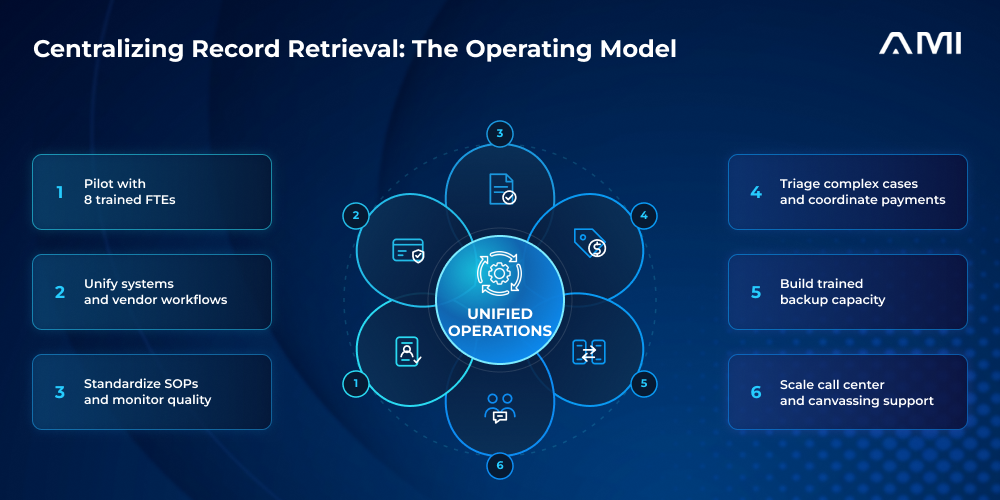
The delivery model brought six activities together around one centralized operation. Each addressed a documented source of delay or inconsistency.
- Prove the model through a focused pilot. Start with eight trained FTEs and demonstrate the ability to execute work effectively before expanding the engagement.
- Unify systems and vendor workflows. Bring offices and outsourced teams into a shared operating environment so information can move more consistently.
- Standardize procedures and monitor quality. Use newly drafted SOPs, a quality monitoring layer, and process excellence reviews to reinforce consistent execution.
- Separate complex work and coordinate payments. Route difficult cases to triage teams and give custodian payments dedicated ownership.
- Maintain trained backup capacity. Build a bench resource pool and departmental training modules to support staffing additions and workload spikes.
- Extend support into growing business lines. Add call center staffing and resources as medical canvassing and other operations expand.
The strength of this model came from the connection between capacity and control. Shared workflows supported consistency, while trained resources and specialist teams gave the operation room to respond to changing demand.
What Changed: Before and After
The comparison below summarizes the documented changes in scale, coordination, and operating coverage.
Before AMI | After AMI |
|---|---|
AM InfoWeb began as one of seven vendors with limited operational responsibility. Fragmented ownership made workflows and status updates harder to coordinate. | An eight-FTE pilot established the basis for a broader partnership. AM InfoWeb took on the majority of outsourced operations while one other vendor retained a smaller supporting role. |
Acquired companies and vendor teams used different technology stacks. Incompatible systems fragmented information and created duplicate effort. | The client’s offices moved to a unified system. Better compatibility and data flow supported coordination and simplified execution. |
Teams lacked consistent SOPs and quality monitoring. This made output quality and completion timelines harder to predict. | New SOPs were reinforced through a quality monitoring layer. Process excellence reviews helped teams refine execution and reduce irregularities. |
Complex cases and delayed custodian payments slowed record collection. Requests could remain blocked while teams waited for responses or resolution. | Specialist triage and payments teams addressed these bottlenecks. Dedicated ownership helped difficult cases progress and supported better custodian coordination. |
Staffing shortages and rising volumes strained the existing workforce. Expansion into canvassing added further demand for trained staff and call center coverage. | The engagement grew from eight to more than 450 FTEs at the time of the case account. A trained bench and 24/5 operations supported capacity expansion and continuing workflow coverage. |
Results and Business Impact
The engagement developed from limited backup support into a delivery partnership integrated across the client’s business lines. The original case account reports the following outcomes:
- Scale: An initial eight-FTE pilot grew to more than 450 FTEs, supported by a trained bench for further staffing additions.
- Coverage: 24/5 operations helped maintain turnaround and workflow continuity.
- Customer experience: The source reports an 8/10 customer score, labeled NPS in the original account.
- Operational control: Centralized execution improved request handling consistency, productivity, and coordination.
- Cost model: Running operations from AM InfoWeb’s facility supported a lower-cost delivery model; the source does not quantify the savings.
The operational outcome was a more coherent way to deliver record retrieval services at scale. Systems, staffing, procedures, and specialist support were brought into one model, helping the client manage growing workloads with greater consistency.
How AM InfoWeb Supports Record Retrieval Operations
AM InfoWeb has two decades of experience in the U.S. healthcare industry and uses a co-managed model that brings AI agents and skilled human agents together to eliminate process bottlenecks and execute secure healthcare workflows. Its current support capabilities include:
- Record retrieval and medical canvassing support aligned to client workflows.
- Trained teams, flexible capacity, and call center coordination.
- SOP development, quality monitoring, and process improvement.
- Specialist support for complex cases and custodian coordination.
The documented intervention in this engagement centered on vendor consolidation, shared systems, standardized processes, and workforce development.
Conclusion
The client’s growth needed an operating model that could hold together as volumes, offices, and business lines expanded. AM InfoWeb used a focused pilot to establish the partnership, then connected systems, procedures, specialist teams, and staffing capacity. The resulting model supported a much larger operation while making delivery more consistent and easier to coordinate.