

Outsourcing Vendor Selection Criteria: Pick U.S. Vendors You Trust
TL;DR: outsourcing vendor selection criteria
Evaluate operating capability against real workflows and exceptions.
Inspect staffing, quality, security, governance, and recovery evidence.
Use scenario demonstrations instead of polished promises alone.
Define transition, performance, and exit requirements before selection.
Outsourcing vendor selection criteria help healthcare buyers compare potential partners using evidence rather than sales presentation quality. The right criteria cover delivery capability, staffing, security, governance, economics, implementation, resilience, and exit readiness.
Selection should test how a vendor handles the difficult cases that shape operational risk. A partner may perform a routine task well but struggle with exceptions, access constraints, seasonal peaks, or cross-team coordination.
Explore how AM InfoWeb supports healthcare operations with a co-managed delivery model.
What Are Outsourcing Vendor Selection Criteria?
They are the weighted requirements and evidence used to determine whether a vendor can deliver the intended healthcare workflow safely, reliably, and economically. Criteria should reflect the operating model, data involved, service levels, risk, and expected buyer responsibilities.
The team should define mandatory gates separately from scored preferences. A vendor that fails a material security, legal, or capability requirement should not compensate with a lower price.
How Should Buyers Evaluate Capability Fit?
Ask vendors to map their proposed process against actual volumes, systems, exception types, turnaround expectations, and downstream dependencies. Review similar work, but confirm that the scope and operating conditions are genuinely comparable.
Use scenario demonstrations. Give finalists representative routine and exception cases, then evaluate the questions they ask, controls they apply, escalation paths they choose, and evidence they preserve.
Which Staffing and Quality Questions Matter?
Review role design, experience, recruitment, training, nesting, supervision, workforce planning, attrition, coverage, and access to subject-matter expertise. Understand what work is automated, what requires skilled people, and where final authority remains with the buyer.
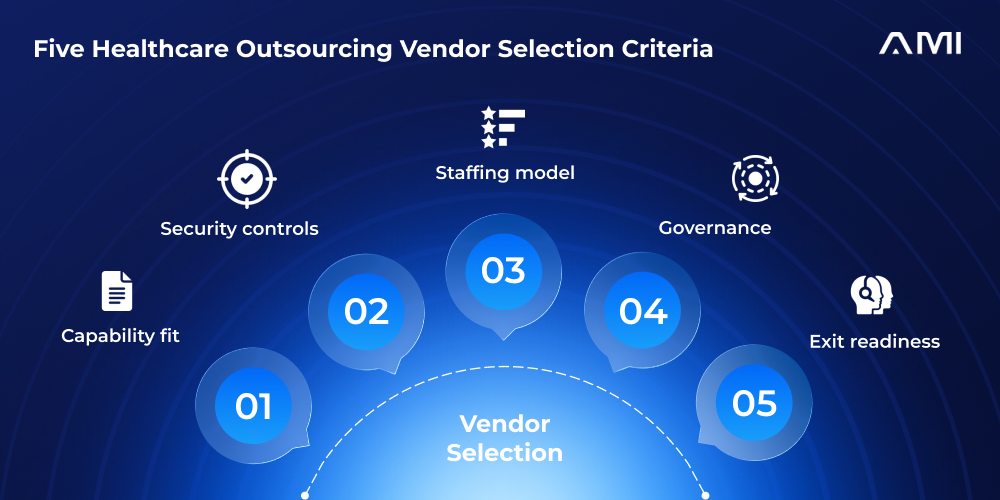
| Selection area | Evidence to request | Warning sign |
|---|---|---|
| Capability | Workflow design and scenario demonstration | Generic process that ignores exceptions |
| Staffing and quality | Role matrix, training, QA calibration | Unclear supervision or quality ownership |
| Security and compliance | Controls, incidents, subcontractors | Marketing claims without operating evidence |
| Governance | Metrics, escalation, corrective actions | Reporting without decision rights |
| Resilience and exit | Continuity tests, data return, transition support | No practical exit plan |
How Should Security and Compliance Be Assessed?
Map the data flow, access model, locations, systems, integrations, retention, subcontractors, incident process, and audit evidence. If the vendor will handle protected health information, determine applicable business-associate responsibilities with privacy and legal teams.
HHS explains that business associates and their subcontractors may have direct HIPAA obligations. Buyers should evaluate contract terms and operating controls together rather than treating compliance as a checkbox.
Primary source: HHS guidance on business associates.
Explore related capabilities across AM InfoWeb's healthcare services.
What Governance Model Should a Vendor Demonstrate?
The proposal should show operating and executive forums, service measures, issue escalation, root-cause review, change control, capacity planning, and corrective-action ownership. Buyers also need visibility into automation changes that affect workflow behavior.
Ask who can make decisions, how quickly risks escalate, and what evidence supports closure. Governance should be designed before launch, not improvised after performance declines.
Why Do Resilience and Exit Readiness Matter?
Evaluate business continuity, recovery testing, backup staffing, system dependencies, incident communications, data portability, knowledge transfer, and the process for moving work at contract end. A viable exit is part of responsible sourcing.
NIST Cybersecurity Framework 2.0 places governance alongside identification, protection, detection, response, and recovery. That lifecycle view helps buyers assess whether a vendor can manage disruption and accountability over time.
Primary source: NIST Cybersecurity Framework.

Why do healthcare vendor selections fail after contract signature?
Proposals can hide workflow gaps, weak exception handling, and unclear governance. AM InfoWeb gives buyers an operating model built around skilled teams, AI-assisted support, quality controls, and visible accountability.
How AM InfoWeb Supports Healthcare Outsourcing Partnerships
AM InfoWeb has two decades of experience in the U.S. healthcare industry and uses a co-managed model where AI agents and skilled human agents work together to eliminate process bottlenecks and execute secure healthcare workflows.
AM InfoWeb can support:
- Workflow-specific operating design for routine work and complex exceptions
- Skilled human teams supported by AI-assisted intake, routing, and visibility
- Quality calibration, governance reporting, and corrective-action discipline
- Secure healthcare workflows with transition, resilience, and exit planning
Healthcare organizations retain responsibility for their own clinical, legal, privacy, policy, and final operational decisions.
How Should Healthcare Buyers Make the Final Choice?
Use mandatory gates, weighted evidence, scenario demonstrations, reference validation, and total-cost analysis. Select the partner whose operating model fits the real workflow and whose controls remain visible after launch. Confidence should come from tested evidence, not the strongest presentation.
Evaluating healthcare outsourcing partners? AM InfoWeb can demonstrate workflow capability, controls, governance, and accountable delivery.
Get in TouchFrequently Asked Questions
About the Author

Written by
Urza Dey
Urza Dey is a content and copywriter with over five years of experience across marketing, B2B SaaS, HealthTech, EdTech, and related industries. At AMI, they contribute to content strategy, blog development, and marketing communication focused on healthcare operations, business process management, and AI-enabled service delivery.
Related Posts
Healthcare Contact Center Outsourcing: When Should You Do It?
But in healthcare, outsourcing should not be based only on cost or coverage. The bigger question is whether...
Healthcare Contact Center Automation: 9 Workflows With Human Oversight
Automation can reduce friction, improve consistency, and support faster service, but it should not replace trained...