

Operational Efficiency in Healthcare: Measure Capacity Without Shifting Work
TL;DR: operational efficiency in healthcare
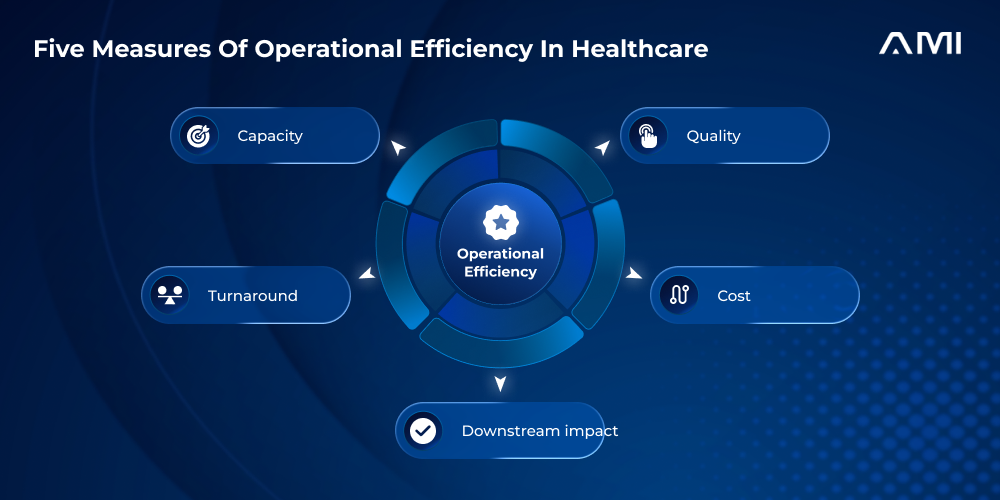
Efficiency measures capacity, quality, timeliness, cost, and downstream impact together.
Queue aging often reveals hidden capacity loss better than average time.
Local speed is not improvement when another team absorbs rework.
Automation should remove friction while people own exceptions and judgment.
Operational efficiency in healthcare means using people, systems, time, and information to complete necessary work reliably without avoidable delay or rework. It is not simply asking staff to handle more volume.
An operation can look faster while pushing defects into another queue. Leaders therefore need measures that connect capacity and cost to quality, turnaround, patient or member experience, and the workload created downstream.
Explore how AM InfoWeb supports healthcare operations with a co-managed delivery model.
What Does Operational Efficiency in Healthcare Mean?
Operational efficiency is the ability to convert available capacity into timely, accurate outcomes with minimal preventable friction. In administrative operations, that includes clean intake, clear ownership, efficient handoffs, accessible information, and rapid exception resolution.
Efficiency is contextual. A useful measure relates resources to a defined output and tests whether quality or access changed at the same time.
Where Do Administrative Workflows Lose Capacity?
Capacity is often lost through incomplete intake, duplicate entry, avoidable status checks, unclear queues, work batching, missing access, and repeated handoffs. These small delays compound when volume rises.
Workflow maps and queue data help distinguish a staffing shortage from a process problem. Adding people to a poorly designed flow can increase coordination effort without increasing completed outcomes.
Which Metrics Measure Efficiency Without Shifting Work?
Use a balanced set of measures that follows work from request to final outcome. CMS describes quality improvement as a structured effort linked to measurable improvement; operational teams should apply the same discipline by defining the aim, measures, and change being tested.
Primary source: CMS Quality Measurement and Quality Improvement.
| Measure | What it reveals | Balancing check |
|---|---|---|
| Completed outcomes per paid hour | Usable capacity | Error and rework rate |
| End-to-end turnaround | Total customer wait | Queue aging by stage |
| First-pass quality | Work completed correctly | Downstream corrections |
| Cost per completed outcome | Economic efficiency | Service and outcome quality |
| Escalation rate | Exception burden | Resolution and repeat contact |
How Can Leaders Improve Capacity at Scale?
Start with demand segmentation. Routine work, complex exceptions, seasonal peaks, and urgent requests need different staffing and routing rules. Standardize the repeatable path and preserve specialist time for situations that require judgment.
Improve flow before raising targets. Better intake, work prioritization, cross-training, visible queues, and clear escalation ownership can release capacity without transferring hidden effort to patients or another department.
Explore related capabilities across AM InfoWeb's healthcare services.
How Should Automation and Human Work Be Balanced?
Automation can prepare context, validate fields, route work, and surface exceptions. Skilled people should handle ambiguity, sensitive communication, policy interpretation, and final decisions that require authority.
A co-managed workflow should show what the technology attempted and why a person received the case. If staff must reconstruct context, the automation has shifted work rather than removed it.
How Do Leaders Connect Efficiency to Economics and Quality?
Translate operational measures into avoided rework, reduced overtime, improved throughput, shorter aging, fewer repeat contacts, and more reliable service. Include transition, technology, management, and quality-control costs in the economic view.
Review efficiency by workflow and complexity instead of relying on one blended average. Governance should investigate tradeoffs whenever speed improves but quality, escalations, or downstream effort worsen.

How AM InfoWeb Supports Operational Efficiency in Healthcare
AM InfoWeb has two decades of experience in the U.S. healthcare industry and uses a co-managed model where AI agents and skilled human agents work together to eliminate process bottlenecks and execute secure healthcare workflows.
AM InfoWeb can support:
- Workflow mapping, demand segmentation, and queue analysis
- AI-assisted intake and routing with skilled human exception handling
- Quality sampling, rework analysis, and capacity reporting
- Scalable operating support with documented escalation ownership
Healthcare organizations retain responsibility for their own clinical, legal, privacy, policy, and final operational decisions.
How Should Healthcare Leaders Begin Improving Efficiency?
Choose one end-to-end workflow and define its completed outcome. Measure current demand, queue aging, first-pass quality, rework, and downstream effort. Improve the constraint, test the balancing measures, and scale only when capacity and quality move together.
Need clearer capacity and quality measures? AM InfoWeb can help uncover friction and support scalable healthcare operations.
Get in TouchFrequently Asked Questions
About the Author

Written by
Urza Dey
Urza Dey is a content and copywriter with over five years of experience across marketing, B2B SaaS, HealthTech, EdTech, and related industries. At AMI, they contribute to content strategy, blog development, and marketing communication focused on healthcare operations, business process management, and AI-enabled service delivery.
Related Posts
Revenue Cycle Management Automation for AI-First Healthcare Operations
Revenue Cycle Management Automation is often discussed as a billing or software topic, but many...
Healthcare Contact Center Automation: 9 Workflows With Human Oversight
Automation can reduce friction, improve consistency, and support faster service, but it should not replace trained...