

AI-to-Human Handoff: How Healthcare Contact Centers Escalate Complex Cases
TL;DR: AI-to-human handoff
A good handoff is a transfer of responsibility and context.
Escalation triggers should include risk, uncertainty, and caller preference.
Agents need a concise case packet rather than a raw transcript.
Measure transfer completion and resolution, not just containment.
An AI-to-human handoff is the moment a healthcare contact center stops asking an automated agent to handle a request and gives a trained person clear ownership. Done well, the caller does not have to repeat the entire story, the agent can see what was already tried, and the organization can trace the resolution.
Done poorly, the transfer becomes another queue. The caller may repeat identifiers, explain the issue again, or receive a conflicting answer. Handoff design therefore matters as much as the AI conversation itself.
Explore how AM InfoWeb supports AI-assisted healthcare contact center operations with skilled human oversight.
What Is an AI-to-Human Handoff in a Healthcare Contact Center?
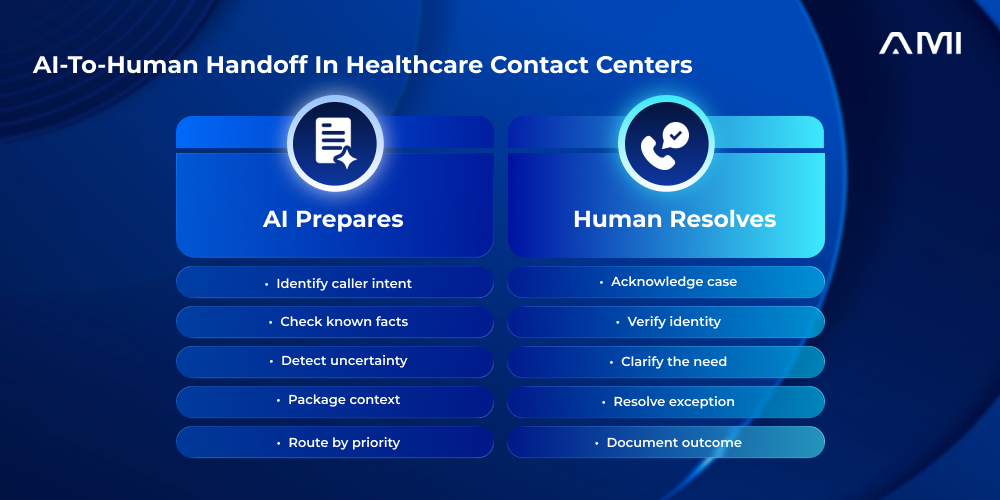
It is a controlled transfer from an AI-assisted interaction to a human agent or specialist. The transfer should include the caller’s stated goal, permitted context, any verification state, steps already completed, open questions, urgency, and the reason for escalation.
A handoff differs from simply ending a bot session with a phone number. The receiving team needs an actionable case, and the caller needs a clear expectation about who is taking over and what happens next.
Which Calls Should Escalate From AI to a Person?
Escalate when the request is sensitive, unclear, urgent, outside the AI’s approved scope, or repeatedly unsuccessful. Caller preference can also be a valid trigger. A contact center should define explicit rules for potential safety concerns, complaints, disputed information, complex benefits, privacy questions, and accessibility needs.
Do not make a caller prove failure through several loops. If intent is not resolved after a bounded attempt, offer a human path and preserve the interaction history.
What Information Belongs in a Warm-Transfer Packet?
A concise packet helps the human agent begin where the AI stopped. It should contain only the information needed for the receiving role, using approved access controls. A raw transcript can be useful for audit, but it is not a substitute for a short case summary.
| Packet element | Why it matters | Human check |
|---|---|---|
| Caller goal and preferred channel | Keeps the response focused | Confirm the request |
| Verified and unverified identifiers | Avoids assuming identity is complete | Follow approved verification |
| Actions attempted and results | Prevents repeated steps | Validate before continuing |
| Uncertainty and escalation reason | Explains why AI stopped | Resolve or route onward |
| Owner and next action | Prevents a lost transfer | Document outcome |
How Does a Contact Center Make the Transfer Feel Seamless?
Tell the caller that a person is taking over, why the transfer is happening in plain language, and what information will accompany the case. Route to the right queue rather than a general line whenever possible. If a live transfer is unavailable, set a callback or follow-up expectation.
The agent should acknowledge the context already supplied, confirm essential facts, and take ownership. A warm transfer is not a promise that the human will instantly solve every issue; it is a promise that the case will not restart from zero.
See related implementation ideas in AM InfoWeb’s healthcare services.
How Should Identity and PHI Be Handled During Handoff?
A prior AI conversation should not automatically count as completed identity verification. The human agent should follow the organization’s approved procedure for the requested action and access only the minimum necessary information for the role. Sensitive details should not be repeated unnecessarily in a broad queue note.
HHS explains that identity verification for an individual’s access request may be oral or written depending on the request and delivery channel, while unreasonable verification measures should not become barriers. Organizations should apply that guidance with privacy and legal leadership to their specific workflows.
Which Metrics Reveal Whether Handoffs Are Working?
Track transfer completion, time to a qualified person, repeat information rate, abandoned transfers, case-resolution rate, repeat contact, correction rate, and caller feedback. Review samples where the receiving agent lacked context or the caller was routed more than once.
Containment alone is a weak success measure. A lower escalation rate may reflect genuine resolution, but it may also mean callers are trapped in automation. Read the metrics together with QA reviews and patient experience signals.
For a primary reference, see the HHS HIPAA Right of Access guidance.

How AM InfoWeb Supports AI-to-Human Handoffs
AM InfoWeb has two decades of experience in the U.S. healthcare industry and uses a co-managed model where AI agents and skilled human agents work together to eliminate process bottlenecks and execute secure healthcare workflows.
AM InfoWeb can support:
- AI-assisted intent capture and case-context preparation
- Defined triggers and queues for sensitive or complex requests
- Skilled human agents for clarification, resolution, and follow-up
- Quality review of transfer completeness, routing, and outcomes
Healthcare organizations retain responsibility for their own clinical, legal, privacy, policy, and final operational decisions.
What Makes a Handoff Worth Designing Carefully?
The best AI-to-human handoff protects both continuity and accountability. It gives callers a clear next step, gives agents the context to act, and gives leaders evidence of what happened. Start by testing the difficult cases, not only the easiest ones to automate.
Want smoother AI-to-human escalation? AM InfoWeb can help define triggers, prepare handoff context, route cases, and review resolution quality.
Get in TouchFrequently Asked Questions
About the Author

Written by
Urza Dey
Urza Dey is a content and copywriter with over five years of experience across marketing, B2B SaaS, HealthTech, EdTech, and related industries. At AMI, they contribute to content strategy, blog development, and marketing communication focused on healthcare operations, business process management, and AI-enabled service delivery.
Related Posts
Healthcare Contact Center Automation: 9 Workflows With Human Oversight
Automation can reduce friction, improve consistency, and support faster service, but it should not replace trained...

Why Contact Center Quality Assurance Matters in Healthcare
Contact center quality assurance is the process of reviewing interactions, measuring performance against defined...